

For IT professionals moving into defensive security roles, Blueteam-academy’s From IT to Cybersecurity pathway is the strongest career-ready option available in 2026. It combines a practical decision-making framework (the Threat & Control Method), hands-on labs, a capstone project, generative AI enhancements, and 12 months of access, all for a one-time fee. No subscription trap, no vague theory modules.
Here is who this recommendation fits best:
- Career switchers from IT: You already understand networks, systems, and infrastructure. This pathway translates that foundation directly into defensive security skills employers hire for.
- Certification prep candidates: The curriculum aligns with CompTIA Security+ and CISSP domains, so your study time builds toward recognized credentials.
- Resume builders: Capstone projects and templates give you concrete, portfolio-ready artifacts to show hiring managers, not just a completion badge.
Pro Tip: If you are still comparing options, request a sample syllabus or module outline from any course you are considering. A credible program will share it without hesitation.
Table of Contents
- What types of cybersecurity courses should you consider?
- How do you choose the right cybersecurity course for your goals?
- What should a credible cybersecurity course syllabus cover?
- Why do hands-on labs and capstones matter more than video hours?
- What do cybersecurity courses typically cost, and how long do they take?
- Why Blueteam-academy works for IT-to-cybersecurity transitions
- How do you turn coursework into a job-ready portfolio?
- Financial aid, scholarships, and employer sponsorship options
- Key Takeaways
- The gap most IT pros miss when switching to cybersecurity
- Blueteam-academy’s From IT to Cybersecurity pathway
- Useful sources and further reading
What types of cybersecurity courses should you consider?
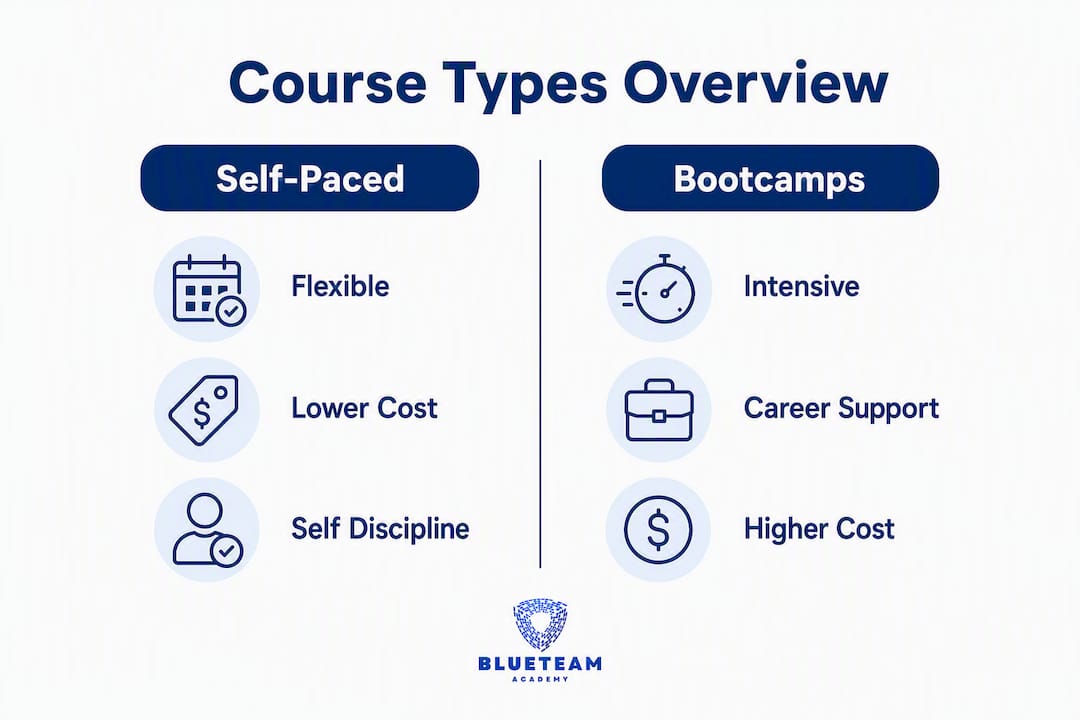
The phrase “best cybersecurity courses” covers a wide spectrum of offerings, and the right type depends entirely on where you are starting and where you want to land. Knowing the categories prevents you from enrolling in a beginner fundamentals course when you actually need cert prep, or paying bootcamp prices for content you could get from a self-paced certificate.

Beginner fundamentals courses introduce threat concepts, security controls, and basic tooling. They suit people with no prior IT background and typically run four to eight weeks. The Foundations of Cybersecurity course, part of the Google Cybersecurity Professional Certificate, is a well-known example at this level.
Professional certificates are multi-course programs designed to get you job-ready in months. The Google Cybersecurity Professional Certificate includes approximately 170 hours of instruction with hands-on labs and prepares learners for entry-level cybersecurity analyst roles. IBM’s equivalent is a 14-course series with capstone projects that maps to CompTIA Security+ preparation. These programs work well for career switchers who want a structured, employer-recognized credential.
Vendor-aligned certificates focus on a specific platform. Microsoft’s Cybersecurity Analyst Professional Certificate, for example, maps to Azure identity management and Microsoft Defender, with a discount voucher for the SC-900 exam included. These are valuable for platform-specific roles but should be balanced with generalist defensive fundamentals to maximize your employability across employers.
Immersive bootcamps compress six to twelve months of content into an intensive, cohort-based format. They cost significantly more and demand full-time commitment. They suit learners who need accountability structures and can dedicate the time.
Academic and credit-bearing programs such as the Johns Hopkins cybersecurity professional certificate go deeper into regulatory frameworks like FedRAMP and CMMC, and increasingly incorporate AI for cybersecurity defense topics. These fit experienced practitioners or those targeting federal or enterprise roles.
Pro Tip: Self-paced courses work best when you block calendar time the same way you would a live class. Cohort-based programs add accountability but reduce flexibility. Match the format to your actual schedule, not your ideal one.
How do you choose the right cybersecurity course for your goals?
Start with goal clarity. The single most useful question is: what does success look like in twelve months? A specific answer (“I want to pass CompTIA Security+ and apply for SOC analyst roles”) filters out most of the noise immediately.
Once you have that answer, work through this checklist in order:
- Job-readiness signals. Does the course list specific job titles it prepares you for? Does it reference real employer partnerships or hiring outcomes? Vague claims like “launch your career” are not evidence.
- Hands-on labs and capstone. Can you see a sample lab or capstone rubric before enrolling? Labs that simulate real incidents, SIEM alerts, or incident response workflows are worth far more than video-only content.
- Certification mapping. Does the syllabus explicitly align with CompTIA Security+, CySA+, CISSP domains, or another recognized exam? Alignment should be stated, not implied.
- Time to complete. Professional certificates typically take three to six months at 5–10 hours per week. If a course claims you can become job-ready in two weeks, treat that skeptically.
- Cost model. Understand the full cost: subscription fee, exam voucher, proctored exam fee, and any lab access charges. A low headline price can mask significant add-ons.
- Instructor and reviewer credentials. Who built the curriculum? Industry practitioners with current roles carry more weight than academic generalists for a career-transition course.
- Community and career support. Access to alumni channels, mock interviews, and resume reviews meaningfully improves placement outcomes for career switchers.
Questions worth asking any course provider directly: Do labs persist after the course ends? Is there a capstone rubric? What percentage of completers land roles within six months? Do you offer employer connections or job board access?
Pro Tip: Ask for alumni contacts or a community forum link. A program confident in its outcomes will connect you with graduates. One that deflects that request is telling you something.

What should a credible cybersecurity course syllabus cover?
A strong curriculum covers both the technical domains employers test for and the practical tools you will use on day one. Use this as a checklist when reviewing any program’s module list.
Core topic domains to look for:
- Networking fundamentals (TCP/IP, DNS, firewalls, VPNs)
- Linux command line and system administration basics
- Python for security automation and scripting
- Threat modeling and risk frameworks (NIST CSF, MITRE ATT&CK)
- SIEM tools and log analysis
- Intrusion detection and prevention systems (IDS/IPS)
- Incident response procedures and playbooks
- Digital forensics fundamentals
- Cloud security basics (IAM, shared responsibility model)
- Compliance and regulatory awareness (relevant to U.S. roles: HIPAA, PCI-DSS, FedRAMP)
Google’s career-ready certificate, for instance, explicitly covers Python, Linux, SQL, and SIEM tools alongside practice-based assessments, which gives you a useful benchmark for what a solid beginner program includes.
The table below maps core topic areas to the certification domains they support:
| Topic area | Certification alignment |
|---|---|
| Networking fundamentals | CompTIA Security+, CompTIA Network+ |
| Threat modeling and risk frameworks | CISSP domains, CompTIA CySA+ |
| SIEM and log analysis | CompTIA CySA+, SOC analyst roles |
| Incident response | CISSP, CompTIA CySA+, SANS GIAC |
| Cloud security fundamentals | CompTIA Cloud+, vendor certs (AWS, Azure) |
| Python and scripting | CompTIA Security+, OSCP preparation |
| Compliance frameworks | CISSP, CISM, federal/government roles |
For beginner tracks, depth means understanding what a tool does and running guided labs. For intermediate tracks, depth means owning a lab end-to-end: configuring a SIEM, writing detection rules, and producing an incident report. The gap between those two levels is exactly what separates a certificate holder from a candidate who gets callbacks.
Why do hands-on labs and capstones matter more than video hours?
Passive video consumption does not build the muscle memory hiring managers test for. A candidate who has configured Suricata rules, triaged SIEM alerts, and written an incident report has something to show. A candidate who watched someone else do it does not.
Signals of genuinely high-quality hands-on training:
- Persistent lab environments you can return to after a module ends, not single-use sandboxes that reset.
- Real-world tooling: Wireshark, Suricata, Splunk or an equivalent SIEM, and actual log datasets rather than fabricated screenshots.
- A graded capstone with a rubric tied to job tasks, not a multiple-choice quiz dressed up as a project.
- Simulated incidents that require you to detect, investigate, and document, mirroring what a SOC analyst actually does on shift.
Harvard’s CS50 Introduction to Cybersecurity frames this well: security is a set of trade-offs between usability, cost, and risk, not a checklist of absolute protections. Labs that force you to make and defend those trade-off decisions are the ones that prepare you for real conversations with hiring managers and security leads.
To validate lab depth before you enroll: request a sample lab, check whether the capstone rubric maps to specific job tasks, and confirm whether lab access continues after course completion.
Pro Tip: Document every lab with a short writeup: what you did, what you found, and what you would do differently. Publish these to a GitHub repository or a personal portfolio site. That habit, started during training, becomes your most credible hiring artifact.
What do cybersecurity courses typically cost, and how long do they take?
Cost and timeline vary significantly by course type. The table below gives qualitative ranges for U.S. learners in 2026 for different types of courses, considering typical durations, costs, and hands-on components.
Before committing, ask about these additional costs:
- Exam voucher fees (CompTIA Security+ exam currently costs around several hundred dollars in the U.S.)
- Proctored exam fees if the course includes a graded assessment
- Lab access fees charged separately from the course subscription
- Career services add-ons (resume review, mock interviews) that may not be included in the base price
One-time fee models, like Blueteam-academy’s, remove the subscription anxiety of “am I learning fast enough to justify this month’s charge?” That psychological difference matters more than it sounds when you are balancing training with a full-time job.
Why Blueteam-academy works for IT-to-cybersecurity transitions
Most online cybersecurity training is built for absolute beginners or for experienced practitioners studying for a specific exam. Blueteam-academy targets the gap in between: IT professionals who already understand infrastructure and want to move into defensive security roles without starting from zero.
The From IT to Cybersecurity pathway maps directly to the selection criteria covered earlier in this guide:
- Practical decision framework: The Threat & Control Method gives you a structured way to identify threats, select controls, and justify decisions to stakeholders. This is the kind of reasoning that separates a junior analyst from someone who gets promoted.
- Hands-on labs and capstone: The program includes labs and a capstone project designed to produce portfolio artifacts, not just completion certificates.
- Generative AI enhancements: Course content is enhanced with generative AI tools, reflecting how modern security teams actually work.
- Peer-reviewed curriculum: Content is reviewed for quality and accuracy, which matters when you are building knowledge you will rely on in production environments.
- 12 months of access: You are not racing a subscription clock. One-time fee, one year to work through the material at a pace that fits your schedule.
- Career support: Resume templates, interview prep guidance, and community access help you translate completed labs into job applications.
Blueteam-academy’s stated mission is to close the cybersecurity skills gap through practical training authored by industry experts. That focus on the skills gap is not marketing language: the U.S. cybersecurity workforce shortage is well-documented, and programs that produce job-ready graduates serve a real market need.
The Threat & Control Method is worth understanding before you enroll, because it shapes how the entire curriculum is organized. It is not a theoretical model you study once. It is the lens through which every lab and module is framed.
How do you turn coursework into a job-ready portfolio?
Completing a course is the starting point, not the finish line. Employers hiring for entry-level and junior security roles want evidence of competence, and a certificate alone rarely provides it. Here is a practical sequence:
- Build a capstone-based portfolio. Your capstone project is your strongest artifact. Document it thoroughly: the scenario, your methodology, the tools you used, and your findings. Write it up as if you were handing it to a security lead on your first day.
- Document labs with writeups. For each significant lab, write a short technical summary. Include the objective, the steps you took, the output, and what you learned. These become blog posts, GitHub README files, or portfolio entries.
- Publish a GitHub repository or e-portfolio. Hiring managers and recruiters do check GitHub. A repository with scripts, detection rules, or incident response templates signals that you work like a practitioner, not a student.
- Build targeted resumes. Reference specific tools and outcomes, not just course names. “Configured Suricata IDS rules to detect lateral movement in a simulated environment” is more compelling than “completed cybersecurity training.”
- Time your certification exam strategically. Take CompTIA Security+ after completing your capstone and portfolio, when the material is fresh and you have concrete examples to anchor abstract concepts. CySA+ follows naturally if you are targeting SOC analyst or threat analyst roles.
Career-aligned support, including resume reviews, mock interviews, and employer connections, significantly improves placement outcomes for career switchers compared to content-only programs. If your course does not include these elements, seek them out through alumni communities or professional groups like ISACA and (ISC)².
Pro Tip: Use your course’s alumni channel or community forum to find people who recently landed roles. Ask them what the interview process looked like and what they wish they had built in their portfolio. That intelligence is worth more than any generic interview prep guide.
For a detailed breakdown of realistic timelines and role progression after training, the cybersecurity career path guide on Blueteam-academy’s site is a practical reference.
Financial aid, scholarships, and employer sponsorship options
Cybersecurity training does not have to come entirely out of your own pocket. Several funding routes are worth exploring before you pay full price.
Employer sponsorship is the most underused option. Many IT departments have training budgets that go unspent each year. A direct conversation with your manager, framed around the business value of having a security-capable team member, often unlocks funding. Bring a specific course proposal with a cost and a projected timeline.
Federal and state workforce programs fund cybersecurity training for eligible workers. The Workforce Innovation and Opportunity Act (WIOA) provides grants for approved training programs through state workforce agencies. The CyberCorps Scholarship for Service program, administered by the National Science Foundation, funds full degrees at participating institutions in exchange for federal service commitments.
Vendor and platform scholarships exist at several major providers. Google has offered need-based financial assistance for its professional certificates through Coursera. Microsoft and other vendors periodically offer discounted or sponsored access to their certification programs through community and nonprofit partnerships.
Tax deductions are worth noting for self-funded learners. Education expenses directly related to maintaining or improving skills in your current trade or business may qualify as a deductible expense under IRS Publication 970. Consult a tax professional for your specific situation, as eligibility depends on your employment status and how the training relates to your current role.
If you are considering a bootcamp, ask directly about income share agreements (ISAs), deferred tuition, or installment payment plans. Not all bootcamps advertise these options upfront, but most offer them.
Key Takeaways
For IT professionals, the fastest path to a cybersecurity role runs through practical, job-aligned training with a capstone project, certification mapping, and career support, not through the longest or most expensive program available.
| Point | Details |
|---|---|
| Match course type to your goal | Career switchers need job-aligned programs with labs and capstones, not beginner fundamentals courses. |
| Validate labs before enrolling | Request a sample lab or capstone rubric; persistent environments and real tooling separate strong programs from passive video courses. |
| Budget for the full cost | Factor in exam voucher fees, lab access, and career services beyond the headline course price. |
| Build a portfolio during training | Document every lab and publish your capstone; a GitHub repository with real artifacts outperforms a certificate alone. |
| Blueteam-academy for IT transitions | The From IT to Cybersecurity pathway offers the Threat & Control Method, hands-on labs, capstone, and 12-month access for a one-time fee. |
The gap most IT pros miss when switching to cybersecurity
The conventional wisdom says: get a certificate, pass an exam, apply for jobs. That sequence is not wrong, but it misses the most important variable. Hiring managers in defensive security roles are not primarily screening for certificate names. They are screening for evidence that you can think through a threat scenario, select a proportionate control, and explain your reasoning to a non-technical stakeholder.
That gap between “passed the exam” and “thinks like a practitioner” is where most career switchers stall. The IT professionals who move fastest into security roles are the ones who spent their training time building artifacts and practicing decisions, not accumulating credentials. A GitHub repository with a documented incident response simulation will open more doors than a third certificate from a well-known platform.
The other thing worth saying plainly: vendor-aligned certificates are useful, but they are not a substitute for generalist defensive fundamentals. A candidate who only knows Azure Defender is a liability in an environment that runs AWS or a hybrid stack. Build the fundamentals first, then layer vendor specializations on top.
If you are an IT professional reading this, the transition from IT to cybersecurity is more achievable than most training marketing suggests, and it is also more demanding than a certificate completion page implies. The programs that close that gap are the ones worth your time and money.
Blueteam-academy’s From IT to Cybersecurity pathway
Skip the subscription treadmill. Blueteam-academy’s From IT to Cybersecurity pathway is built specifically for IT professionals who want to move into defensive security roles without paying bootcamp prices or restarting from absolute zero.
What the pathway delivers:
- Structured modules built around the Threat & Control Method
- Hands-on labs and a capstone project that produce portfolio-ready artifacts
- Generative AI enhancements integrated into the learning experience
- Resume templates and interview prep guidance
- Peer-reviewed content authored by industry practitioners
- 12 months of access for a single, one-time fee
No monthly charges. No upsells for lab access. One payment, one year to complete the program at a pace that works around your current job.
Browse the full online course catalog to see available modules, or go directly to the From IT to Cybersecurity page to review the syllabus and enroll.
Useful sources and further reading
- From IT to Cybersecurity, Blueteam-academy: Primary course page with syllabus, modules, and enrollment details.
- Blueteam-academy home: Overview of the platform, mission, and available training programs.
- Google Cybersecurity Professional Certificate, Coursera: Beginner-to-analyst pathway with approximately 170 hours of instruction and hands-on labs, preparing learners for entry-level roles.
- Foundations of Cybersecurity, Coursera: First course in the Google certificate series; useful for absolute beginners.
- Introduction to Cybersecurity Essentials, Coursera: Beginner-level fundamentals course covering threats, controls, and device hardening.
- CS50’s Introduction to Cybersecurity, Harvard Online: Academic-level introduction emphasizing risk-based thinking and security trade-offs.
- JHU Cybersecurity Certificate Program: Advanced professional certificate covering AI-powered defense and U.S. federal compliance frameworks.
- Launch a Cybersecurity Career, Google: Career-readiness guidance and program overview from Google’s certificate team.
