

You can move into a U.S. cybersecurity role by mapping your current skills, earning one or two targeted certifications, and building a short hands-on portfolio. That’s the whole plan. Everything else is sequencing.
CompTIA Security+ is the most common first credential hiring managers recognize, and CyberSeek maps the live demand across every U.S. metro so you can see exactly which roles are open near you. The Bureau of Labor Statistics projects information security analyst employment to grow much faster than average [VERIFY current projection year], which means the window for career changers is genuinely wide right now. Blueteam-academy’s IT-to-cybersecurity training path is built specifically for professionals who already run infrastructure and want a structured, practical route into security roles.
This week, do three things:
- Pick one entry-level role to target (SOC analyst, security analyst, or GRC analyst are the most accessible starting points).
- Schedule your first CompTIA Security+ study session, even if it’s only 90 minutes.
- Set up a free account on a hands-on lab platform and complete one beginner exercise.
TL;DR: Map your existing skills, earn Security+, build two or three lab projects, and apply before your resume feels “ready.”
Table of Contents
- How to map your transition to cybersecurity step by step
- How to turn your current experience into security-ready resume bullets
- Which certifications and training routes make sense first
- How to build hands-on experience hiring managers actually value
- How to build a portfolio and optimize your resume for security recruiters
- What entry-level security roles pay and what they expect from you
- How to apply and prepare for security interviews
- Transition pathways from common starting careers
- Why Blueteam-academy is built for this exact transition
- Key Takeaways
- The part most career-change guides won’t tell you
- Blueteam-academy gives career changers a structured path, not just course content
- Useful sources and further reading
How to map your transition to cybersecurity step by step
The path looks different depending on where you’re starting, but the sequence is consistent: decide on a role, build foundations, earn a cert, get hands-on, then apply.
Phase 1: Decide on a target role. SOC analyst, security analyst, vulnerability analyst, GRC analyst, and junior penetration tester are the most realistic entry points. Pick one before you study anything, because the cert and lab choices flow from the role.
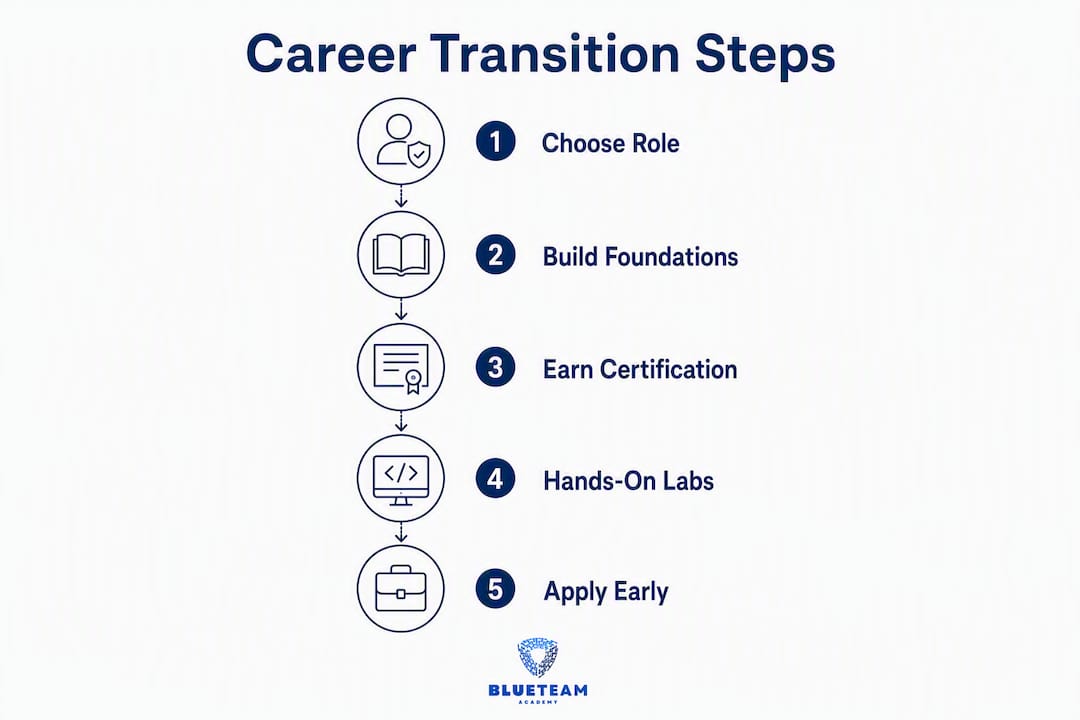
Phase 2: Build or confirm your foundations. If you already manage servers, networks, or code, you have most of what you need. If you’re coming from a non-tech background, spend the first few months on networking basics (TCP/IP, DNS, firewalls), operating system fundamentals (Linux and Windows), and introductory scripting (Python or Bash).
Phase 3: Earn your first certification. Security+ is the right starting point for almost everyone. From there, the path splits: CySA+ for analyst tracks, CompTIA Network+ or Cisco certifications for network security, and OSCP or eJPT for penetration testing. CISSP comes years later, after you’ve accumulated real experience.

Phase 4: Build hands-on evidence. Labs, capture-the-flag (CTF) competitions, and GitHub-documented projects are what hiring managers actually look at. A cert without a portfolio is a weaker application than a cert with two documented lab write-ups.

Phase 5: Apply and iterate. Most career changers wait too long. Apply once you have Security+ and one or two projects. The interview process itself teaches you what gaps to close next.
Route briefings by starting background
Beginner (non-tech background). You’ll need 12–18 months of part-time study to build networking, OS, and scripting foundations before pursuing entry security roles. The upside: you’re not unlearning bad habits, and communication skills from non-tech careers are genuinely valued. The constraint is time.
IT professional (help desk, sysadmin, network admin). IT professionals can often transition in as little as 3–12 months when they map existing responsibilities to security tasks. A sysadmin who already patches servers and reviews event logs is doing vulnerability management and basic detection work. The cert formalizes what you’re already doing.
Developer. Application security (AppSec) is a natural pivot. You already understand code execution, dependencies, and APIs. Add OWASP Top 10 knowledge, practice with static analysis tools, and target application security engineer or DevSecOps roles.
Part-time study at 10–15 hours per week is the sustainable approach for working adults and typically leads to transitions in roughly 8–12 months while maintaining income. Quitting your job to study full-time is riskier than it sounds.
How to turn your current experience into security-ready resume bullets
Most career changers already have security-relevant experience. They just haven’t framed it that way yet.
Common transferable skills by background:
- Help desk / IT support: Incident triage, user access management, password reset workflows (identity and access management), escalation documentation (incident response adjacent), phishing report handling.
- Sysadmin: Patch management, log review, backup and recovery, firewall rule changes, user provisioning and deprovisioning, vulnerability scanning.
- Network admin: Firewall configuration, VPN management, traffic analysis, network segmentation, intrusion detection system (IDS) tuning.
- Developer: Secure coding practices, code review, dependency management, API authentication, input validation.
- Compliance / auditing: Risk assessment, policy documentation, vendor assessments, regulatory mapping (HIPAA, PCI-DSS, SOX).
- Military / law enforcement: Incident response, chain-of-custody documentation, threat analysis, high-pressure decision-making, physical security.
Before-and-after resume bullet examples
| Original bullet | Security-focused rewrite |
|---|---|
| “Responded to user password reset requests” | “Managed identity and access requests for 400+ users, enforcing least-privilege policies and reducing unauthorized access incidents” |
| “Maintained server patch schedules” | “Administered monthly vulnerability remediation cycles across 60 Windows and Linux servers, reducing critical CVE exposure by prioritizing CVSS scores” |
| “Configured firewall rules for new applications” | “Designed and implemented perimeter firewall rule sets for 12 application deployments, aligning configurations with network segmentation policy” |
| “Reviewed application code before releases” | “Conducted pre-release code reviews with OWASP Top 10 as the baseline, identifying and remediating SQL injection and XSS vulnerabilities” |
| “Documented IT incidents for management” | “Authored incident postmortems and root-cause analyses for Tier 2 escalations, producing remediation timelines used in quarterly risk reviews” |
The 30-minute mapping exercise: Pull your last three performance reviews or job descriptions. For each responsibility, ask: “Does this touch access control, detection, response, data protection, or risk?” If yes, rewrite it with the security outcome front and center. Aim for five bullets before you touch your resume.
Employers value communication, ethical judgment, and the ability to translate technical risk into business terms — soft skills that career changers from compliance, project management, and customer-facing roles often bring in stronger than candidates who came up purely through IT.
Pro Tip: Before applying externally, check whether your current employer has a security team. Offering to help with a phishing simulation, a policy review, or a vulnerability scan is the fastest way to get security work on your resume without changing jobs.
Which certifications and training routes make sense first
CompTIA Security+ is the most widely recommended first certification for career changers and appears in more entry-level security job postings than most other baseline credentials. It covers network security, cryptography, identity management, risk management, and incident response at a level that maps directly to SOC analyst and security analyst job descriptions.
Recommended certification sequence
- Security+ (universal starting point, vendor-neutral, DoD 8570 approved)
- CySA+ for SOC and analyst tracks; CompTIA Network+ or Cisco CCNA for network security roles; eJPT or PNPT for penetration testing tracks
- GSEC or SSCP as alternatives to Security+ for candidates who want a more rigorous baseline
- CISSP only after several years of hands-on experience; it’s a senior credential, not a starting point
The recommended progression is Security+ as the baseline, then CySA+ or role-specific certs, with CISSP reserved for senior roles.
Training routes compared
Multiple training routes exist: degree, bootcamp, community college, and self-study, each with tradeoffs in time, cost, and hiring signal. A four-year degree carries the strongest long-term signal but takes years and costs tens of thousands of dollars. A bootcamp compresses the timeline significantly and often includes career services, but quality varies widely. Community college programs offer structured learning at lower cost, though scheduling can be rigid. Self-study with targeted certifications is the most flexible and cost-effective route, and many career changers succeed with it when they pair it with hands-on labs.
Estimated costs for the certification route [figures from research pool; verify current exam pricing directly with CompTIA and ISC2]:
- Self-study path (Security+ exam + study materials): roughly $300–$600
- Bootcamp plus certification: roughly $3,000–$8,000 depending on provider
- Full certification pathway (Security+ through CySA+ with labs and materials): roughly $1,000–$4,500
First-cert path by starting background
- Non-tech background: Start with CompTIA IT Fundamentals+ or a structured bootcamp to build networking and OS basics, then Security+.
- Help desk / sysadmin: Go directly to Security+. You already have the foundational knowledge; the cert formalizes it.
- Network admin: Security+ plus Network+ (if you don’t already hold it) or CCNA Security.
- Developer: Security+ plus OWASP study and a static analysis tool project.
Studying 10–15 hours per week while working is the approach most likely to succeed without financial pressure. Block study time on your calendar the same way you’d block a recurring meeting.
How to build hands-on experience hiring managers actually value
Practical, hands-on projects and demonstrable problem-solving often carry more weight than a long list of certifications when hiring managers evaluate entry-level candidates. A lab write-up that shows you can capture packets, identify anomalies, and document findings tells a clearer story than another line on a cert list.
Home lab setup checklist
- Spin up a virtualized environment. VirtualBox or VMware Workstation (free tier) running a Windows Server VM and a Kali Linux VM is enough to start.
- Install a SIEM. Splunk Free or the Elastic Stack (ELK) lets you ingest logs and practice detection queries.
- Capture your first packet. Use Wireshark to capture traffic between your VMs. Document what you see: protocols, source/destination, anomalies.
- Run a vulnerability scan. Use OpenVAS or Nessus Essentials against your own lab environment. Export the report and write a one-page remediation plan.
- Simulate a basic detection rule. Write a Splunk or Elastic alert for a failed login threshold. Document the logic, the false-positive risk, and the tuning approach.
- Log your work. Every lab session gets a write-up: what you did, what you found, what you’d do differently. These become portfolio pieces.
Portfolio projects you can complete and publish
- Packet analysis write-up: Capture a traffic sample, identify a protocol anomaly, and document findings in a GitHub README.
- SIEM detection rule: Build and document a detection use case (brute force, lateral movement indicator) with tuning notes.
- Vulnerability assessment report: Scan a lab VM, prioritize findings by CVSS score, and write a remediation plan.
- Incident response playbook: Draft a playbook for one scenario (ransomware, phishing, credential stuffing) using the NIST SP 800-61 framework as a structure.
- Threat model: Apply STRIDE or MITRE ATT&CK to a simple application architecture and document the findings.
Getting non-paid experience
- CTF competitions: PicoCTF, CTFtime.org, and National Cyber League (NCL) are accessible entry points. Document your solutions.
- Bug bounty programs: HackerOne and Bugcrowd have programs open to beginners. Even a single valid report is resume-worthy.
- Volunteer IT security support: Nonprofits and small businesses often need help with security assessments, policy reviews, or phishing awareness training.
- Open-source contributions: Contributing detection rules, documentation, or scripts to open-source security projects (Sigma rules, MISP, TheHive) demonstrates real-world collaboration.
How to build a portfolio and optimize your resume for security recruiters
A portfolio doesn’t need to be elaborate. Three well-documented projects on GitHub, a clean one-page resume with security-framed bullets, and an updated LinkedIn profile are enough to get past most initial screens.
Portfolio checklist:
- Lab write-ups: Two or three documented exercises showing methodology, tools used, and findings. Clarity matters more than complexity.
- Scripts or automation: Even a simple Python script that parses a log file or automates a scan shows you can code in a security context.
- Detection rules: A documented Splunk or Elastic query with tuning notes signals SOC readiness.
- Incident postmortem: A structured write-up of a simulated or real incident using a standard format (timeline, root cause, lessons learned).
- Threat model: A STRIDE or MITRE ATT&CK-based analysis of a simple system, showing you can think like an attacker.
LinkedIn optimizations that move the needle:
- Rewrite your headline to include your target role: “IT Professional | Transitioning to Cybersecurity | CompTIA Security+ Candidate” is more searchable than a generic job title.
- Add a featured section with links to your GitHub portfolio or a published lab write-up.
- List Security+ (even as “in progress”) under certifications.
- Use keywords from job descriptions in your summary: SOC, SIEM, incident response, vulnerability management, threat detection.
Networking and mentorship:
- Join your local ISACA chapter and attend one meeting. Most chapters welcome students and career changers.
- (ISC)² local chapters and OWASP chapters hold regular meetups and often have mentorship programs.
- LinkedIn is underused for direct outreach. A short, specific message to a SOC analyst asking one concrete question gets a response more often than a generic connection request.
- The SANS Community and r/cybersecurity on Reddit are active forums where career changers get real answers.
What entry-level security roles pay and what they expect from you
Entry-level security roles in the U.S. cluster around a few core job families. Here’s what each involves and what the market looks like.
Common entry-level roles
| Role | Core responsibilities | Typical U.S. salary range | Source |
|---|---|---|---|
| SOC Analyst (Tier 1) | Alert triage, log review, escalation, SIEM monitoring | [VERIFY: BLS/CyberSeek current year] | BLS, CyberSeek |
| Security Analyst | Vulnerability management, reporting, policy support | [VERIFY: BLS/CyberSeek current year] | BLS, CyberSeek |
| Vulnerability Analyst | Scanning, prioritization, remediation tracking | [VERIFY: BLS/CyberSeek current year] | BLS, CyberSeek |
| Junior Penetration Tester | Scoped assessments, report writing, tool-assisted testing | [VERIFY: BLS/CyberSeek current year] | BLS, CyberSeek |
| GRC / Junior Auditor | Risk assessments, compliance mapping, policy documentation | [VERIFY: BLS/CyberSeek current year] | BLS, CyberSeek |
The BLS Occupational Outlook Handbook for information security analysts is the authoritative source for U.S. salary and employment data. Check it directly for current median wage figures, as these are updated annually.
Milestone checklist by study phase
Months 0–3 (foundation): Complete Security+ study materials, set up a home lab, document one lab project. What to show: a study plan, a lab write-up, a GitHub repo.
Months 3–6 (certification and portfolio): Pass Security+, complete two additional lab projects, attend one local security meetup. What to show: a cert, two portfolio pieces, one professional contact.
Months 6–12 (application): Apply to entry roles, complete a CTF, refine your resume with security bullets. What to show: a portfolio with three projects, a tailored resume, interview preparation.
These are milestone ranges, not guarantees. IT professionals with existing infrastructure experience often reach the application phase faster than non-technical career changers, who typically need 12–18 months to build foundational knowledge before pursuing entry roles.
How to apply and prepare for security interviews
Most career changers apply too late. You don’t need a perfect resume. You need Security+, two portfolio projects, and the ability to walk through your thinking out loud.
Application checklist
- Tailor your resume to each job description. Mirror the language in the posting (SIEM, incident response, vulnerability management) in your bullet points.
- Write a short cover note (three paragraphs: why security, what you bring, what you’ve built). Attach a portfolio link.
- Update your LinkedIn before you apply. Recruiters check it immediately after reading your resume.
- Prepare a GitHub or Notion walkthrough of your two or three best projects. Be ready to screen-share and explain your methodology.
- Research the company’s stack. If the job posting mentions Splunk, make sure you’ve used it in a lab and can speak to it.
Interview question bank with evidence to show
- “Walk me through how you’d investigate a suspicious login alert.” Show your SIEM detection rule write-up and explain the triage logic.
- “What’s the difference between a vulnerability and a risk?” Answer with a concrete example from your vulnerability assessment lab.
- “How would you explain a phishing risk to a non-technical executive?” This is where your communication skills from a non-tech background become an asset. Draw on your cybersecurity awareness training knowledge to frame risk in business terms.
- “Describe a time you had to prioritize competing tasks under pressure.” Map a real example from your current or previous role to a security context (incident triage, patch prioritization).
Practice tasks to prepare for
- Log analysis exercise: Given a sample log file, identify anomalies and document findings. Practice this in your home lab before an interview.
- Threat modeling whiteboard: Given a simple architecture diagram, identify attack surfaces using STRIDE. Practice explaining your reasoning aloud.
- Incident response scenario: Walk through a ransomware or phishing scenario step by step: detection, containment, eradication, recovery, lessons learned.
When discussing salary in interviews, anchor to BLS and CyberSeek data for your target role and metro area. For internal lateral moves, frame the conversation around the value of your existing institutional knowledge combined with your new security skills.
Transition pathways from common starting careers
The fastest pivots happen when your current role already overlaps with security tasks. Here’s how the most common starting points map to security roles.
Pathway and skill-mapping table
| Starting role | Natural security pivot | First cert | Three lab/project priorities | Networking step |
|---|---|---|---|---|
| Help desk / IT support | SOC Analyst (Tier 1) | Security+ | SIEM alert triage lab, phishing analysis write-up, incident postmortem | Join local ISACA chapter |
| Sysadmin | Security Engineer / Security Analyst | Security+ → CySA+ | Vulnerability scan report, patch management automation script, detection rule | (ISC)² local chapter |
| Network admin | Network Security Engineer | Security+ + CCNA Security | Firewall rule audit, IDS/IPS tuning lab, network segmentation design | OWASP chapter or ISSA |
| Developer | Application Security Engineer / DevSecOps | Security+ + OWASP study | SAST tool integration project, threat model, secure code review write-up | OWASP local chapter |
| Military / law enforcement | Incident Response / Digital Forensics | Security+ → CompTIA CySA+ or FOR508 | Chain-of-custody documentation lab, memory forensics exercise, IR playbook | AFCEA or InfraGard |
The help desk to SOC analyst path is one of the most well-worn routes in the industry. Help desk professionals already handle incident triage, user access issues, and escalation workflows. The gap is usually detection tooling (SIEM, EDR) and formal security methodology, both of which close quickly with targeted lab work.
Sysadmins moving into security engineering often find the transition faster than expected because patch management, log review, and firewall administration are already part of the job. The sysadmin-to-security-engineer path benefits from adding Zero Trust architecture concepts and identity-centric security thinking to an existing infrastructure skill set.
IT professionals generally move faster than non-technical career changers because the foundational knowledge is already in place. Non-technical candidates should expect to spend 12–18 months in part-time study before they’re competitive for entry roles.
Why Blueteam-academy is built for this exact transition
Blueteam-academy’s training is designed for IT professionals who already run infrastructure and want a structured, practical route into security roles. It’s not a general IT course with a security module bolted on. The curriculum is built around the Threat & Control Method, a decision-making framework that teaches you to think about security problems the way a practitioner does: identify the threat, select the appropriate control, and document the rationale. That framework is explained in detail on the Threat and Control Method page.
What the training includes:
- Self-paced recorded courses designed by industry practitioners
- Generative AI enhancements that adapt explanations to your experience level
- Peer-reviewed content quality-checked against real-world security standards
- Templates for lab documentation, threat models, and incident postmortems
- Student community access and support channels for questions between sessions
- 12 months of access so you can study at the pace that fits your schedule
Who it fits best:
- IT professionals (help desk, sysadmin, network admin) targeting SOC analyst, security analyst, or security engineer roles
- Career changers with 10–15 hours per week available for structured study
- Professionals who want a practical framework rather than a certification-only prep course
The cybersecurity career path guide for IT pros on the Blueteam-academy blog maps the full progression from IT roles to security titles, including which certifications to sequence and which roles to target first. It’s a useful companion to the training itself.
Key Takeaways
A successful transition to cybersecurity requires mapping your existing skills, earning a targeted certification like CompTIA Security+, and building a short hands-on portfolio before you apply.
| Point | Details |
|---|---|
| Start with Security+ | CompTIA Security+ is the most common first cert in entry-level job postings and the right baseline for nearly every career changer. |
| IT pros move faster | IT professionals can often transition in as little as 3–12 months; non-technical career changers typically require 12–18 months of part-time study. |
| Study part-time, keep income | Studying regularly while working leads to a successful transition over several months without financial pressure. |
| Portfolio beats a long cert list | Hiring managers prioritize hands-on proof: two or three documented lab projects carry more weight than additional credentials alone. |
| Blueteam-academy for IT pros | Blueteam-academy’s self-paced courses and Threat & Control Method are built for IT professionals targeting security roles with 10–15 hours per week to study. |
The part most career-change guides won’t tell you
The biggest obstacle to a cybersecurity career change isn’t knowledge. It’s the belief that you need to know more before you start applying.
Every career changer I’ve seen stall out does so at the same point: after Security+, before the first application. They add another cert, then another lab, then another course, convinced that one more credential will make them “ready.” It won’t. Hiring managers at the entry level are not looking for someone who has already done the job. They’re looking for someone who can demonstrate they understand the problem, think through it methodically, and communicate clearly. Those are things you can show with two lab write-ups and a well-prepared interview.
The other thing worth saying plainly: cybersecurity is not a field that’s going to be automated away. Demand for critical thinkers who can analyze novel threats and adapt to shifting attack surfaces is rising, not falling, precisely because AI is changing the threat environment. The skills gap is real and persistent [VERIFY: ISC2 or WEF workforce data for current figures]. That’s not a sales pitch. It’s the structural reason this career change is worth the effort.
Study consistently. Build demonstrable projects. Apply before you feel ready. And treat the interview process as part of your education, not the final exam.
Blueteam-academy gives career changers a structured path, not just course content
Most self-study routes leave you assembling your own curriculum from scattered resources, which works if you already know what you don’t know. Blueteam-academy solves that problem directly. The courses are sequenced for IT professionals making the move into security, built around the Threat & Control Method so you develop a practitioner’s decision-making process alongside the technical skills.
The one-time fee gives you 12 months of access to recorded courses, AI-enhanced explanations, peer-reviewed content, lab templates, and a student community. You study at your pace, on your schedule, without a subscription that charges you whether you log in or not.
If you’re running infrastructure now and want a clear, structured path into a security role, browse the Blueteam-academy course catalog and find the program that fits your background and target role.
Useful sources and further reading
These are the authoritative U.S. sources for salary data, workforce statistics, certification guidance, and career pathway information. Check them directly for current figures, as data is updated on varying schedules.
-
BLS Occupational Outlook Handbook: Information Security Analysts — The primary U.S. source for median salary, employment projections, and job outlook data. Updated annually. Use this for any salary figure you cite in a job application or negotiation.
-
CyberSeek [VERIFY: confirm current URL at cyberseek.org] — Workforce demand tool showing live job openings, career pathways, and skill gaps by U.S. metro area. Funded by NICE (National Initiative for Cybersecurity Education). The career pathway map is particularly useful for visualizing role progressions and the certifications employers request.
-
ISC2 Cybersecurity Workforce Study [VERIFY: confirm current edition at isc2.org] — Annual global workforce study with U.S.-specific data on the skills gap, compensation, and hiring trends. The most cited source for the workforce shortage figure.
-
CompTIA: How to Transition from Networking to Cybersecurity — Practical guidance from the organization that administers Security+, Network+, and CySA+. Useful for understanding how networking experience maps to security roles and which CompTIA certifications to sequence.
-
University of Dallas: How to Make a Career Change to Cybersecurity — Accessible overview of the career change process, including considerations for candidates without a technical background.
-
Blueteam-academy: From IT to Cybersecurity — The pillar resource for IT professionals making this transition, covering role mapping, certification sequencing, and the Threat & Control Method framework.
-
NICCS (National Initiative for Cybersecurity Careers and Studies) — niccs.cisa.gov — CISA’s training and career resource hub, including programs for veterans transitioning into cybersecurity roles.

One response to “Transition to Cybersecurity: Roadmap for Career Changers”
[…] field is for you at all, our honest guide to whether cybersecurity is hard and our roadmap for career changers are good starting points before you dive into tool […]