

For IT professionals making the move into cybersecurity, Blueteam-academy is the recommended alternative to TryHackMe — structured around the Threat & Control Method, mapped to employer-relevant outcomes, and built specifically for the US career transition path. If your goal is a hireable skill set rather than a leaderboard ranking, that distinction shapes every platform choice you make.
Here is a quick shortlist to orient you before the full comparison:
- Blueteam-academy — Best for IT professionals transitioning into defensive cybersecurity roles; course-based, NIST-aligned, one-time fee with 12 months of access.
- Hack The Box (HTB) — Best for advanced practitioners who want isolated VM labs and CTF-style challenges that sharpen offensive skills.
- INE / Infosec Skills — Best for cert-track learners (eJPT, eCPPT, OSCP-adjacent paths) who need structured video courses alongside labs.
- Cybrary — Best for enterprise teams and individuals who need role-based learning paths with employer-facing reporting.
- Offensive Security (OffSec) — Best for professionals pursuing OSCP, OSEP, or other OffSec certifications with rigorous lab environments.
The comparison below covers pricing and free tiers, difficulty, primary focus (offense vs. defense vs. cert prep), learning style, and enterprise features. CyberSeek and the NIST NICE Framework are the two standards used throughout to anchor career-readiness claims.
Table of Contents
- How do these TryHackMe alternatives compare side by side?
- Profiles of each platform and what they actually offer
- How do you pick the right platform for your goals?
- Is TryHackMe still relevant, and how does difficulty compare?
- Why Blueteam-academy stands out for US career transitions
- Key Takeaways
- The gap between platform popularity and career outcomes
- Blueteam-academy: a direct path from IT to cybersecurity
- Useful sources and further reading
How do these TryHackMe alternatives compare side by side?
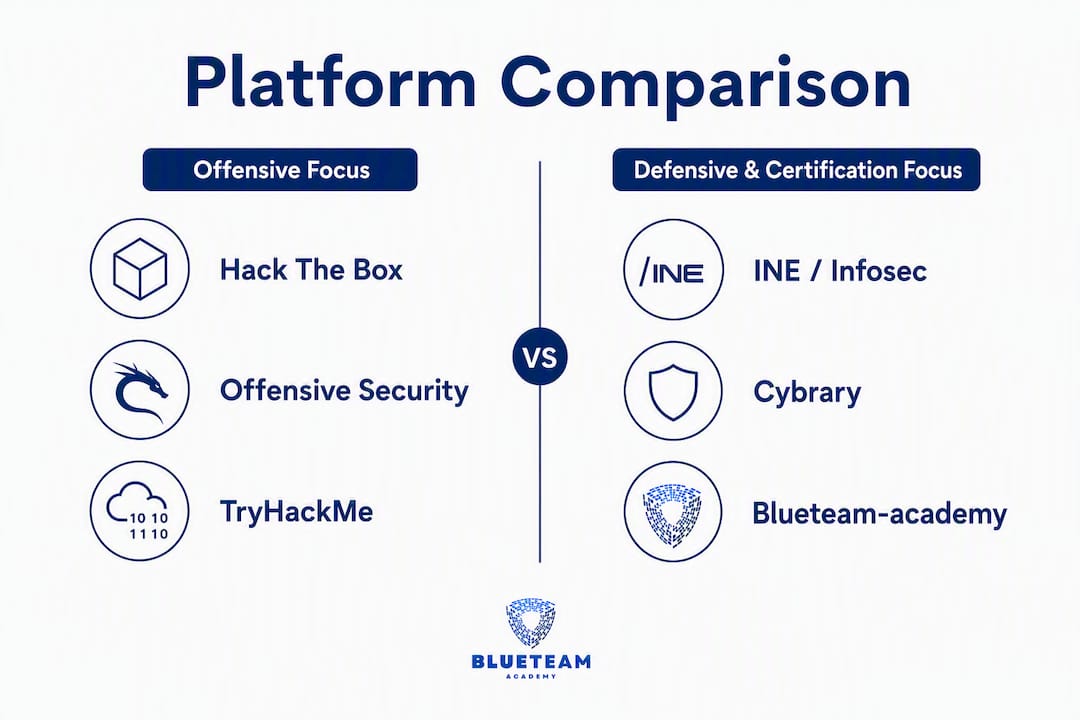
Platforms in this space cluster by purpose: gamified offensive practice, structured cert prep, and enterprise skill validation are three genuinely different products that happen to share a browser interface.

Feature comparison
| Platform | Free Tier | Difficulty | Primary Focus | Learning Style | Best For | Skill Validation | Enterprise Features |
|---|---|---|---|---|---|---|---|
| Blueteam-academy | No (paid courses) | Beginner–Intermediate | Defensive / cert prep | Structured coursework + templates | IT-to-cybersecurity career pivot | Peer-reviewed, AI-enhanced | US employer-relevant outcomes |
| TryHackMe | Yes (limited rooms) | Beginner–Intermediate | Offensive / general | Guided rooms, browser-based VMs | Absolute beginners | Badges, learning paths | Limited |
| Hack The Box | Yes (free machines) | Intermediate–Advanced | Offensive / CTF | Isolated VMs, CTF challenges | Advanced practitioners | Certifications (CPTS, CBBH) | HTB Enterprise Labs |
| INE / Infosec Skills | Yes (free starter) | Beginner–Advanced | Cert prep (eJPT, eCPPT) | Video courses + labs | Cert-track learners | Industry certs | Team plans |
| Cybrary | Yes (limited) | Beginner–Intermediate | Defensive / role-based | Video + virtual labs | Enterprise upskilling | Role-based assessments | Strong (reporting, hiring) |
| Offensive Security | No (paid labs) | Advanced | Offensive / cert prep | Isolated lab environments | OSCP / OffSec cert seekers | OSCP, OSEP, OSED | Enterprise cyber range |
| OverTheWire | Free | Beginner–Intermediate | Offensive / wargames | Community wargame tracks | Skill sharpening (supplement) | None | None |
Pricing overview
| Platform | Free Tier | Paid Entry Point | Notes |
|---|---|---|---|
| Blueteam-academy | No | One-time fee (see courses page) | 12 months access; no subscription |
| TryHackMe | Yes | ~$14/month | Annual plan reduces cost |
| Hack The Box | Yes | ~$14/month | VIP unlocks retired machines |
| INE / Infosec Skills | Yes (starter) | ~$49/month | Annual plans available |
| Cybrary | Yes (limited) | ~$99/month (teams) | Individual and team tiers |
| Offensive Security | No | ~$799/year (Learn One) | Cert exam included in bundles |
| OverTheWire | Free | Free | No paid tier |
Best pick by use case:
- Career transition from IT: Blueteam-academy’s structured coursework and Threat & Control Method map directly to defensive job roles, with no subscription clock running.
- Cert prep (OSCP, eJPT): INE for entry-level certs; Offensive Security for the OSCP itself.
- Hiring assessments and enterprise reporting: Cybrary’s role-based assessments and manager dashboards are purpose-built for that workflow.
- Advanced CTF and lab practice: Hack The Box, once you are past the beginner stage.
Profiles of each platform and what they actually offer
Hack The Box (HTB)
HTB puts you in front of a live machine with no walkthrough. You either enumerate, exploit, and escalate — or you don’t. That sink-or-swim philosophy is exactly what separates guided platforms from CTF-style ones: HTB rewards prior knowledge and punishes gaps. The free tier gives access to active machines; VIP unlocks the retired machine archive, which is where most structured practice happens.
Pros: Realistic lab environments, strong community write-ups post-retirement, CPTS and CBBH certifications carry employer recognition, HTB Enterprise Labs for team use.
Cons: Steep entry curve for anyone without prior offensive fundamentals, limited defensive content, no formal curriculum for beginners.
Best for: Practitioners with 6+ months of foundational knowledge who want to build an offensive portfolio or pursue HTB certifications.
Sample path: Start with HTB Academy modules (structured) → move to active free machines → VIP for retired machines → pursue CPTS certification.
INE / Infosec Skills
INE bundles video instruction with hands-on labs under one roof, which makes it one of the more complete options for cert-track learners. The eJPT (Junior Penetration Tester) certification is a legitimate entry point that US employers recognize, and the lab environments are browser-accessible without a local VM setup. The free starter tier covers enough ground to evaluate the platform before committing.
Pros: Structured video + lab combination, recognized entry-level certs (eJPT), broad topic coverage from network security to cloud, team plans for corporate training.
Cons: Monthly subscription model adds up, content quality varies across course authors, less community-driven than HTB.
Best for: Learners who want a cert credential alongside lab practice, particularly those targeting eJPT or eCPPT as a first formal qualification.
Sample path: Free starter content → eJPT learning path → lab practice → eJPT exam → eCPPT or OSCP prep.
Cybrary
Cybrary’s strongest differentiator is its enterprise reporting layer. Managers can track team progress, assign role-based paths, and pull skill-gap reports — features that individual learning platforms rarely offer. The individual tier is more limited, but the platform’s alignment with role-based frameworks makes it useful for anyone whose employer is paying for training and needs to demonstrate ROI.
Pros: Role-based learning paths, employer-facing dashboards, defensive content depth, free tier available.
Cons: Individual free tier is restricted, some courses feel dated, less hands-on lab depth than HTB or INE.
Best for: Enterprise teams and individuals whose training budget comes from an employer who needs reporting and compliance documentation.
Sample path: Role assessment → assigned learning path → virtual labs → skill assessment report for manager.
Offensive Security (OffSec)
OffSec’s OSCP remains the most recognized penetration testing certification in US hiring. The Learn One subscription bundles lab access with a cert exam attempt, which makes the cost easier to justify. The labs are genuinely difficult, and OffSec does not soften the experience. If OSCP is your target, there is no shortcut that replicates the actual lab environment.
Pros: OSCP is a gold-standard cert for US offensive security roles, rigorous lab environments, OffSec Proving Grounds for additional practice.
Cons: Expensive entry point, no meaningful free tier, content is almost exclusively offensive, not suited for defensive or cert-prep beginners.
Best for: Experienced practitioners with a clear goal of earning OSCP, OSEP, or OSED.
Sample path: OffSec PEN-200 course → Proving Grounds practice → OSCP exam attempt.
OverTheWire
OverTheWire offers free wargame tracks (Bandit, Natas, Narnia, and others) that are genuinely useful for sharpening narrow technical skills like Linux privilege escalation and web exploitation basics. There is no progress tracking, no curriculum, and no employer-reportable output. Use it as a low-cost supplement, not a career pivot tool.
Pros: Completely free, focused technical challenges, strong community.
Cons: No structured curriculum, no progress tracking, no cert alignment, no employer-facing output.
Best for: Supplementing structured training with focused skill drills, particularly for Linux fundamentals and web basics.
Pro Tip: Many learners use OverTheWire’s Bandit track to build Linux command-line confidence before starting a structured platform. Treat it as a warm-up, not a curriculum.
Blueteam-academy
Blueteam-academy is built for one specific reader: the IT professional who already runs infrastructure and wants to move into a defensive cybersecurity role. The Threat & Control Method gives you a practical decision-making framework rather than a list of topics to memorize. Courses are recorded, peer-reviewed, and enhanced with generative AI support, and you get 12 months of access from a single purchase. There is no subscription renewal to worry about.
For more on how hands-on lab work maps to career outcomes, the publisher’s own guide walks through what employers actually look for when evaluating candidates from non-traditional backgrounds.
Pros: Career-transition focus, Threat & Control Method framework, peer-reviewed content, AI-enhanced materials, templates and support channels included, no subscription model.
Cons: No free tier, primarily defensive focus (not suited for OSCP prep), less CTF/gamification than HTB or TryHackMe.
Best for: IT professionals making a deliberate move into cybersecurity, particularly those targeting defensive roles (SOC analyst, security engineer, incident responder).
How do you pick the right platform for your goals?
The range of available options spans open-source wargames to enterprise cyber ranges, which means the wrong choice wastes months of training time that never translates to employer-relevant skills. Work through this checklist before committing.
Evaluation checklist
- Map to professional standards — Does the platform align its content to the NIST NICE Framework or MITRE ATT&CK? Selecting a platform without checking that alignment risks training time that doesn’t translate to employer needs.
Questions to ask before you pay
- Are labs isolated (dedicated VM per user) or shared? Shared environments can expose your work to other users and limit realism.
- What happens to your access if you cancel? Some platforms lock you out immediately.
- How often is content refreshed, and is there a public changelog?
- Does the platform provide an employer-facing report or shareable credential?
Red flags
- No progress tracking or skill-gap reporting.
- Pricing that is not publicly listed (opaque pricing often signals aggressive upsells).
- No mapping to NIST, MITRE ATT&CK, or any recognized framework.
- Lab content that hasn’t been updated in over 18 months.
- No community forum, Discord, or support channel.
Pro Tip: Before paying, request a trial account or sample lab. Run one full exercise and check whether the feedback mechanism tells you why an answer is correct, not just whether it is. Platforms that explain the reasoning build transferable skills; platforms that only score you build test-taking habits.
Is TryHackMe still relevant, and how does difficulty compare?
Short answer: TryHackMe is still a solid starting point for absolute beginners, but it has real limits for career-focused learners past the foundational stage.
Difficulty and value by scenario
| Scenario | Recommended Platform Type | Difficulty Level | Key Limitation |
|---|---|---|---|
| Absolute beginner, no IT background | TryHackMe | Low | Limited cert alignment, gamified |
| IT pro transitioning to defensive roles | Blueteam-academy | Beginner–Intermediate | No CTF/gamification |
| Cert track (eJPT, eCPPT) | INE / Infosec Skills | Beginner–Intermediate | Subscription cost |
| Advanced offensive practice / CTF | Hack The Box | Intermediate–Advanced | Steep entry curve |
| OSCP pursuit | Offensive Security | Advanced | Expensive, no free tier |
| Hiring assessments / enterprise reporting | Cybrary | Beginner–Intermediate | Limited individual free tier |
Direct comparisons
Is Hack The Box harder than TryHackMe? Yes, consistently. TryHackMe uses guided rooms with hints and step-by-step walkthroughs. HTB drops you into a machine with no scaffolding. Guided rooms suit beginners; sink-or-swim CTF environments suit advanced practice. The gap is significant enough that many learners use TryHackMe to build fundamentals before moving to HTB.
Is TryHackMe still relevant in 2026? For someone with zero cybersecurity background, yes. For an IT professional who already manages firewalls, endpoints, or cloud infrastructure, TryHackMe’s beginner rooms cover ground you already know. You will move faster on a platform calibrated to your existing skill level.
Two scenario examples:
- Career transition from sysadmin to SOC analyst: You need defensive skills, SIEM familiarity, and a framework for threat analysis. TryHackMe’s gamified rooms don’t give you that. Blueteam-academy’s structured coursework, built around the Threat & Control Method, maps directly to that job description. See the cybersecurity career path for IT pros for a fuller breakdown of what that transition actually requires.
- Hiring manager evaluating candidates: You need a platform that produces reportable skill assessments, not leaderboard scores. Platforms built for hiring workflows separate assessment features from general learning features. Cybrary and enterprise cyber ranges serve that use case; TryHackMe and HTB do not.
Why Blueteam-academy stands out for US career transitions
Blueteam-academy is not trying to be a CTF platform or a cert factory. It is built for the IT professional who already understands infrastructure and needs a structured path into defensive cybersecurity, with materials that hold up in a US job interview.
The core differentiator is the Threat & Control Method — a practical decision-making framework that teaches you to analyze threats and select controls, rather than memorizing a topic list. That framework maps to how security decisions are actually made in enterprise environments, which is what US employers are hiring for.
What you get with Blueteam-academy:
- Recorded, self-paced courses designed by industry experts and peer-reviewed for accuracy.
- Generative AI enhancements that support comprehension without replacing the learning process.
- Templates and practical tools you can apply immediately in a real environment.
- Student community access and direct support channels.
- 12 months of access from a single purchase — no subscription renewal, no access cliff.
When to choose Blueteam-academy over the other options:
If you are an IT professional with existing infrastructure knowledge and your goal is a defensive cybersecurity role in the US, Blueteam-academy’s structured approach will get you to employer-relevant competency faster than a gamified platform. If you want OSCP, go to OffSec. If you want CTF practice, go to HTB. If you want a career-transition framework built around how US security teams actually operate, Blueteam-academy is the right fit.
For a deeper look at what the transition from IT to cybersecurity actually involves, the IT-to-cybersecurity transition guide walks through the skill gaps, the role options, and what employers are looking for right now.
Key Takeaways
For career-focused US learners, the best TryHackMe alternative depends on your current skill level and goal: Blueteam-academy for IT-to-cybersecurity transitions, Hack The Box for advanced offensive practice, INE for cert prep, and Cybrary for enterprise reporting.
| Point | Details |
|---|---|
| Platform purpose drives the choice | Gamified practice, cert prep, and enterprise assessment are distinct products — pick the one that matches your immediate career task. |
| NIST alignment matters | Platforms mapped to the NIST NICE Framework translate training time into employer-relevant skills; those without that mapping often don’t. |
| Difficulty gap is real | Hack The Box is significantly harder than TryHackMe; IT professionals with existing infrastructure knowledge often skip TryHackMe entirely. |
| Free tiers have limits | OverTheWire and TryHackMe free tiers build narrow skills but lack progress tracking, cert alignment, and employer-reportable output. |
| Blueteam-academy for career transitions | IT professionals targeting defensive US cybersecurity roles get a structured, framework-driven path with 12 months of access at a one-time fee. |
The gap between platform popularity and career outcomes
The most-discussed platforms in cybersecurity training are not always the ones that produce the fastest career outcomes. TryHackMe built its reputation on accessibility, and that reputation is deserved for absolute beginners. But popularity and career-readiness are different metrics, and conflating them is one of the more common mistakes IT professionals make when choosing a training path.
CTF-style platforms reward a specific skill: finding and exploiting vulnerabilities under time pressure. That skill matters in penetration testing roles. It matters much less in the defensive roles that make up the majority of US cybersecurity job openings, where the work is threat analysis, control selection, incident response, and security architecture. A learner who spends six months on CTF challenges and then interviews for a SOC analyst role will find that their leaderboard score does not translate to the questions being asked.
The NIST NICE Framework exists precisely to close that gap. It defines the knowledge, skills, and abilities that US employers use to write job descriptions and evaluate candidates. A platform that maps its content to that framework is not just teaching cybersecurity — it is teaching the version of cybersecurity that gets you hired. That is the lens worth applying when you evaluate any training option, including this one.
Blueteam-academy: a direct path from IT to cybersecurity
Most cybersecurity training platforms are built for people who already know they want to be in security. Blueteam-academy is built for IT professionals who are making the transition and need a structured, defensible path — not a collection of challenges to grind through.
The self-paced courses use a one-time fee model with 12 months of access, which means you are not racing a subscription clock. The Threat & Control Method gives you a repeatable framework for security decision-making that you can apply in your current role before you have even finished the course.
- Browse the full course catalog at Blueteam-academy’s online courses to see what is available and what each course covers.
- Ready to start? Visit Blueteam-academy to review the course overview and enroll.
Useful sources and further reading
| Source | What it covers |
|---|---|
| NIST NICE Framework Resource Center | The authoritative US standard for cybersecurity workforce roles, knowledge areas, and skill definitions. |
| OverTheWire: Wargames | Free community wargame tracks (Bandit, Natas, Narnia) for technical skill sharpening; no curriculum or progress tracking. |
| TryHackMe Alternatives (CB Insights) | Market-level analysis of how training platforms differentiate by purpose and audience. |
| TryHackMe Alternatives (CybersecTools) | Aggregated comparison of alternatives mapped to NIST coverage areas and feature sets. |
| TryHackMe Alternatives for Hiring (CyberHire) | Focused comparison of platforms built for hiring assessments vs. general learning. |
| Cyber Security Training Platforms Compared (Hacktivity) | Editorial comparison of guided vs. sink-or-swim learning philosophies across major platforms. |
| Blueteam-academy: IT to Cybersecurity | Publisher’s career transition guide for IT professionals moving into defensive security roles. |
| Best Cybersecurity Courses for IT Pros | Publisher’s guide to course-based learning and cert prep options for IT professionals. |
All statistics in this article are sourced and linked. Any claim that could not be verified against a named source (BLS, CyberSeek, ISC2, or equivalent) has been stated qualitatively rather than numerically. No figures have been invented.
