

Cybersecurity hiring in 2026 is strong, and the defining shift is AI forcing a re-sort of which roles employers actually fill. The U.S. Bureau of Labor Statistics projects information security analyst employment to grow 29% from 2024 to 2034, a rate nearly four times the average for all occupations. NIST reported in 2025 that CyberSeek updates revealed a 57,000 increase in tracked cybersecurity job openings, confirming that demand is still climbing. Robert Half’s 2026 Salary Guide reports a substantial portion of U.S. employers are willing to increase starting compensation for candidates with in-demand security skills., with cloud security and AI-adjacent expertise called out specifically.
For you as a candidate, that combination means one thing: the market rewards specificity. Showing up with a generic security background is harder to sell than it was two years ago. Showing up with cloud security hands-on experience, an IAM project, or an AI-security lab is a different conversation entirely.
Key Takeaways
The cybersecurity job market in 2026 rewards candidates who combine cloud or identity skills with documented project evidence, not just certifications.
| Point | Details |
|---|---|
| Demand is growing fast | BLS projects 29% growth for information security analysts from 2024 to 2034, with a 2024 median pay of $124,910. |
| Cloud and AI skills move offers | Robert Half’s 2026 Salary Guide found 53% of U.S. employers willing to raise starting pay for candidates with in-demand security skills. |
| Projects beat cert lists alone | Recruiters increasingly screen for documented lab work and portfolio projects alongside certifications. |
| Use primary data sources | Track BLS, CyberSeek, ISC2, and Robert Half figures quarterly to keep your career decisions grounded in current market data. |
| Blueteam-academy maps to employer needs | The curriculum covers cloud security, IAM, detection engineering, and GRC with hands-on labs and career templates for IT professionals transitioning into security. |
Table of Contents
- What are the top cybersecurity job trends for 2026?
- How much demand is there for cybersecurity professionals right now?
- Which cybersecurity roles are employers actually hiring for in 2026?
- What skills, tools, and certifications will employers pay more for in 2026?
- What should you expect for cybersecurity salaries and compensation in 2026?
- How do you break into or advance in cybersecurity in 2026?
- How should your training map to what employers actually need in 2026?
- What emerging threats are reshaping cybersecurity job requirements in 2026?
- What Blueteam-academy would prioritize for a 2026 cybersecurity career
- Blueteam-academy training built around 2026 hiring needs
- Sources
What are the top cybersecurity job trends for 2026?
The following shifts are reshaping which roles get funded and which skills get premium offers this year.
- AI as both threat vector and required skill. The World Economic Forum’s Global Cybersecurity Outlook 2025 identifies AI-related vulnerabilities as the fastest-growing cyber risk. Employers now expect security engineers to understand how AI systems can be attacked, not just how to defend traditional infrastructure.
- Cloud-native security demand. Multi-cloud architectures across AWS, GCP, and Azure have made cloud security a baseline expectation rather than a specialty. Postings increasingly require cloud-native tooling experience, not just familiarity with on-prem equivalents.
- Identity-first security. IAM has moved from a supporting function to the primary control plane in zero-trust architectures. Employers treat identity misconfiguration as the most common breach entry point, and hiring reflects that.
- GRC and privacy growth. Regulatory pressure from frameworks like NIST CSF 2.0, CMMC, and state-level privacy laws is pushing organizations to staff compliance and risk roles they previously outsourced or left unfilled.
- DevSecOps and secure SDLC. Product teams are absorbing security responsibility earlier in the development cycle. AppSec and DevSecOps engineers who can work inside a CI/CD pipeline are in short supply.
- Entry-level squeeze. Live job-board snapshots from August 2026 show a pronounced tilt toward engineering-heavy roles: security engineering, AppSec, and detection engineering dominate postings, while explicit “entry-level” listings remain thin. SOC analyst and information security analyst roles remain the most accessible doorways.
- Remote and hybrid stabilization. Fully remote security roles still exist, particularly in cloud, detection engineering, and GRC, but many employers have pulled back to hybrid arrangements for roles requiring hands-on lab access or cleared work.
How much demand is there for cybersecurity professionals right now?
That projection covers a single occupational code; the actual cybersecurity workforce spans dozens of job titles not captured in that one category.
The CyberSeek supply-and-demand heatmap gives a more granular view. It maps open roles by state and metro area, showing where demand outpaces local talent supply. The NIST-reported 57,000 increase in tracked openings from 2025 is the clearest recent signal that the gap is widening, not closing.
Industry trackers report hundreds of thousands of open U.S. cybersecurity positions as of early 2026, consistent with the growing demand trend, but exact counts vary and require primary source confirmation. That figure is consistent with the directional trend from CyberSeek and NIST, but treat it as context rather than a certified count.
ISC2’s 2024 Cybersecurity Workforce Study put the global unfilled-position gap at 4.8 million in 2024, with minimal workforce growth that year. The U.S. share of that gap is significant, and ISACA’s State of Cybersecurity 2025 adds an important caveat: budget constraints are now a meaningful hiring limiter. Organizations that need talent may still delay headcount, which is why contract and consulting paths are gaining traction alongside full-time roles.
| Data source | Metric | Period |
|---|---|---|
| BLS | 29% projected growth, information security analysts | 2024–2034 |
| BLS | $124,910 median annual pay, information security analysts | 2024 |
| NIST / CyberSeek | +57,000 tracked U.S. cybersecurity job openings | 2025 update |
| ISC2 | 4.8 million global unfilled positions | 2024 |
Regional concentration: CyberSeek data consistently shows the highest posted demand concentrated in the Washington D.C. metro (driven by federal and defense contractors), New York City, the San Francisco Bay Area, Dallas-Fort Worth, and Chicago. If you’re open to relocation or remote work, those markets offer the densest opportunity.
Methodology note: BLS figures come from the Occupational Outlook Handbook and cover the “information security analysts” occupational code. CyberSeek and NIST data aggregate live job postings across multiple titles and are updated periodically. ISC2 figures are self-reported workforce survey data. Where figures come from different methodologies, they are labeled by source.
Which cybersecurity roles are employers actually hiring for in 2026?
The role mix has shifted toward engineering-heavy and specialized positions. Here is where the real hiring volume sits, and what employers want for each.
- Security engineer / architect. The highest-volume role family in most job-board snapshots. Employers want cloud platform experience (AWS Security Hub, Azure Defender, GCP Security Command Center), scripting ability in Python or Go, and familiarity with MITRE ATT&CK. Compensation typically runs above the BLS median for analysts. Prior software or systems engineering experience is a genuine differentiator.
- Cloud security engineer. Distinct from general security engineering in that the entire scope is cloud-native. Expect requirements for cloud certifications (AWS Security Specialty, Google Professional Cloud Security Engineer), IaC security (Terraform, CloudFormation), and CSPM tooling. This role is one of the fastest-growing in terms of posting volume.
- AI security specialist. A newer role family, but posting growth is accelerating following the WEF’s documentation of AI-related vulnerabilities as the fastest-growing risk category. Employers want candidates who understand adversarial ML, prompt injection, model supply chain risks, and LLM security testing. Most postings still require a security engineering foundation plus AI/ML exposure.
- IAM / identity engineer. Zero-trust adoption has made IAM a standalone engineering discipline. Okta, Azure AD (Entra ID), CyberArk, and SailPoint appear frequently in postings. Candidates with PAM experience command a premium.
- Information security analyst. The BLS’s primary tracked role and the most accessible entry point. SOC analyst positions feed this pipeline. If you’re targeting entry-level cybersecurity jobs, this is where to focus your first applications.
- GRC / compliance analyst. Regulatory pressure from CMMC, NIST CSF 2.0, SOC 2, and state privacy laws is generating steady hiring. These roles often accept candidates from adjacent fields (audit, legal, IT risk) and don’t always require deep technical backgrounds, though familiarity with control frameworks matters.
- AppSec / DevSecOps engineer. Product-embedded security roles requiring secure code review, SAST/DAST tooling, and the ability to work inside GitHub Actions or Jenkins pipelines. Software engineering experience is often a prerequisite, not a bonus.
- Incident response / DFIR. Demand is steady rather than explosive. Employers want SIEM proficiency (Splunk, Microsoft Sentinel, Chronicle), EDR experience (CrowdStrike, SentinelOne), and documented case work. GIAC certifications (GCFE, GCIH) carry weight here.
- Red team / penetration tester. Posting volume is thinner than blue-team roles. Employers expect OSCP or equivalent demonstrated skill. This is not the easiest entry point for career changers without prior security experience.
- Cybersecurity / privacy attorney. Posting growth is real, driven by breach notification laws and AI governance requirements. This is a niche requiring both legal credentials and technical literacy.
What skills, tools, and certifications will employers pay more for in 2026?
Technical skills that move the needle
Cloud security is the single most cross-cutting skill requirement in 2026 postings. AWS, GCP, and Azure security configurations appear in roles from analyst to architect. Identity and access management follows closely, particularly PAM and federation protocols (SAML, OAuth, OIDC). AI and ML security concepts, including adversarial inputs and model governance, are moving from “nice to have” to explicit requirements in engineering-heavy postings.

Detection engineering, SIEM tuning, and EDR configuration remain core for blue-team roles. Splunk, Microsoft Sentinel, and CrowdStrike Falcon are the tools named most often. Container and Kubernetes security (Falco, Trivy, OPA/Gatekeeper) is increasingly required for cloud-native environments.
Certifications that still carry weight
- CompTIA Security+ remains the baseline for analyst and entry-level roles, and it satisfies DoD 8570 requirements for federal-adjacent work.
- CISSP is the standard for senior and architect-level positions. It requires five years of experience, so it’s a mid-career target, not a starting point.
- Cloud security certifications (AWS Security Specialty, CCSP, Google Professional Cloud Security Engineer) directly support compensation increases per the Robert Half 2026 Salary Guide.
- GIAC certifications (GPEN, GCIH, GCFE, GWAPT) carry strong signal for specialized IR, AppSec, and red-team roles.
- CISM and CRISC from ISACA remain relevant for GRC and risk management tracks.
A short caveat: certifications open doors, but they rarely close offers on their own. Recruiters increasingly screen for project-based evidence alongside cert listings. A documented cloud misconfiguration audit or a SIEM detection rule you built and tuned will do more work in an interview than a cert listed without context.
Pro Tip: Build a small GitHub repository with three to five security projects: a cloud misconfiguration assessment, a detection rule with documented logic, and a brief threat model. That portfolio gives interviewers something concrete to ask about, which shifts the conversation from “do you know this?” to “show me how you think.”
What should you expect for cybersecurity salaries and compensation in 2026?
The BLS 2024 median pay for information security analysts is $124,910. That figure covers a broad occupational category, so actual offers vary significantly by role, specialization, and geography.
Employers are willing to increase starting compensation for candidates with in-demand security skills](https://www.roberthalf.com/us/en/insights/research/what-to-know-about-hiring-and-salary-trends-in-cybersecurity), with cloud security and AI-adjacent expertise specifically identified as the levers that move offers. That means your negotiation position is strongest when you can point to a specific, demonstrable skill the employer needs and the market underproduces.
For SOC analyst roles specifically, city-level pay variation is substantial. The SOC analyst salary breakdown by tier and city shows meaningful metro premiums in D.C., New York, and San Francisco relative to mid-market cities.
Negotiation levers that actually work
- Demonstrated project proof. A documented lab or real-world project tied to the role’s primary skill requirement gives you a concrete anchor for a higher offer.
- Relevant specialization. Cloud security, AI security, and IAM command premiums over generalist security backgrounds right now.
- Competing offers. Even a competing interview at a comparable employer strengthens your position. Recruiters respond to market evidence.
- Certifications with context. A cert plus a project that uses the cert’s skills is more persuasive than a cert alone.
- Remote vs. on-site flexibility. Fully remote roles sometimes carry geographic pay adjustments. Know the employer’s policy before negotiating.
Regional cost-of-living matters. A $130,000 offer in Austin and a $130,000 offer in San Francisco represent very different purchasing power. CyberSeek’s heatmap shows where demand is densest, but that concentration doesn’t always mean the highest real compensation after housing costs.
How do you break into or advance in cybersecurity in 2026?
This is a practical sequence, not a rigid timeline. Move through steps at your own pace, and skip what you’ve already covered.
-
Map your existing skills to security roles. If you run infrastructure, you already understand networks, endpoints, and access control. The IT-to-cybersecurity career path is shorter than most people assume. Identify which role family (analyst, cloud security, GRC, AppSec) aligns with your current technical depth.
-
Build three portfolio projects. A SOC triage case with documented detection logic, a cloud misconfiguration assessment on a personal AWS or Azure account, and a small threat model for a fictional application. These give interviewers something real to evaluate. Hands-on cybersecurity labs are the fastest way to build that evidence without waiting for a job to provide the environment.
-
Earn one targeted certification. CompTIA Security+ for analyst roles; a cloud security cert for cloud-focused paths; GIAC for specialized IR or AppSec. Don’t collect certifications without projects to back them up.
-
Use a lab environment consistently. TryHackMe, Hack The Box, and cloud provider free tiers all give you a place to practice detection, misconfiguration hunting, and incident response without needing employer infrastructure.
-
Apply with specificity and network deliberately. CyberSeek’s heatmap shows which metros have the most open roles relative to local supply. Target those markets first. LinkedIn, local ISACA and ISC2 chapter events, and BSides conferences are all practical networking venues.
-
Prepare for interviews with artifacts, not just answers. Bring a one-page summary of your portfolio projects. Walk through your detection logic or your cloud audit methodology. Interviewers remember candidates who show their reasoning, not just their credentials.
For career changers specifically: adjacent IT experience maps directly to security. Network administration translates to network security monitoring. Systems administration translates to endpoint security and hardening. You don’t need to start from zero.
How should your training map to what employers actually need in 2026?
Employers in 2026 are not hiring for theoretical knowledge alone. The shift toward engineering-heavy roles means training programs that emphasize hands-on labs, applied projects, and real tooling experience produce candidates who clear recruiter screens faster than those from lecture-only programs.
| Employer need | Recommended training feature |
|---|---|
| Cloud security skills (AWS/GCP/Azure) | Cloud security modules with live lab environments |
| Identity and access management | IAM-specific labs covering federation, PAM, and zero-trust concepts |
| AI/ML security concepts | Applied AI-security labs covering adversarial inputs and model risk |
| Detection engineering / SIEM | Hands-on SIEM configuration and detection rule building |
| Secure SDLC / AppSec | Secure code review exercises and CI/CD pipeline security labs |
| GRC and compliance | Framework mapping exercises (NIST CSF, SOC 2, CMMC) |
| Interview and career readiness | Career templates, portfolio guidance, and peer review |
Blueteam-academy’s courses are built around this structure. The curriculum combines the Threat & Control Method (a practical decision-making framework for security analysis), recorded classes, peer-reviewed content, and generative AI enhancements. Modules cover cloud security, identity, detection engineering, and GRC, with career templates included to help you translate lab work into hiring evidence. You get 12 months of access, a student community, and support channels.
One honest note: training gives you the foundation and the framework. Getting hired requires you to apply that foundation through real projects, consistent lab practice, and targeted applications. No program, including this one, produces outcomes without learner effort.
What emerging threats are reshaping cybersecurity job requirements in 2026?
The threat environment is directly driving specialization demand, and understanding which threats are growing fastest helps you pick where to build depth.
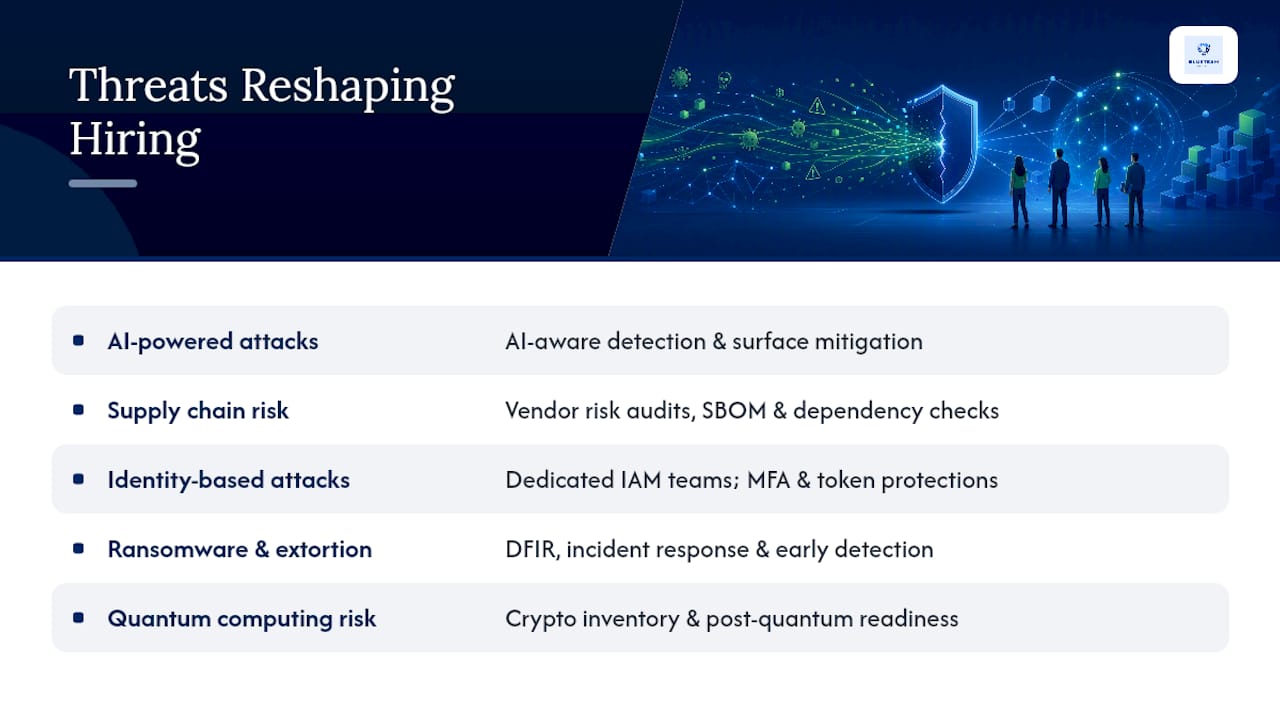
AI-powered attacks are the most consequential shift. The WEF’s 2025 cybersecurity outlook documents AI-related vulnerabilities as the fastest-growing risk category. Attackers are using AI to accelerate phishing personalization, automate vulnerability discovery, and generate malicious code at scale. Defenders need to understand how AI system integration expands attack surfaces and how to build detection logic that accounts for AI-generated threat patterns.
Supply chain and third-party risk continues to generate incidents and, consequently, hiring. Security engineers who can assess vendor risk, audit software dependencies, and implement SBOM (Software Bill of Materials) practices are in demand across both enterprise and government sectors.
Identity-based attacks remain the dominant breach vector. Credential theft, MFA bypass, and OAuth token abuse are the techniques appearing most frequently in incident reports. This directly explains the IAM hiring surge: organizations are staffing identity security as a dedicated function rather than a shared responsibility.
Ransomware and extortion operations have matured into industrialized services. Incident response and DFIR teams are under sustained pressure, and organizations are investing in detection engineering to catch intrusions earlier in the kill chain rather than responding after encryption.
Quantum computing risk is a longer-horizon concern, but NIST’s post-quantum cryptography standards are already prompting organizations to begin cryptographic inventory work. GRC and architecture roles are starting to include post-quantum readiness as a planning requirement.
Each of these threat categories maps to a hiring need. If you’re choosing a specialization, pick one threat domain and build depth in the defensive techniques that counter it.
What Blueteam-academy would prioritize for a 2026 cybersecurity career
If we were planning a cybersecurity career entry or pivot right now, here is how we’d think about it.
Start with cloud security, not because it’s trendy, but because it’s the skill that appears in the most role families simultaneously. Cloud security knowledge helps you in security engineering, detection engineering, GRC, and AppSec roles. It’s the highest-leverage first investment.
Layer identity on top of that. IAM and zero-trust concepts are the second most cross-cutting skill set, and the combination of cloud plus identity puts you in contention for a wide range of mid-market and enterprise roles.
On certifications: get CompTIA Security+ if you don’t have it, then pursue a cloud security cert that matches your primary platform. Don’t chase certifications beyond that until you have projects to back them up. A cert without a portfolio is a checkbox. A cert with three documented projects is a conversation.
Track the data, not the anecdotes. BLS, CyberSeek, ISC2, and Robert Half publish updated figures regularly. Check them quarterly. Job market conditions shift, and your career decisions should be grounded in current data rather than forum posts or LinkedIn commentary.
The trade-off to accept: specialization means narrowing your initial target list. That feels counterintuitive when you’re job searching, but a focused application to roles where your skills are a strong match outperforms a broad spray to every security posting. Recruiters notice fit.
Blueteam-academy training built around 2026 hiring needs
If you’re an IT professional ready to move into cybersecurity, the fastest path is training that mirrors what employers actually test for in interviews, not a generic security survey course.
Blueteam-academy’s self-paced courses are built for exactly this transition. You get hands-on labs covering cloud security, identity and access management, detection engineering, and GRC, plus the Threat & Control Method framework that teaches you to reason through security decisions the way employers expect. Career templates help you translate lab work into portfolio evidence. You get 12 months of access, a student community, and direct support.
Browse the available cybersecurity training courses and see which modules match the role you’re targeting. Outcomes depend on your effort and application, but the curriculum is built to close the gap between IT experience and cybersecurity hiring requirements.
Sources
The figures and projections in this article come from the following primary sources. Check each directly for dataset dates, methodology notes, and the most current updates.
- Information Security Analysts : Occupational Outlook Handbook: : U.S. Bureau of Labor Statistics
- New CyberSeek updates reveal 57,000 increase cybersecurity job openings
- ISC2-2024-Cybersecurity-Workforce-Study
- Global Cybersecurity Outlook 2025 (digest) — World Economic Forum
Any figure marked [VERIFY] in this article comes from an industry tracker rather than a primary government or workforce study source. Cross-reference those figures against BLS and CyberSeek before using them in workforce planning decisions.
