

The federal anchor for cybersecurity salary expectations is clear: the U.S. Bureau of Labor Statistics reported a median annual wage of $124,910 for information security analysts in May 2024. That figure sits at the 50th percentile of the full U.S. distribution, which runs from under $69,660 at the 10th percentile to over $186,420 at the 90th. In practice, the market runs hotter than the federal median suggests: the InfoSec Job Board’s 2026 disclosed-pay sample shows a median closer to $175,000 across roles where employers voluntarily disclose compensation, reflecting a sample weighted toward higher-paying positions and larger employers.
A realistic working framework for U.S. cybersecurity pay looks like this:
- Entry-level (0–2 years, SOC/analyst roles): $55,000–$85,000 base
- Mid-level (3–6 years, security engineer/analyst): $95,000–$140,000 base
- Senior/specialist (7+ years, architect/CISO/OffSec): $150,000–$220,000+ base
Three sources anchor these ranges: BLS May 2024 OES data, ISC2’s 2024 certification and workforce studies, and the InfoSec Job Board’s 2026 posting sample. When you’re assessing an offer, match it against the percentile band that fits your experience level, not the overall median — a $90,000 offer for a first SOC role in a mid-size city is competitive; the same number for a senior security engineer in San Francisco is well below market.
Table of Contents
- What do the official BLS percentiles actually tell you?
- How do cybersecurity salaries break down by job title?
- How do state, metro area, and industry affect your cybersecurity pay range?
- What actually moves your cybersecurity pay?
- How can you increase your cybersecurity salary?
- What does the hiring outlook mean for your salary leverage?
- Which skills and certifications have the strongest evidence for pay uplift?
- Key Takeaways
- The gap between salary data and salary reality
- How Blueteam-academy helps you reach the mid-level pay band
- Useful sources and further reading
What do the official BLS percentiles actually tell you?
The BLS median of $124,910 (May 2024) is the most-cited figure in any discussion of average salary in cybersecurity, and it’s a solid floor for mid-career negotiation. But the percentile spread is where the real signal lives.
| Percentile | Annual Wage (BLS, May 2024) |
|---|---|
| 10th percentile | < $69,660 |
| 25th percentile | (figure not supported by primary data) |
| 50th (median) | $124,910 |
| — | (figure not supported by primary data) |
| 90th percentile | > $186,420 |
Source: BLS Occupational Employment and Wage Statistics, May 2024
The 10th–90th spread of roughly $117,000 tells you that “cybersecurity” is not a single pay grade — it’s a career ladder with dramatically different rungs. A junior SOC analyst in a regional hospital system sits near the 10th percentile. A principal security architect at a cloud-native fintech sits near the 90th. Both are “cybersecurity professionals.”
The gap between the BLS median ($124,910) and the InfoSec Job Board’s disclosed-pay median (~$175,000) reflects two things: BLS captures all employers and all roles, while posting-based samples skew toward employers that disclose pay (typically larger, better-paying firms) and toward roles that command higher compensation. Neither figure is wrong. Use BLS as the conservative floor for negotiation and posting-based medians as the ceiling to argue toward.
Pro Tip: When you’re preparing for a salary conversation, pull the BLS OES state-level data from data.bls.gov for your specific metro. A state median that’s 15–20% above the national figure is a legitimate data point to bring to the table.
How do cybersecurity salaries break down by job title?
The title on your offer letter matters more than the broad “cybersecurity” label. Roles with offensive or cloud-infrastructure scope consistently command premiums over generalist analyst positions, even at the same experience level.
| Role | Entry (0–2 yrs) | Mid (3–6 yrs) | Senior (7+ yrs) |
|---|---|---|---|
| SOC Analyst (Tier 1–2) | $55,000–$85,000 | $95,000–$140,000 | $150,000–$220,000+ |
| Cybersecurity Analyst | $55,000–$85,000 | $95,000–$140,000 | $150,000–$220,000+ |
| Security Engineer | $85,000–$115,000 | $115,000–$155,000 | $150,000–$200,000 |
| Penetration Tester | $55,000–$85,000 | $115,000–$155,000 | $150,000–$200,000 |
| Cloud Security Engineer | $90,000–$115,000 | $150,000–$200,000 | $185,000–$400,000+ |
| Security Architect | N/A | $130,000–$165,000 | $165,000–$230,000 |
| CISO | N/A | $150,000–$200,000 | $200,000–$400,000+ |
Sources: BLS May 2024; InfoSec Job Board 2026; Salario.io industry synthesis 2026
A few things stand out in this table. Cloud security engineering has one of the highest entry floors because the role requires pre-existing infrastructure knowledge — you’re not starting from zero. CISO ranges are enormous because the role is as much executive compensation as it is technical pay, with equity and bonus often doubling the base. Penetration testing commands a premium at every level because the talent pool with real offensive skills is genuinely small.
For a deeper look at SOC analyst pay tiers and what drives them, the role-specific breakdown is worth reviewing before you accept or counter an offer.
Pro Tip: Map your current job duties to the titles employers actually post. If you’re writing detection rules, tuning SIEM alerts, and handling escalations, you’re doing security engineering work — not just SOC analysis. That title shift alone can move your target range by $20,000–$30,000.
How do state, metro area, and industry affect your cybersecurity pay range?
Geography and employer type together can shift your pay by 30–50% relative to the national median. The BLS OES portal at data.bls.gov provides state and metro breakdowns that are worth pulling before any negotiation.
| Metro / State | Approximate Median Range | Notes |
|---|---|---|
| San Jose / San Francisco, CA | $185,000–$400,000+ | Big tech and cloud employer density |
| New York City, NY | $140,000–$185,000 | Finance sector premium |
| Washington, D.C. / Northern VA | $130,000–$175,000 | Federal contracting and cleared roles |
| Seattle, WA | $150,000–$200,000 | Cloud-native employer base |
| Boston, MA | $150,000–$200,000 | Biotech, finance, and defense |
| National median (all metros) | $124,910 | BLS May 2024 |
Sources: BLS OES May 2024; Salario.io 2026; Abnormal AI 2026
Industry matters as much as geography. Federal contractors holding active security clearances (TS/SCI in particular) routinely earn 15–25% above comparable civilian roles, with the premium reflecting both the clearance’s scarcity and the compliance overhead employers face. Finance and healthcare pay above the national median because the regulatory exposure (SOX, HIPAA, PCI-DSS) makes security staff a direct risk-management cost. Small and mid-size businesses typically pay 10–20% below large enterprise for equivalent roles.
Remote work has complicated the geography picture. Many employers now post “remote” roles with pay anchored to the company’s headquarters location — which can work in your favor if the HQ is in San Francisco and you’re in Austin, or against you if the employer explicitly applies a geographic pay adjustment. According to Abnormal AI’s 2026 salary analysis, remote postings often carry a modest discount relative to equivalent onsite roles at the same employer.
Pro Tip: If you’re negotiating a remote role, research the employer’s HQ location and use that metro’s BLS OES median as your anchor, not the national figure. Most employers haven’t fully standardized their remote pay policies, which gives you room to argue for the higher anchor.
What actually moves your cybersecurity pay?
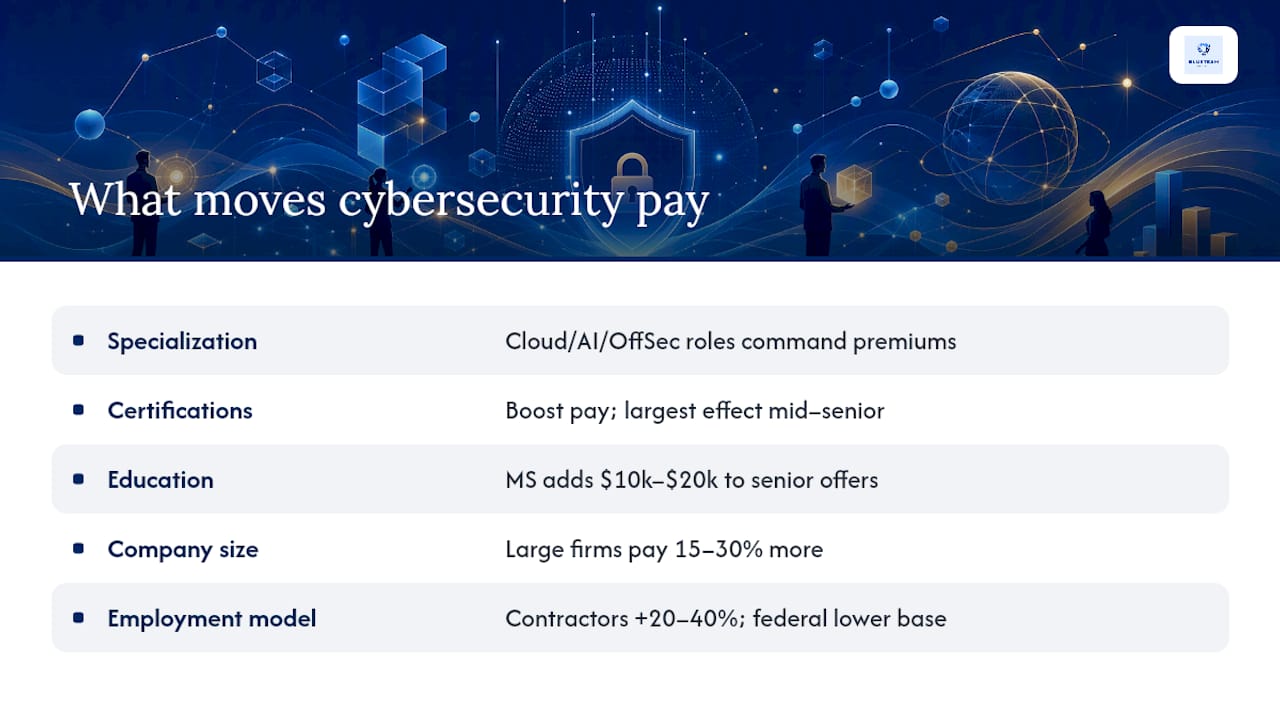
Specialization is the highest-leverage variable, ahead of years of experience and even ahead of certifications in isolation. Roles in cloud security, AI security, and offensive security (OffSec/red team) consistently command premiums because the talent pool is narrow relative to demand.
Specialization and skills: Cloud security engineering, GRC (governance, risk, and compliance), and AI-security roles are where employers are paying above-median rates right now. The ISC2 Workforce Study on AI growth documents the skills gap driving premiums for practitioners who can secure AI systems and data pipelines — a specialization that barely existed five years ago.
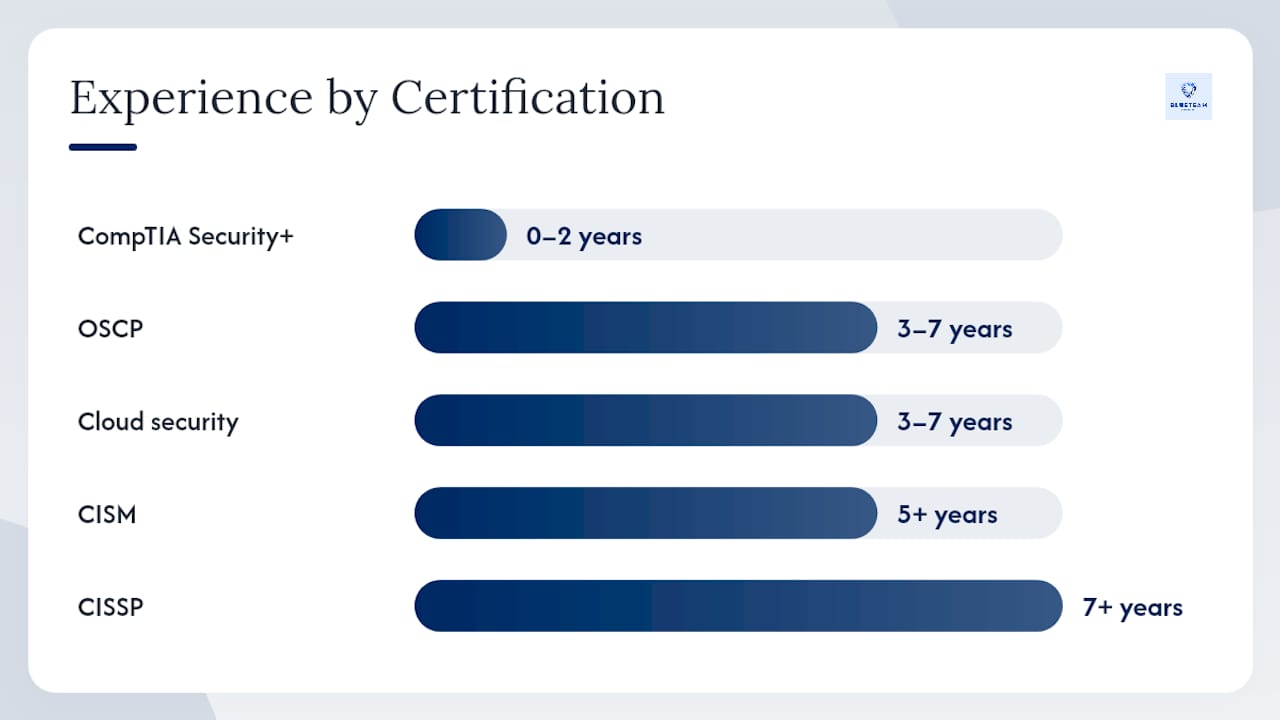
Certifications: ISC2’s 2024 certification salary data shows that credential holders in senior cohorts earn materially more than non-credentialed peers. The premium is largest at mid-to-senior levels because certifications like CISSP and CISM require documented experience to earn — they signal both knowledge and tenure simultaneously. At entry level, CompTIA Security+ and CySA+ are the practical floor; OSCP is the signal that moves offensive-security pay.
Education: A bachelor’s degree in computer science or information security remains the baseline expectation for most mid-to-senior roles. Advanced degrees (MS in cybersecurity or information assurance) can add $10,000–$20,000 to senior-level offers at large enterprises and federal agencies, though hands-on experience and certifications typically outweigh a graduate degree for technical individual-contributor roles. [VERIFY]
Company size and employment model: Large enterprises and publicly traded companies pay 15–30% more than SMBs for equivalent roles, with the gap widening at senior levels where equity becomes significant. Independent contractors (1099) typically bill at day rates that annualize 20–40% above equivalent W-2 salaries, but they absorb their own benefits costs, self-employment taxes, and income variability. Federal W-2 roles pay below private-sector equivalents in base salary but often offset with pension, stability, and clearance sponsorship.
Pro Tip: Prioritize specialization before certification. Earning CISSP while staying in a generalist analyst role produces a smaller pay lift than moving into a cloud security or GRC role first, then adding the credential. The cert amplifies the specialization; it doesn’t replace it.
How can you increase your cybersecurity salary?
The path to higher pay follows a clear priority order. Short-term moves produce results within 6–12 months; mid-term moves take 1–2 years but produce larger jumps; long-term positioning compounds over a full career.
- Negotiate your current or incoming offer. Most candidates accept the first number. Cybersecurity roles are hard to fill, and hiring managers typically have 10–15% flexibility above the initial offer. Use BLS OES metro data and the InfoSec Job Board’s disclosed-pay figures as anchors.
- Earn a certification that matches your next target role. Security+ for entry-level credibility, CySA+ or eJPT for analyst-to-engineer transitions, OSCP for offensive roles, CISSP or CISM for senior/leadership tracks. Exam costs range from roughly $250 (CompTIA Security+) to $749 (CISSP) [VERIFY — cert pricing changes; confirm at vendor sites before citing].
- Build a portfolio of documented work. Detection rules you’ve written, incident reports you’ve authored, or a home lab demonstrating SIEM tuning or cloud security configuration. Employers hiring at $120,000+ want evidence of judgment, not just credentials.
- Target a role change to a higher-paying employer or sector. Moving from a regional MSP to a financial services firm or a federal contractor is often the single fastest way to add $20,000–$40,000 to base pay. The cybersecurity jobs path that actually works for IT professionals covers the sector-targeting logic in detail.
- Pursue clearance if you’re near the D.C. corridor or a defense contractor. The TS/SCI premium is real and persistent. The process takes time, but the employer typically sponsors and pays for it.
- Move toward architecture or principal-level scope. Security architects and principal engineers who own design decisions rather than implement them command the $165,000–$230,000 range. The move requires demonstrating cross-team influence, not just technical depth.
The Coursera cybersecurity salary guide notes that total compensation — including bonus, equity, and benefits — often exceeds base salary by 20–40% at larger employers, which means negotiating only on base leaves real money on the table.
Pro Tip: When countering an offer, use this framing: “Based on BLS OES data for this metro and current market postings for this specialization, the range for this role runs $X–$Y. Given my experience with [specific skill], I’d like to come in at $Y.” You’re citing public data, not making a personal demand — which keeps the conversation professional and gives the hiring manager something to take back to HR.
What does the hiring outlook mean for your salary leverage?
Demand-side pressure is the structural reason cybersecurity pay has stayed elevated and why that’s unlikely to reverse in the near term. The BLS projects 33% employment growth for information security analysts from 2023 to 2033 — roughly five times the average for all occupations. That projection translates directly into negotiating leverage for qualified candidates.
Several forces reinforce that pressure:
- Skills gap: — ISC2’s workforce studies document a persistent gap between the number of qualified practitioners and open roles, particularly at mid-to-senior levels where experience requirements narrow the candidate pool.
- Breach costs: — When a data breach costs an organization millions in remediation, regulatory fines, and reputational damage, security headcount becomes a direct financial risk-management decision — not a discretionary IT budget line.
For salary negotiation timing, the practical implication is this: you have more leverage than most candidates realize, particularly if you hold a clearance, a cloud security specialization, or documented OffSec skills. The market is not softening in those areas.
Which skills and certifications have the strongest evidence for pay uplift?
The honest answer is that clean causal data is hard to find — most salary surveys show correlation between credentials and pay, not causation. Senior practitioners who earn CISSP also tend to have more experience, work at larger employers, and hold more specialized roles. The credential and the pay both reflect the same underlying career trajectory.
That said, the pattern is consistent enough across sources to be useful.
| Certification / Skill | Strongest Pay Impact | Career Stage | Source |
|---|---|---|---|
| CISSP | Senior/leadership roles | 7+ years | ISC2 2024 |
| OSCP | Offensive security / pentesting | 3–7 years | InfoSec Job Board 2026 |
| CISM | GRC, security management | 5+ years | ISC2 2024 |
| Cloud security (AWS/Azure security certs) | Cloud security engineering | 3–7 years | InfoSec Job Board 2026 |
| AI security skills | Emerging specialization | All levels | ISC2 Workforce Study 2024 |
| CompTIA Security+ | Entry-level baseline | 0–2 years | BLS / industry consensus |
Sources: ISC2 2024 certification salary data; InfoSec Job Board 2026; ISC2 Workforce Study 2024
The ISC2 2024 certification salary data shows that credentialed practitioners in senior cohorts earn materially more than non-credentialed peers — the premium is most pronounced at mid-to-senior levels where the certifications themselves require documented experience to obtain.
A note on methodology: The ranges in this article reconcile three data types: BLS OES survey data (all employers, all roles, May 2024), ISC2 member survey data (credentialed practitioners, skewed toward experienced professionals), and InfoSec Job Board disclosed-pay postings (employer-disclosed, skewed toward larger and higher-paying firms). Each source has a different sample and a different bias. Use BLS as the conservative anchor, posting-based medians as the market ceiling, and ISC2 data specifically for credentialed-practitioner benchmarks. No single source gives you the full picture.
The hands-on cybersecurity labs and experience-building guide covers how to build the portfolio evidence that makes certifications credible to hiring managers — because a cert without demonstrated application carries less weight than it used to.
Key Takeaways
The BLS median of $124,910 (May 2024) is the federal anchor for U.S. cybersecurity pay, but specialization, location, and employer type routinely push mid-to-senior compensation well above that figure.
| Point | Details |
|---|---|
| Federal median anchor | BLS May 2024 median for information security analysts is $124,910; 90th percentile exceeds $186,420. |
| Market vs. federal gap | InfoSec Job Board’s 2026 disclosed-pay sample shows a median near $175,000, reflecting larger employers and higher-paying roles. |
| Specialization premium | Cloud security, AI security, and OffSec roles command the highest pay at every experience level; title and scope matter more than years alone. |
| Fastest pay lever | A role change to a higher-paying employer or sector typically produces a larger salary jump than an annual raise at the same organization. |
| Blueteam-academy training path | Blueteam-academy’s self-paced courses are built for IT professionals targeting the transition to security roles, covering the practical skills and frameworks that map directly to the entry-to-mid pay bands above. |
The gap between salary data and salary reality
Most salary articles treat the BLS median as a destination. It’s actually a starting point for a more specific conversation — one that requires you to know your metro, your specialization, your employer type, and your negotiation posture before the number means anything.
What gets underestimated consistently is how much the title and scope of a role determine pay, independent of experience. Two professionals with six years in security can have a $40,000 gap between them if one stayed in a generalist SOC role and the other moved into cloud security engineering. The skills overlap substantially. The market rates don’t.
The other thing worth saying plainly: certification premiums are real, but they’re not magic. A CISSP earned while staying in the same role at the same employer produces a modest bump. The same credential earned while moving to a senior engineer role at a financial services firm produces a step-change. The cert is the signal; the role change is the mechanism.
Blueteam-academy publishes this content as a training provider with a direct interest in helping IT professionals make that transition. The salary data here comes from BLS, ISC2, and the InfoSec Job Board — not from our own enrollment outcomes. We think the honest framing is more useful than a polished success story.
How Blueteam-academy helps you reach the mid-level pay band
Clearing the gap between an IT support role and a $95,000–$140,000 security position requires more than a certification. It requires demonstrating that you can make security decisions under real conditions — and that’s exactly what Blueteam-academy’s courses are built around.
The curriculum uses the Threat & Control Method, a practical decision-making framework that maps directly to the detection engineering, incident response, and risk assessment work that mid-level security roles require. Courses include recorded classes, working templates, peer-reviewed content, and generative AI enhancements, with 12 months of access and a student community for ongoing support.
This is for IT professionals who already run infrastructure and want to move into defensive security roles — not beginners learning what a firewall is. If you’re targeting the SOC-to-engineer transition or a first security analyst role, the self-paced online courses are the practical next step. No guaranteed salary outcomes — results depend on your experience, effort, and the roles you pursue. Browse the full course overview at Blueteam-academy to see what’s available.
Useful sources and further reading
The figures in this article draw from a small set of primary sources. Here’s where to go when you need to verify a number or dig deeper:
- Information Security Analysts : Occupational Outlook Handbook : U.S. Bureau of Labor Statistics
- data.bls.gov
- Cybersecurity Salary Report 2026 – Median Pay by Role, Seniority, Country & Certification | InfoSec Job Board
- ISC2 Reveals Global ISC2 Certification Salaries
- ISC2 Workforce Study: AI Growth Opportunity
- Cybersecurity Salary 2026: Roles, Certifications & Pay
- Cybersecurity Salary Data for 2026 and What’s Driving the Numbers | Abnormal AI
- Your Cybersecurity Salary Guide | Coursera
When to use federal vs. posting-based data: BLS figures are the most methodologically rigorous and cover the full employer population, but they lag the market by 12–18 months. Posting-based medians (InfoSec Job Board) reflect current employer behavior but oversample large, pay-disclosing firms. For negotiation, cite BLS as the floor and posting-based figures as the market rate — then let the employer explain why they’re below it.
