

If you spend your day resetting passwords, clearing print queues, and talking panicked users off the ledge, here is the short version: help desk to SOC analyst is one of the shortest, most repeatable blue team career moves in the US market — because the two jobs run on the same operating loop. Monitor a queue. Triage by severity. Investigate. Document. Escalate. You already do all six. What you are missing is not talent or aptitude. It is one specific body of knowledge — incident handling — plus a plan for acquiring it. This post gives you both.
Cybersecurity is not rocket science. It is a different context applied to muscle memory you already have.
The overlap is not a metaphor. It’s the same job description.
Put a Tier 1 help desk posting next to a Tier 1 SOC posting, and the resemblance stops being a nice analogy and starts being uncomfortable.
Here is a composite of both, drawn from the language that recurs in US postings.
Help Desk Technician (Tier 1)
- Monitor the IT service desk queue and triage incoming user support tickets.
- Prioritize tickets based on severity and business impact.
- Investigate and troubleshoot operating system and application errors.
- Document all troubleshooting steps, interactions, and resolutions in the ticketing system.
- Escalate complex or unresolved issues to Tier 2 network or system administrators.
SOC Analyst (Tier 1)
- Monitor the SIEM queue and triage incoming security alerts.
- Prioritize alerts based on threat severity and potential business impact.
- Investigate and analyze network traffic, operating system logs, and security events.
- Document all investigation steps, indicators of compromise, and findings in the incident tracking system.
- Escalate complex or high-risk incidents to Tier 2 incident responders.
The verbs are identical: monitor, triage, prioritize, investigate, document, escalate. The operational framework is already installed. What changes is the object. You stop asking “why is this broken?” and start asking “is this hostile?”
And you should not take our word for that. Open a new tab, go to Indeed or LinkedIn, filter for “SOC Analyst” and “Tier 1” in your metro, and read five real postings end to end. Then read your own current job description. The exercise takes fifteen minutes and it will do more for your confidence than any motivational thread on Reddit.
What a Tier 1 alert actually looks like
Here is where the two jobs stop being identical, and it is worth being precise about it, because this is the part most career-change content skips.
A help desk ticket arrives with a narrative. A human wrote it. It says “I can’t get into the VPN.” A SIEM alert arrives with no narrative at all. It says something closer to: rule 4625-BRUTEFORCE fired, host FIN-WS-114, 47 failed logons in 90 seconds, followed by one success.
Your triage now looks like this:
- Is this real, or is it the environment? Forty-seven failures then a success is a textbook password spray — or it is a service account with a stale credential in a scheduled task, hammering the domain controller every night at 2 a.m. If you have run a Windows estate, you have already met that second scenario. You know it exists. A career-changer with no operational background does not.
- What does normal look like on this host? Does FIN-WS-114 usually authenticate at 2 a.m.? From that source IP? That question is native to anyone who has spent two years watching how an environment behaves.
- What happened after the success? Event ID 4688 for process creation, 4720 for a new account, 4672 for special privileges assigned. Anything that looks like the attacker settling in.
- Escalate or close? With a written reason either way, because a Tier 2 responder will read it.
Notice what carried over and what did not. The triage discipline carried over completely. The knowledge of what “normal” looks like carried over completely — and that is the single most valuable thing you own. What did not carry over is knowing which artifacts to look at and in what order. That is learnable. It is a curriculum, not a talent.
The three pillars, and the one you’re actually missing
One of the most common questions we get is some version of: “What do I actually need to know to work as a SOC analyst?”
Three pillars:
- Computers. How a machine works from the inside out — operating systems, file systems, processes, services, the registry, scheduled tasks, authentication.
- Networking. How machines talk to each other. Protocols, ports, DNS, proxies, and the ability to read a packet capture without flinching.
- Incident handling. The methodical process of detecting, analyzing, containing, eradicating, and recovering from a security event.
There is a fourth thing nobody puts in a job posting, and the help desk hands it to you free: you have watched real users click real things and then explain why. That instinct is worth more in phishing triage than any course module — it is the same reason security awareness training only scales when the person writing it has actually met the users.
It cuts the other way too. The attackers who took down MGM Resorts did not defeat a firewall — they called the help desk and talked their way in. Your seat is already a security control. The industry just has not been paying you like one.
Read that list again with your own résumé in hand. If you have done real help desk work, you already own most of pillars one and two. Not academically — operationally, which is better. You know what a service account is because one broke on your watch.
Pillar three is the gap. And its fundamental mechanics are, again, a specialized version of ticket handling: intake, classify, investigate, act, record, hand off. The steps are familiar. The evidence is new.
That is a much smaller gap than “career change.” It is closer to a lateral move with a reading list. If you are still deciding whether the SOC is even the right destination — as opposed to GRC, IAM, or cloud security — start with the wider blue team career path and come back here once you have picked a lane.
Closing the gap: the Threat & Control Method, applied to you
The Threat & Control Method is the four-step decision process we teach for defending an environment: Inventory → Threats → Controls → Scale. It works on a corporate network. It also works on a career, because a career gap is just a risk you have not modeled yet.
Step 1: Inventory
Take a brutally honest inventory of what you know. Pull the technical requirements out of five real Tier 1 SOC postings — networking, Windows event logs, Linux CLI, SIEM, phishing analysis, EDR, MITRE ATT&CK, scripting — and score yourself on each:
- 3 — I’ve got this. I could teach it.
- 2 — I’m solid. I can do it without help.
- 1 — I know what it is. Concept understood, no hands-on experience.
- 0 — You know nothing. Complete blind spot.
Write it down. On paper or in a spreadsheet, not in your head. An inventory you cannot look at is not an inventory.
Step 2: Threats
In a network, a threat is what can go wrong. In your career, the threat is the distance between your inventory and the job you want.
Your 0s and 1s are the threats. Prioritize exactly the way you would in a security plan: by impact and by likelihood of being tested. A 0 on “SIEM” is a high-impact threat, because it appears in nearly every Tier 1 posting and it will come up in the interview. A 0 on “malware reverse engineering” is not — that is a Tier 3 skill, and nobody expects it from you.
The immediate goal is narrow: eliminate the 0s that appear in the job descriptions you actually intend to apply to. Not every 0 in cybersecurity. That list is infinite, and chasing it is how people spend three years preparing and never apply.
Step 3: Controls
A control is what you apply to reduce a threat. For every gap in Step 2, write a specific action and a specific source. Vague controls do not get executed.
- Gap — 0 on SIEM. Control: stand up a free-tier SIEM in a lab and ingest your own Windows logs until you can write a working detection query.
- Gap — 0 on network traffic analysis. Control: work through Practical Packet Analysis (Chris Sanders) and analyze publicly available PCAP samples in Wireshark until reading one is boring.
- Gap — 1 on Windows security. Control: build a small SOC home lab, detonate a benign test sample, and watch what it does to the event log. Eric Capuano’s free “So You Want to Be a SOC Analyst” series is the standard walkthrough for this.
- Gap — 1 on MITRE ATT&CK. Control: map ten alerts you build in your lab to specific ATT&CK technique IDs. Being able to say “this is T1110.003” in an interview is disproportionately effective.
Notice these controls all produce artifacts — a query, a lab, a written analysis. That matters. Artifacts are what you talk about when the interviewer asks for experience you technically do not have yet.
Step 4: Scale
A plan without a schedule is a wish.
- Allocate time. Pick real, specific blocks. “Tuesday and Thursday, 8–10 p.m., plus Saturday morning” beats “evenings” every time.
- Be realistic about volume. However much material there is, that is how much time it takes. Deciding to compress it does not compress it.
- Set the target. Divide the material by the time you have. Six topics at one every two weeks is twelve weeks. Put a date on the calendar twelve weeks out and label it start applying.
To be clear about what that date is: it is the date you start applying, not the date you get hired. Hiring timelines depend on your market, your network, and luck. What the date does is convert an open-ended anxiety into a finite project — which is the actual difference between people who make this move and people who talk about making it for four years.
The tools trap
A warning, because this is where a lot of motivated people burn six months.
The trap is hyper-focusing on a specific product. A particular SIEM, a particular EDR, a particular sandbox. It feels productive, it is measurable, and it occasionally works — someone lands a job at a shop that happens to run the exact tool they studied and concludes that the tool was the reason.
The problem is that you rarely know which stack a company uses until you are already in the interview process. You study the market leader, assume it is the safe bet, and then hear: “That’s great, but we run something else.”
Study the process instead. Incident handling is a methodology. It has to work with any tool on the market, or with none — plenty of investigation happens in a terminal and a text file. Different employers also run genuinely different protocols depending on their regulatory environment; a hospital’s containment procedure and a bank’s are not the same document.
If you understand how to investigate an alert and why each step exists, the interface is a week of onboarding. If you only know the interface, you are one procurement decision away from starting over. Tools are the Controls layer. You want the reasoning underneath it.
What the US market actually looks like
Numbers, without the inflation:
- The U.S. Bureau of Labor Statistics projects 29% employment growth for information security analysts from 2024 to 2034, against roughly 3% for all occupations, with about 16,000 openings per year over the decade. The median annual wage was $124,910 in May 2024. (BLS, Occupational Outlook Handbook, 2024–34 projections.)
- CyberSeek — the NIST/CompTIA/Lightcast job-posting tracker — reported roughly 514,000 US cybersecurity job postings in its most recent reporting period, with a supply-to-demand ratio around 74%, meaning employers fill about three of every four roles they post.
- Tier 1 SOC analyst compensation typically falls below that BLS median, since the median covers the entire occupation, including senior roles.
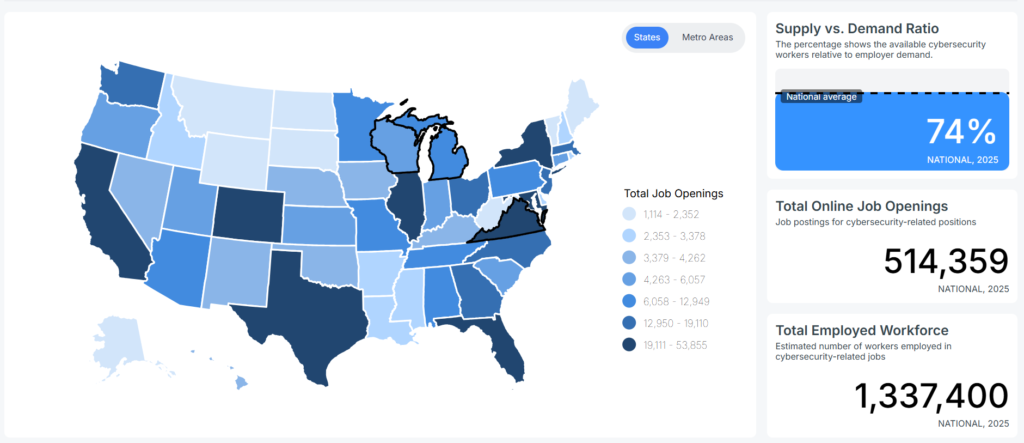
source: cyberseek.org
Two honest caveats. First, that median is not an entry-level number, and anyone showing it to you as your starting salary is selling something. Second, a workforce gap is not the same as an open door. ISC2’s 2025 Cybersecurity Workforce Study — a record 16,029 respondents — found that 33% of professionals say their organization lacks the resources to staff its security team adequately, and 36% reported budget cuts. The constraint on hiring is money, not a shortage of willing candidates. (ISC2, 2025 Cybersecurity Workforce Study, published December 2025.)
If you want the wider role-by-role picture — network security engineer, SIEM engineer, GRC analyst, and where each one hires from — we broke that down in cybersecurity jobs for IT pros.
Which is exactly why the help desk to SOC analyst route works better than the bootcamp route. You are not applying as an entry-level hire. You are applying as an experienced IT professional moving laterally — a category employers are demonstrably more willing to fund.
Your help desk time was Phase 1
The story you have been telling yourself is that the help desk is where your career stalled. Reframe it. The help desk is where you learned what normal looks like on a live network, under pressure, with a queue behind you. That is the one thing a SOC cannot teach quickly and the one thing a fresh graduate lacks.
Take the inventory. Name the threats. Write the controls. Put them on a calendar.
You are not starting from zero. You are starting from the pillar most people never get.
Ready to build the whole decision process, not just the SOC piece? The From IT to Cybersecurity program teaches the Threat & Control Method as a repeatable way to reason about any environment you are handed — which is what separates an analyst who closes alerts from one who gets promoted past them.
Want this kind of breakdown in your inbox? The Keep IT Safe newsletter goes out to IT professionals working their way into defensive security. Sign up here.

3 responses to “Help Desk to SOC Analyst: You’re Missing One Pillar, Not Three”
[…] Tip: The help desk to SOC analyst transition is faster than most people think, but only if you close the right skill gap. The gap is […]
[…] desk: Stop closing phishing tickets at “password reset.” Trace how theuser got compromised. Document the lure, the […]
[…] You want to work in a SOC and your cloud exposure is close to zero. If your background is help desk or desktop support, a detection-and-response track may be the shorter bridge. We break that route down in the help desk to SOC analyst path. […]