

The highest paying cybersecurity jobs in the U.S. sit across five categories: executive leadership (CISO and VP-level), senior security engineering, cloud and AI security, offensive security and red team operations, and enterprise cybersecurity sales. Base salaries at the senior end of technical tracks run from roughly $150,000 to well above $200,000, while sales-track roles with quota-based on-target earnings (OTE) can push total compensation past $400,000.
The Bureau of Labor Statistics pegs the occupational median for information security analysts at $124,910, a useful floor for mid-level roles. At the senior end, InfoSec Job Board’s August 2026 disclosed-pay sample found a cross-role cybersecurity median of $174,000 and a security engineering median of $260,000 among postings with disclosed compensation.
The roles covered in detail below:
- Chief Information Security Officer (CISO)
- VP of Security / Security Director
- Senior Security Engineer / Security Architect
- Cloud Security Engineer / Architect
- AI and ML Security Engineer
- Penetration Tester / Red Team Operator
- Security Operations Center (SOC) Manager
- Incident Response Lead / Threat Hunter
- Governance, Risk, and Compliance (GRC) Manager
- Application Security Engineer
- Cybersecurity Sales Engineer / Account Executive
- VP of Cybersecurity Sales / CRO
Key Takeaways
The highest paying cybersecurity jobs in the U.S. sit at the intersection of deep technical specialization, management authority, or quota-driven sales performance, and the certifications that matter most are CISSP, CISM, and OSCP depending on your target track.
| Point | Details |
|---|---|
| Top salary tiers | CISO, senior security engineering, cloud/AI security, and sales-track roles reach $150,000–$260,000 in total compensation. |
| Biggest pay lever | Years of experience and industry (finance, defense, healthcare) move pay more than any single certification. |
| Certification ROI | CISSP adds roughly $25k–$35k to median salaries; OSCP is the key credential for offensive and red team tracks. |
| Sales track ceiling | VP of Cybersecurity Sales median OTE reaches near $475k, exceeding most technical-track roles at the same seniority. |
| Blueteam-academy fit | Blueteam-academy’s Threat & Control Method curriculum maps directly to cloud security, SOC management, and incident response roles. |
Table of Contents
- The highest paying cybersecurity jobs in the U.S., ranked
- 1. Chief Information Security Officer (CISO)
- 2. VP of Security / Security Director
- 3. Senior Security Engineer / Security Architect
- 4. Cloud Security Engineer / Architect
- 5. AI and ML Security Engineer
- 6. Penetration Tester / Red Team Operator
- 7. SOC Manager
- 8. Incident Response Lead / Threat Hunter
- 9. Governance, Risk, and Compliance (GRC) Manager
- 10. Application Security Engineer
- 11. Cybersecurity Sales Engineer
- 12. VP of Cybersecurity Sales / CRO
- What actually drives the gap between cybersecurity salaries
- How to reach these roles: career ladders and certifications that pay off
- How salary bands were chosen for this article
- A practical perspective on which roles are worth targeting
- Blueteam-academy prepares you for the defensive roles that pay
- Sources
The highest paying cybersecurity jobs in the U.S., ranked
Before diving into each role, the table below gives you a side-by-side snapshot of the key dimensions. Salary figures are labeled by source and data year; “typical range” reflects senior-level disclosed-pay samples where the BLS occupational median would understate what top earners actually make.
| Role | Typical U.S. Salary Band | Exp. Required | High-Value Certs | Common Employer Types | Comp Mix |
|---|---|---|---|---|---|
| CISO | $150,000–$260,000 | 10–15 yrs | CISSP, CISM | Large regulated enterprise, federal contractor | Base + bonus + equity |
| VP of Security / Security Director | $180k–$280k | 8–12 yrs | CISSP, CISM | Enterprise, healthcare, finance | Base + bonus |
| Senior Security Engineer / Architect | $150,000–$260,000 | 6–10 yrs | CISSP, cloud certs | Cloud provider, tech company, bank | Base + equity |
| Cloud Security Engineer / Architect | $150k–$260k | 5–9 yrs | CCSP, AWS Security, CISSP | Cloud provider, SaaS company | Base + equity |
| AI / ML Security Engineer | $150,000–$260,000 | 5–9 yrs | CISSP, cloud AI certs | Tech company, AI startup | Base + equity |
| Penetration Tester / Red Team Operator | $124,910–$174,000 | 4–8 yrs | OSCP, GPEN, GXPN | Federal contractor, consulting firm | Base + bonus |
| SOC Manager | $130k–$200k | 6–10 yrs | CISSP, CISM, Security+ | MSSP, large enterprise | Base + bonus |
| Incident Response Lead / Threat Hunter | $124,910–$174,000 | 5–9 yrs | GCIH, GCFA, CISSP | Consulting, financial services | Base + bonus |
| GRC Manager | $124,910–$174,000 | 5–9 yrs | CISM, CRISC, CISSP | Finance, healthcare, government | Base + bonus |
| Application Security Engineer | $130k–$220k | 4–8 yrs | GWEB, CSSLP, OSCP | Tech company, fintech | Base + equity |
| Cybersecurity Sales Engineer | $140k–$230k OTE | 4–8 yrs | Security+, vendor certs | Security vendor, VAR | Base + commission |
| VP Cybersecurity Sales / CRO | $260,000+ OTE | 10–15 yrs | None required | Security vendor, enterprise SaaS | Base + commission + equity |
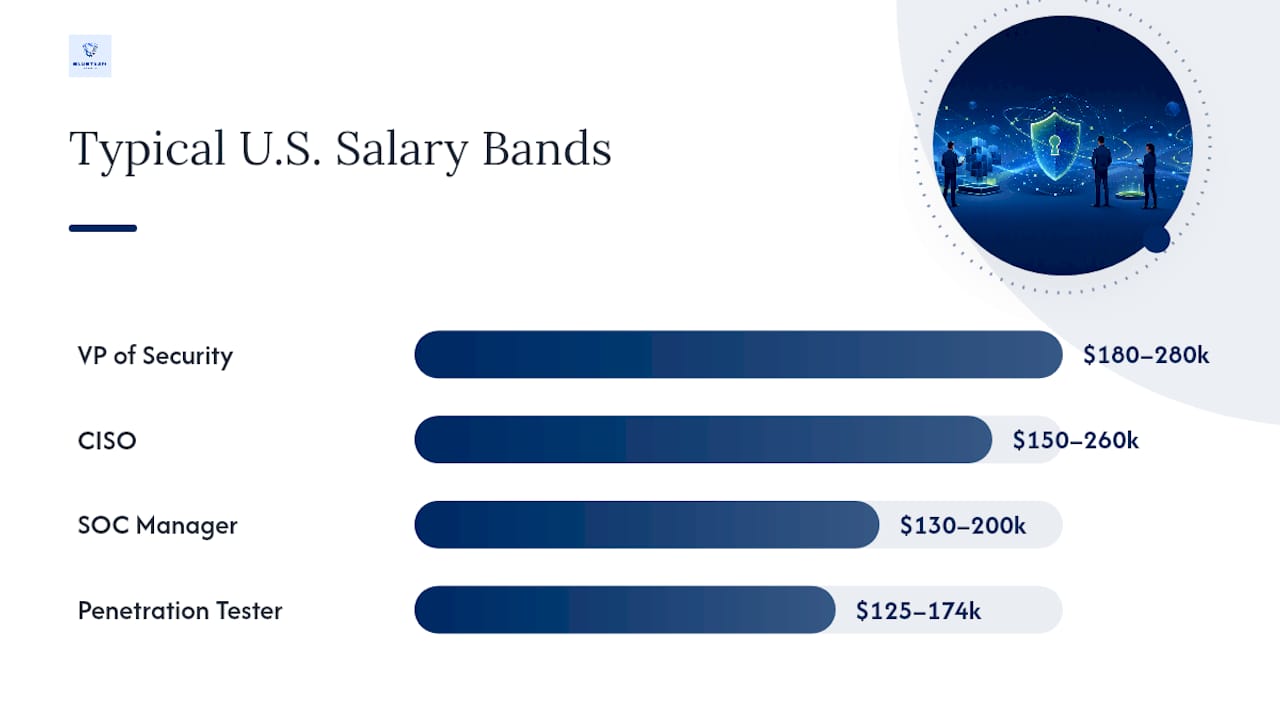
Salary ranges draw from InfoSec Job Board’s 2026 disclosed-pay sample, DecipherU’s BLS OES May 2024 analysis, and BLS OOH. Senior and executive figures include equity and bonus where those are standard; base-only figures are lower.
1. Chief Information Security Officer (CISO)
The CISO owns the organization’s entire security posture: strategy, budget, board reporting, regulatory compliance, and incident response authority. At a large regulated enterprise, that scope translates directly into compensation. DecipherU’s analysis of BLS OES May 2024 data places the CISO-proxy technical-track median near the occupational median for computer and information systems managers, with total compensation at large public companies often exceeding typical managerial levels once equity and bonuses are included.
Because no dedicated BLS occupational code exists for CISO, the BLS uses the Computer and Information Systems Managers category as the closest proxy. That occupational median understates what senior CISOs at Fortune 500 firms or regulated financial institutions earn, which is why disclosed-pay samples and executive compensation surveys tend to show higher figures.
What drives CISO pay
- Industry: Finance, healthcare, and defense pay the highest CISO premiums due to regulatory exposure (SOX, HIPAA, CMMC).
- Company size: Public companies with board-level security committees pay significantly more than mid-market firms.
- Clearance: Federal contractor CISOs with active Top Secret/SCI clearances command additional premiums.
- Certifications: CISSP and CISM are near-universal expectations. ISC2’s May 2024 certification salary data confirms certified professionals report measurably higher median salaries than non-certified peers.
2. VP of Security / Security Director
One step below CISO in most org charts, the VP of Security or Security Director typically owns a specific domain: infrastructure security, product security, or security operations. The role is often where high-performing security engineers land before moving into the CISO seat, and it pays accordingly, with typical U.S. bands running $180,000–$280,000 in base plus bonus.
The distinction between a VP of Security and a Security Director is mostly organizational. At tech companies, VP is the senior title; at banks and healthcare systems, Director often carries equivalent authority. Either way, the expectation is that you can translate technical risk into business language and defend budget decisions to a CFO.
3. Senior Security Engineer / Security Architect
Security architects design the controls that the rest of the team implements. They decide which SIEM platform gets deployed, how zero-trust segmentation maps to the network topology, and where the gaps are in the current control framework. That design authority, combined with the depth of technical knowledge required, puts senior architects among the best paying IT security jobs in the market.

InfoSec Job Board’s 2026 data shows a security engineering median of $260,000 among disclosed-pay postings, reflecting the premium the market places on senior, specialized engineers. At cloud providers and large tech firms, equity grants can push total compensation well above that figure for staff-level engineers.
Certifications that move the needle
CISSP is the most widely recognized credential for architects. Salario.io’s 2026 aggregation of BLS and market data estimates CISSP adds a meaningful salary premium to median salaries in sampled datasets. Cloud-specific credentials (AWS Certified Security Specialty, Google Professional Cloud Security Engineer) add further leverage when the role is cloud-native.
4. Cloud Security Engineer / Architect
Cloud security has become one of the fastest-growing specializations in the field, driven by the migration of enterprise workloads to AWS, Azure, and GCP. The role sits at the intersection of DevSecOps, identity and access management, and infrastructure-as-code security, which means practitioners need both security depth and platform fluency.
Typical U.S. base salaries run well into six figures at the senior level, with equity grants common at cloud providers and well-funded SaaS companies. The ISC2 October 2024 workforce study identifies cloud security as one of the areas where the talent gap is most acute, which keeps upward pressure on compensation.
The Certified Cloud Security Professional (CCSP) from ISC2 and the AWS Certified Security Specialty are the two credentials most frequently listed in senior cloud security job postings. Holding both, alongside a CISSP, positions you at the top of the candidate pool for cloud architect roles.
5. AI and ML Security Engineer
This is the newest category on the list and arguably the one with the most salary upside over the next three to five years. AI and ML security engineers protect machine learning pipelines from adversarial attacks, data poisoning, and model theft, while also securing the infrastructure that runs large language models in production.
The ISC2 October 2024 workforce study specifically flags AI-related role growth as a major opportunity within the cybersecurity workforce, noting that the talent gap in this niche is particularly wide. Compensation reflects that scarcity; senior AI security engineers at major tech companies and AI-focused startups typically see high total compensation, with equity often making up a significant share.
If you already work in infrastructure or cloud security, this is the lateral move with the highest pay ceiling right now. The skills transfer is real: network segmentation, IAM, and container security all apply directly to securing ML infrastructure.
6. Penetration Tester / Red Team Operator
Penetration testers and red team operators are the offensive side of the security house. Entry-level pen testers at consulting firms start with competitive salaries, while senior red team operators, especially those with active security clearances working on federal contracts, can command significantly higher base compensation. CyberSecJobs notes that cleared senior roles in offensive security often fall into the $200,000+ range depending on contract level and clearance tier.
The OSCP (Offensive Security Certified Professional) is the credential that separates serious candidates from the field. It is hands-on, proctored, and technically demanding, which is exactly why hiring managers trust it. For federal roles, adding a GPEN or GXPN from GIAC signals the depth that government clients expect. Veterans with existing clearances have a meaningful advantage here: NICCS resources for veterans highlight how clearance access can accelerate both hiring speed and compensation for U.S. cybersecurity roles.
7. SOC Manager
The SOC Manager runs the security operations center: shift scheduling, analyst performance, escalation procedures, tooling decisions (SIEM, SOAR, EDR), and metrics reporting to leadership. It is a management role that still requires enough technical depth to evaluate analyst work and make triage calls during a live incident.
Pay typically runs into six figures at large enterprises and managed security service providers (MSSPs). The CISSP and CISM are the standard credentials for this level; Security+ remains relevant as a baseline but rarely differentiates at the manager tier. If you are currently a senior SOC analyst or incident responder, the SOC Manager role is often the most direct path to breaking the $150,000 floor without moving into pure architecture or executive tracks.
8. Incident Response Lead / Threat Hunter
Incident response leads and threat hunters operate at the sharp end of detection and containment. Threat hunters proactively search for adversary activity that automated tools missed, using frameworks like MITRE ATT&CK to structure their hypotheses. IR leads coordinate the full lifecycle of a breach response: containment, eradication, forensic preservation, and post-incident reporting.
Both roles pay competitive salaries at senior levels, with consulting firms and financial services firms tending to be at the higher end of the range. The GCIH (GIAC Certified Incident Handler) and GCFA (GIAC Certified Forensic Analyst) are the most respected credentials in this space. CISSP adds credibility for leads who also carry management responsibility.
9. Governance, Risk, and Compliance (GRC) Manager
GRC is where cybersecurity meets business risk. GRC managers map controls to frameworks like NIST CSF, ISO 27001, and SOC 2, manage audit relationships, and translate technical risk into language that boards and regulators understand. It is less hands-on-keyboard than engineering roles, but the business impact is high and compensation tends to be strong for experienced GRC managers.
CISM from ISACA is the defining credential for this track. CRISC (Certified in Risk and Information Systems Control, also from ISACA) adds specific weight for risk-focused roles. Both signal the governance fluency that distinguishes a senior GRC professional from a compliance analyst who just fills out spreadsheets.
10. Application Security Engineer
Application security engineers embed security into the software development lifecycle: threat modeling, code review, SAST/DAST tooling integration, and developer security training. As organizations shift left on security, AppSec engineers who can work directly with development teams are in high demand.
Typical pay runs $130,000–$220,000 at senior levels, with tech companies and fintech firms at the top of the range. The CSSLP (Certified Secure Software Lifecycle Professional) from ISC2 and the GWEB (GIAC Web Application Penetration Tester) are the most relevant credentials. OSCP is increasingly listed in AppSec job postings as well, particularly for roles that include offensive testing of internal applications.
11. Cybersecurity Sales Engineer
Sales engineers are the technical half of an enterprise security sales team. They run proof-of-concept deployments, answer deep technical questions during the sales cycle, and translate product capabilities into customer-specific risk language. The role requires genuine security depth, not just product knowledge, which is why it pays well: typical OTE runs $140,000–$230,000, with base salaries in the $110,000–$150,000 range and variable compensation tied to quota attainment.
This is one of the clearest paths for technical practitioners who want to move into higher total compensation without taking on people management. The skills transfer from security engineering is direct, and the ceiling rises quickly with quota performance.
12. VP of Cybersecurity Sales / CRO
At the top of the sales track, VP of Sales and Chief Revenue Officer roles at cybersecurity vendors operate on a different compensation model entirely. DecipherU’s analysis notes that sales-track roles can exceed technical-track ceilings, with median OTEs for VP-level and above significantly higher than most technical roles. At high-growth security vendors, equity grants push total compensation further still.
Reaching this level typically requires 10–15 years of combined technical and sales experience, a track record of building and managing quota-carrying teams, and deep relationships in the enterprise security buying community. No specific certification is required, but a technical background (often including time as a security engineer or sales engineer) is nearly universal among candidates who land these roles.
What actually drives the gap between cybersecurity salaries
Understanding the pay spread between a $90,000 SOC analyst and a $250,000 security architect comes down to a handful of controllable and semi-controllable factors.
Primary pay drivers:
- Years of experience: The single largest predictor of pay within a role category. Senior-level roles (6+ years) consistently pay 40–80% more than entry-level equivalents.
- Industry: Finance, healthcare, and defense pay the highest premiums. A security engineer at a major bank or health insurer typically earns 15–25% more than the same role at a mid-market tech company…
- Security clearance: Active Top Secret or TS/SCI clearances add meaningful premiums for federal contractor and defense roles. CyberSecJobs observes that cleared senior roles in specialized niches frequently reach $200,000+.
- Metro area: San Jose, San Francisco, New York, and Washington D.C. consistently show the highest posted salaries. D.C. is particularly strong for cleared roles; the Bay Area leads for cloud and AI security.
- Company size: Large public companies and well-funded private firms pay more than mid-market employers, partly because the scope of the role is larger and partly because equity is available.
- Certification mix: CISSP, CISM, OSCP, and cloud security credentials each carry measurable premiums. ISC2’s May 2024 data confirms certified professionals report higher median salaries than non-certified peers.
- Compensation structure: Equity (RSUs or options) at tech companies and security vendors can double or triple the value of a base salary over a four-year vesting period. Sales-track OTE structures can exceed technical-track total comp at the same seniority level.
Two illustrative scenarios: A Senior Cloud Security Engineer in the Bay Area at a major cloud provider might see a base of $200,000 plus $80,000 in annual RSU grants, putting total comp near $280,000 [VERIFY]… A cleared Red Team Operator in the D.C. Same seniority level, very different paths to high compensation.
On the sales track: VP of Sales and CRO roles at cybersecurity vendors operate on quota-based OTE structures where top performers can earn $400,000–$500,000+ in total compensation. DecipherU documents median OTEs near $475,000 for VP-level sales roles, which is why the sales track is worth considering for practitioners who have strong communication skills alongside their technical background.
How to reach these roles: career ladders and certifications that pay off
The most common defensive-track ladder runs: SOC Analyst → Incident Responder → Security Engineer → Security Architect → CISO. Typical time at each stage varies, but a realistic progression looks like 1–3 years as an analyst, 2–4 years as an engineer, 3–5 years as an architect or senior engineer, and then a move into leadership. The full path from entry-level to CISO typically takes 12–18 years, though practitioners who specialize early and earn high-impact credentials often compress the middle stages.
For the offensive track: Junior Pen Tester → Penetration Tester → Senior Red Team Operator → Red Team Lead / Offensive Security Manager. OSCP is the credential that opens the door at the junior-to-mid transition; GPEN and GXPN carry weight at the senior level.
If you are currently in IT infrastructure, the transition into cybersecurity does not require starting over. Network engineers, sysadmins, and cloud engineers already hold the foundational knowledge that security roles build on. The cybersecurity career path for IT pros is shorter than most people assume once you map your existing skills to the security control framework.
Certifications ranked by salary impact
- CISSP (ISC2): The most broadly recognized senior credential. Salario.io’s 2026 data estimates a premium of roughly $25,000–$35,000 in sampled datasets. Required or strongly preferred for architect, manager, and CISO roles.
- CISM (ISACA): The governance and management counterpart to CISSP. Particularly valuable for GRC, SOC Manager, and VP-level roles. ISACA positions it as the credential for security managers who need to speak business risk.
- OSCP (Offensive Security): The hands-on offensive credential that hiring managers trust. No multiple-choice questions; you pass by compromising machines in a proctored lab. Directly tied to pay increases on the penetration testing and red team track.
- Security+ (CompTIA): The entry-level baseline. Valuable for clearing DoD 8570 requirements on federal contracts, but it does not differentiate at the senior level. Think of it as the floor, not the ceiling.
- Cloud security certs (CCSP, AWS Security Specialty, Google Professional Cloud Security Engineer): High leverage for cloud and AI security roles. Often listed as required, not just preferred, in senior cloud security job postings.
Pro Tip: The fastest way to accelerate into a senior role is not to collect more certifications — it is to own a project that demonstrates architectural decision-making. Volunteer to lead a SIEM migration, a zero-trust pilot, or a cloud security baseline review. That project becomes the story you tell in every senior interview, and it is the kind of evidence that certifications alone cannot replicate. Pair it with hands-on cybersecurity lab work to build the portfolio that backs up your narrative.
Networking and professional development beyond certifications
Certifications open doors; relationships determine which ones you walk through. The most effective networking in cybersecurity happens at SANS summits, BSides events, and sector-specific conferences like FS-ISAC for finance or HIMSS for healthcare security. LinkedIn is useful for visibility, but the conversations that lead to senior roles tend to happen in smaller, more technical communities: Discord servers, GitHub project collaborations, and local ISACA or ISC2 chapter meetings.
Mentorship is underused. Most senior practitioners are willing to spend 30 minutes a month with someone who asks specific, well-researched questions. The ask should be concrete: “I am targeting cloud security architect roles in 18 months. Can you look at my skill gap and tell me what you would prioritize?” That specificity signals you are serious and makes the conversation useful for both parties.
Lateral moves from IT into high-paying security roles
If you are coming from IT infrastructure, the lateral moves with the clearest pay upside are:
- Network engineer → Cloud Security Engineer: Your routing, firewall, and VPN knowledge maps directly to cloud network security controls. Add CCSP or AWS Security Specialty and you are competitive for mid-level cloud security roles.
- Sysadmin → Security Engineer: Active Directory, endpoint management, and patch processes are the foundation of identity security and vulnerability management. Add CISSP study and a hands-on lab environment and the transition is faster than most people expect.
- DevOps / Cloud Engineer → Application Security or AI Security Engineer: Container security, CI/CD pipeline knowledge, and infrastructure-as-code fluency are exactly what AppSec and AI security teams need. The gap is usually security-specific knowledge, not technical depth.
For a structured view of how these transitions work in practice, the cybersecurity jobs guide for IT pros maps the specific skill overlaps and the gaps worth addressing first.
How salary bands were chosen for this article
Salary figures in this article draw from four source types, each measuring something slightly different.
| Source | What It Measures | Data Period Used |
|---|---|---|
| BLS OOH / OES | Occupational median wages across all employers and seniority levels | BLS OES May 2024 |
| ISC2 Certification Salary Survey | Self-reported median salaries by certification status (global, U.S.-weighted) | May 2024 |
| InfoSec Job Board disclosed-pay sample | Median of job postings with disclosed compensation (skews senior and specialized) | August 2026 |
| DecipherU role ranking | BLS OES May 2024 for technical roles; industry benchmarks for sales roles | BLS OES May 2024 |
How to read these figures:
- BLS occupational medians cover all seniority levels and all employers, so they tend to be lower than what senior practitioners actually earn. The BLS median for information security analysts ($124,910) is a useful floor for mid-level roles, not a ceiling for senior ones.
- Disclosed-pay job-board samples skew toward senior and specialized openings because those are the roles where employers are competing hardest for talent. The InfoSec Job Board $174,000 cross-role median and $260,000 security engineering median reflect that senior-skewed sample.
- Executive and sales-track figures include equity and variable compensation where those are standard. Base-only figures for those roles are lower.
- Geographic adjustments: Bay Area and New York roles typically run 20–35% above national medians; mid-market metros run 10–20% below [VERIFY]… D.C. metro figures for cleared roles are closer to Bay Area levels for senior positions.
- CISO figures use the BLS Computer and Information Systems Managers category as a proxy because no dedicated CISO occupational code exists in the BLS taxonomy. Total compensation at large public companies frequently exceeds the occupational median due to equity and bonus structures.
- Any figure marked [VERIFY]. is an extrapolated estimate based on directional market data rather than a directly sourced statistic.
A practical perspective on which roles are worth targeting
Most salary guides present these roles as equally accessible with enough study time. That framing misses something important: the roles that pay the most are not just harder to reach technically — they require a fundamentally different kind of credibility.
A CISO at a Fortune 500 company does not get hired because they passed CISSP. They get hired because they have a track record of making defensible risk decisions under pressure, communicating those decisions to a board, and building teams that execute. The certification is table stakes. The credibility comes from the work history.
That has a practical implication for how you plan your career. If your goal is the $200,000+ tier, the most important question is not “which certification should I get next?” It is “what decision-making authority can I take on in my current role?” A security engineer who volunteers to own the vendor risk assessment process, or who leads the response to a real incident, is building the evidence base that senior hiring managers actually evaluate.
The same logic applies to offensive roles. OSCP proves you can compromise a machine in a lab. What gets you to senior red team operator is a portfolio of real engagements where you found something the client did not know about and communicated it clearly. The credential opens the door; the work closes the offer.
For practitioners coming from IT infrastructure, the transition into high-paying security roles is genuinely achievable without starting from scratch. Your existing knowledge of how systems actually work is an asset that pure security graduates often lack. The gap is usually specific security knowledge and the ability to frame what you know in security terms, not a fundamental skills deficit.
Blueteam-academy prepares you for the defensive roles that pay
The roles with the clearest path from IT infrastructure — cloud security engineer, security architect, SOC manager, incident response lead — are exactly the roles Blueteam-academy’s curriculum is built around. The self-paced courses use the Threat & Control Method, a practical decision-making framework that teaches you to assess risk and select controls the way a senior practitioner does, not just memorize concepts for a multiple-choice exam. Courses include recorded classes, templates, peer-reviewed content, generative AI enhancements, and 12 months of access, plus a student community and support channels.
If you already run infrastructure and want to map your current skills to the roles in this article, the From IT to Cybersecurity pathway is the right starting point. It shows you exactly where your existing knowledge applies and where the gaps are worth addressing first.
Sources
Bureau of Labor Statistics — Information Security Analysts (OOH)
The authoritative occupational median ($124,910, BLS OES May 2024). Use as the baseline for mid-level roles; recognize it covers all seniority levels, so senior pay runs higher.
BLS OES Profiles
Occupation-level wage tables used to proxy CISO figures via the Computer and Information Systems Managers category (BLS OES May 2024). Essential for understanding how government data approximates executive roles.
ISC2 Certification Salary Survey (May 2024)
Self-reported salary data by certification status. Best source for quantifying the CISSP and CISM premium. Global dataset with U.S. weighting.
ISC2 Workforce Study — AI Growth Opportunity (October 2024)
Documents the talent gap in AI and cloud security roles and the demand-side pressure driving compensation upward in those specializations.
InfoSec Job Board Cybersecurity Salary Report 2026
Disclosed-pay sample from live job postings (August 2026). Cross-role median of $174k and security engineering median of $260k. Best source for senior and specialized market rates.
CyberSeek
Interactive supply-and-demand data for U.S. cybersecurity roles by metro area and role type. Useful for understanding hiring volume and which roles have the most open positions. [VERIFY — data year varies by query]
DecipherU — Highest-Paying Cybersecurity Jobs 2026
Synthesizes BLS OES May 2024 with industry benchmarks. Best source for CISO-proxy technical medians (~$232k) and sales-track OTE figures (~$475k for VP-level).
Salario.io — Cybersecurity Salary 2026
Aggregates BLS figures with market data and provides certification premium estimates (CISSP: roughly $25k–$35k). Useful for certification ROI calculations.
This article is general information, not a substitute for advice from a qualified financial advisor. Consult a qualified financial professional about your own circumstances before acting on anything here.
- Bureau of Labor Statistics — Information Security Analysts (OOH)
- Cybersecurity Salary Report 2026 – Median Pay by Role, Seniority, Country & Certification | InfoSec Job Board
- ISC2 Reveals Global ISC2 Certification Salaries
- Top 12 Highest-Paying Cybersecurity Jobs 2026 ($200K+ Roles) — DecipherU
