

Cybersecurity is challenging, but it is not out of reach — and for most beginners, the biggest obstacle is not raw difficulty but a lack of a clear starting point. The field spans everything from monitoring alerts in a Security Operations Center to reverse-engineering malware, so “hard” means something different depending on which role you are aiming for. A SOC analyst role is genuinely accessible to someone with a solid IT foundation and a few months of focused study. A senior penetration tester or security architect is a different story, typically requiring years of layered experience.
Here is the short version before you read further:
- Your background matters, but it is not a barrier. Prior IT experience (help desk, sysadmin, networking) shortens the learning curve significantly. No IT background means a longer runway, not a closed door.
- Hands-on practice is the gating factor. Employers hiring for entry-level security roles consistently prioritize documented labs and real projects over coursework alone.
- Your first step options are concrete. Self-study with platforms like TryHackMe, a structured bootcamp, or a self-paced professional course like those at Blueteam-academy all work — the right one depends on your timeline and learning style.
Senior certifications like the CISSP reflect years of experience, not a beginner’s first target. Start with CompTIA Security+ or Network+ and build from there.
Table of Contents
- How hard is cybersecurity, really? Understanding the difficulty spectrum
- Is cybersecurity hard for people with no IT background?
- Core skills you need to build first
- How long does it take, and which learning path fits you?
- How to build real skills: labs, CTFs, and practice that employers notice
- Common myths beginners believe about cybersecurity
- Practical steps to take in your first 90 days
- How to choose the right training when you are ready to commit
- Key Takeaways
- The part most guides skip about getting started
- Blueteam-academy: built for IT pros making the move into security
- Useful resources to go further
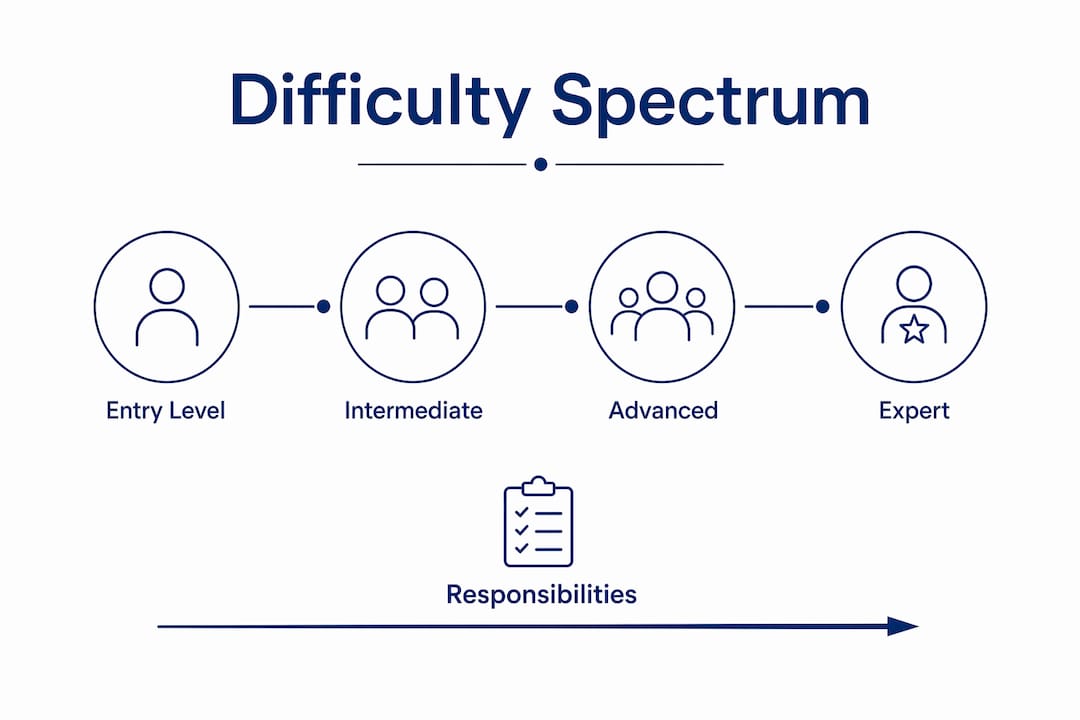
How hard is cybersecurity, really? Understanding the difficulty spectrum
“Hard” in cybersecurity means three distinct things: technical depth, pace of change, and weight of responsibility. The field evolves fast enough that even experienced professionals spend time every week learning something new. And when something goes wrong, the consequences for an organization can be severe. That combination creates real pressure.

But the spectrum of roles is wide. Many beginners make the mistake of measuring the entire field against its most demanding positions. Role choice shapes perceived difficulty more than almost any other factor — and focusing on accessible entry roles shortens time-to-job considerably.
The U.S. Bureau of Labor Statistics projects employment of information security analysts to grow 33% from 2023 to 2033, far outpacing most other occupations. That demand means employers are actively hiring people who are still building their skills, which lowers the practical barrier to entry.
| Role | Difficulty Level | Key Technical Barriers | Typical Entry Point |
|---|---|---|---|
| SOC Analyst (Tier 1) | Moderate | Log analysis, SIEM triage, alert handling | Help desk, IT support, CompTIA Security+ |
| Incident Responder | Moderate-High | Forensics, containment procedures, reporting | SOC analyst, sysadmin experience |
| Penetration Tester | High | Exploitation, scripting, network/app attack chains | CTF experience, CEH or OSCP, dev background |
| Security Architect | Very High | System design, policy, risk frameworks (NIST CSF) | 5–10 years in security or senior IT roles |
The SOC analyst path is where most beginners realistically start. It requires networking fundamentals, familiarity with a SIEM platform, and the ability to triage alerts methodically. That is a learnable skill set, not a gatekept specialty.
Is cybersecurity hard for people with no IT background?
The honest answer: yes, it takes longer without an IT foundation, but it is still achievable. The field has a genuine technical floor. You need to understand how networks communicate, how operating systems manage files and processes, and how to navigate a command line before security concepts will make sense. Trying to skip that foundation is where most non-technical beginners stall.
The baseline concepts that matter most early on:
- Basic networking: TCP/IP, DNS, DHCP, subnetting, and how packets move between systems
- Operating systems: Windows file structure, Active Directory basics, and Linux command-line navigation
- Logical problem-solving: Reading logs, tracing an event sequence, spotting anomalies
- Command line: Bash for Linux, PowerShell for Windows — not scripting yet, just navigation and basic commands
What works in your favor if you are coming from outside IT is that cybersecurity rewards analytical thinking, curiosity, and attention to detail more than raw memorization. People from backgrounds in law enforcement, accounting, healthcare administration, and even journalism have made the transition successfully because those fields build investigative habits that transfer directly to threat analysis.
Pro Tip: The lowest-friction path into security for a non-IT beginner is the help desk → sysadmin → junior security analyst progression. Each step builds the technical vocabulary and system familiarity that makes the next one easier. Trying to jump straight to a security role from zero IT experience adds additional time to your realistic timeline.

For IT professionals already working in support or infrastructure, the transition to cybersecurity is much shorter. Ticketing, triage, and admin work map directly to security tasks — you are already doing parts of the job.
Core skills you need to build first
Getting job-ready in cybersecurity does not require mastering everything at once. It requires building a specific stack of fundamentals in the right order. Here is what to prioritize:
Technical fundamentals
- TCP/IP and networking protocols: You need to read a packet capture and understand what normal traffic looks like before you can spot abnormal traffic.
- Linux command line: Most security tools run on Linux. Navigating directories, reading logs with
grep, and managing permissions are non-negotiable basics. - Windows internals: Active Directory, the Windows Registry, and Windows Event Logs are central to most enterprise environments and most SOC investigations.
- Basic scripting: Python and Bash are the two most useful starting points. You do not need to write complex programs — you need to automate repetitive tasks and parse log data.
Security-specific concepts
- Authentication and authorization: Understand the difference, and understand how both get abused (credential stuffing, privilege escalation).
- Common vulnerabilities: The OWASP Top 10 is a practical starting framework for web application risks.
- Logging and monitoring: Familiarity with SIEM platforms and IDS tools accelerates entry into SOC roles faster than almost any other single skill.
- Incident triage basics: How to categorize an alert, escalate appropriately, and document findings clearly.
Soft skills that hiring managers notice
- Written communication: Incident reports and escalation notes need to be clear and precise. Poor writing is a real liability in a SOC environment.
- Collaborative mindset: Security teams work closely with IT, legal, and leadership. Knowing how to communicate across those groups matters.
- Investigative patience: The ability to follow a thread through dozens of log lines without jumping to conclusions separates good analysts from reactive ones.
Pro Tip: Build a simple tracking spreadsheet with these skill areas as rows. Rate yourself honestly from 1–5 each month. Progress feels slow until you look back at where you started — and that visible movement keeps you going through the harder stretches.
A practical curriculum sequence that produces job-ready junior analysts runs: basic networking → Linux fundamentals → logging and monitoring → incident triage labs → documented incident reports. That sequence is the backbone of Blueteam-academy’s training approach and reflects how real SOC onboarding works.
How long does it take, and which learning path fits you?
Getting to your first security job typically takes a variable amount of time, depending on your starting point and the path you choose. That range is wide because the paths are genuinely different in pace, cost, and outcome.
| Learning Path | Estimated Time | Typical Cost | Likely First Job Title |
|---|---|---|---|
| Self-study + projects | a year or more | — | SOC Analyst, IT Security Specialist |
| Bootcamp / apprenticeship | several months | — | Junior Security Analyst, SOC Tier 1 |
| Bachelor’s degree | multiple years | — | Security Analyst, Security Engineer |
| Certification-first route | several months | — | SOC Analyst, Compliance Analyst |
Each path has real trade-offs. Self-study is the most affordable but requires the most self-discipline and produces results only when paired with consistent hands-on practice. Bootcamps compress the timeline but vary widely in quality — curriculum depth and instructor expertise matter more than the brand name. A bachelor’s degree opens doors at larger organizations and federal agencies, but the BLS data on educational attainment shows that many security analysts enter the field without a four-year degree. Certifications work well as a structured on-ramp, especially when paired with lab work.
For most IT professionals making a lateral move into security, the certification-first route combined with self-paced professional training is the fastest path to a job offer. The cybersecurity career path for IT pros typically looks like this:
- CompTIA Network+ (if networking fundamentals need strengthening)
- CompTIA Security+ (the standard entry-level credential most employers recognize)
- Role-specific certs after your first job: CySA+ for analysts, CEH or OSCP for those moving toward offensive work, CISSP for senior roles after years of experience
Structured training programs break complex topics into manageable lessons that speed up readiness — the key is choosing one with hands-on labs, not just video lectures.
How to build real skills: labs, CTFs, and practice that employers notice
Hands-on practice is what separates a candidate who gets interviews from one who does not. Employers hiring for junior roles want to see that you have actually done the work, not just watched someone else do it.
The most effective practice methods, in order of hiring impact:
- Virtual labs: Platforms like TryHackMe offer guided, browser-based lab environments where you practice real tasks (log analysis, network scanning, incident response) without needing expensive hardware. Start here.
- Capture The Flag (CTF) challenges: CTFs are structured puzzles that simulate real attack and defense scenarios. They build problem-solving speed and teach you to think like both an attacker and a defender. HackThisSite is a well-known beginner-friendly option.
- Home lab: A modest setup — two virtual machines running on a laptop — lets you simulate a small network, generate your own logs, and practice detection. The act of building it teaches as much as using it.
- GitHub documentation: Every lab you complete should produce a short writeup: what you did, what you found, and what you would do differently. A public GitHub repo with reproducible steps is one of the strongest hiring signals for junior roles.
- Internships and volunteer work: Real-world exposure, even unpaid, accelerates learning faster than any platform because it introduces the noise, ambiguity, and communication demands of an actual security environment.
Pro Tip: Structure your weekly practice in timeboxed blocks: 45 minutes of lab work, then 15 minutes writing up what you learned. That documentation habit builds your portfolio automatically and forces you to consolidate what you actually understood versus what you just clicked through.
The practical hiring signal checklist for junior roles looks like this: three documented labs, one group CTF writeup, a GitHub repo with reproducible steps, and a short incident-response writeup. Those four items, presented clearly, carry more weight than a transcript.
Common myths beginners believe about cybersecurity
A few persistent misconceptions send beginners down the wrong path or stop them from starting at all.
Myth: You need to be a math genius.
Reality: Most entry-level and mid-level roles require no advanced math. Cryptography and security research roles do involve mathematics, but SOC analysis, incident response, and compliance work do not. Logical reasoning matters far more than calculus.
Myth: AI will replace entry-level security jobs.
Reality: AI tools like SIEM automation and anomaly detection are augmenting analysts, not replacing them. Threat context, escalation judgment, and stakeholder communication remain genuinely hard to automate. The analysts who learn to use AI tools effectively will be more productive, not redundant. The MITRE ATT&CK framework, along with similar structured knowledge bases, is increasingly integrated into AI-assisted triage, but a human still interprets the output.
Myth: You will earn $200,000 straight out of training.
Reality: The BLS reports a median annual wage of $120,360 for information security analysts. Entry-level SOC roles typically start lower, in the $55,000–$75,000 range depending on location and employer. Compensation grows quickly with experience and specialization, but the starting point is realistic, not spectacular.
Myth: You need a computer science degree.
Reality: Many working security professionals entered through IT support, networking, or self-study. Certifications and demonstrable projects carry significant weight with hiring managers, particularly at the entry level.
Myth: Cybersecurity is only for people who can code.
Reality: Scripting helps, but many analyst and compliance roles require minimal coding. The ability to read and understand code matters more than the ability to write it from scratch at the junior level.
Practical steps to take in your first 90 days
Getting started is the hardest part. Here is a concrete, ordered plan for your first three months:
- Week 1: Assess your baseline. Take a free networking fundamentals quiz (Professor Messer’s CompTIA resources are a solid benchmark). Identify your biggest gaps in TCP/IP, Linux, and Windows.
- Week 2–3: Fill the networking gap. Work through a structured networking course. You need to understand subnetting, DNS, and how a packet travels before security concepts will stick.
- Week 4: Set up a home lab. Install VirtualBox or VMware Workstation Player (both free), spin up a Kali Linux VM and a Windows VM, and connect them on a host-only network.
- Month 1–2: Start TryHackMe’s beginner path. Complete at least three rooms per week. Document every room in a short GitHub writeup — what the task was, what you found, and what command or technique you used.
- Month 2: Register for CompTIA Security+. Begin studying with Professor Messer’s free video series or a structured course. Set a test date 8–10 weeks out to create a deadline.
- Month 2–3: Complete your first CTF. Join a beginner CTF event and write up your experience, even if you only solve one challenge. The writeup matters more than the score.
- Month 3: Build one incident-response scenario. Using your home lab, simulate a basic attack (a failed login attempt, a suspicious process), generate the logs, and write a one-page incident report as if you were reporting to a manager.
- Month 3: Update your LinkedIn and resume. Add your lab work, your Security+ study progress, and your GitHub repo. Recruiters search for these signals actively.
- Throughout: Join a community. Reddit’s r/cybersecurity and r/netsec, Discord servers tied to TryHackMe, and local ISSA chapter events all provide mentorship and job leads that accelerate your timeline.
- End of month 3: Apply for one role. Even if you feel unready. The interview feedback alone will tell you exactly where to focus next.
Pro Tip: When presenting lab work in an interview, lead with the problem you were solving, not the tool you used. “I set up a detection rule in Splunk to catch lateral movement attempts” is more compelling than “I used Splunk.” Employers are hiring for judgment, not just tool familiarity.
How to choose the right training when you are ready to commit
The single most important criterion when evaluating a cybersecurity course is whether it includes hands-on labs tied to measurable outcomes. Video-only courses produce passive learners. Courses that pair instruction with real lab environments, peer or instructor review, and documented projects produce candidates who can actually do the job.
Six criteria worth evaluating before you pay for any training:
| Criterion | What to Look For |
|---|---|
| Hands-on labs | Real lab environments, not just simulations or demos |
| Instructor expertise | Active practitioners, not just academics |
| Peer or instructor review | Feedback loops on your actual work, not just auto-graded quizzes |
| Job outcome alignment | Curriculum maps to real SOC or analyst tasks |
| Time to completion | Realistic for your schedule — self-paced beats fixed cohorts for working professionals |
| Cost and access period | One-time fee with extended access beats monthly subscriptions for most learners |
When choosing between self-study, a bootcamp, and a self-paced professional course, the decision usually comes down to accountability and structure. Self-study works if you are highly disciplined. Bootcamps work if you need a cohort and a deadline. A self-paced professional course with instructor-reviewed projects sits between the two: structured curriculum, flexible schedule, and real feedback.
For IT professionals ready to make a deliberate move into defensive security, Blueteam-academy’s courses overview is worth a close look as a structured, career-focused next step.
Key Takeaways
Cybersecurity is genuinely challenging but accessible to beginners who choose the right entry role, build hands-on skills consistently, and follow a structured learning path.
| Point | Details |
|---|---|
| Role choice determines difficulty | SOC analyst roles are accessible within a moderate timeframe; senior roles like security architect require years of layered experience. |
| Hands-on practice is the hiring signal | Documented labs, CTF writeups, and a GitHub repo carry more weight with employers than coursework alone. |
| IT background shortens the runway | Help desk and sysadmin experience maps directly to security tasks, reducing the learning curve significantly. |
| Certifications provide structure | CompTIA Security+ is the standard first credential; pair it with lab work for the strongest entry-level candidacy. |
| Blueteam-academy for IT pros | Blueteam-academy offers self-paced, peer-reviewed training with hands-on labs and the Threat & Control Method for IT professionals moving into defensive security. |
The part most guides skip about getting started
Most articles about learning cybersecurity focus on what to study. Few talk about the emotional reality of the early months: the feeling that everyone else already knows what they are doing, the frustration of a lab that will not cooperate, the doubt that creeps in when a concept does not click the first time. That experience is normal. It is not a signal that you are wrong for the field.
The students who make it through that period share one habit: they document everything, even the failures. A writeup that says “I tried this, it did not work, here is what I learned” is not a sign of weakness in an interview. It is evidence of exactly the investigative mindset security teams need. Struggle is part of the process, not a detour around it.
Three things worth holding onto as you start:
- Progress in cybersecurity is nonlinear. You will plateau, then suddenly understand three things at once.
- The community is genuinely helpful. Ask questions publicly — on Discord, Reddit, or in a course forum.
- Your first job does not need to be your dream job. It needs to be the role that gives you the experience to get the next one.
Blueteam-academy: built for IT pros making the move into security
Spending months watching video courses and still feeling unprepared for a security interview is a common frustration. Blueteam-academy is designed specifically for IT professionals who want a faster, more direct route into defensive security roles — without the guesswork of piecing together a curriculum from scattered free resources.

The training is self-paced with 12 months of access, so it fits around a full-time job. Every course is built around the Threat & Control Method, a practical decision-making framework that maps directly to real SOC tasks. Content is peer-reviewed and enhanced with generative AI support, and the curriculum pairs recorded instruction with hands-on labs that produce the documented project evidence employers actually want to see.
If you are an IT professional ready to invest in a structured, career-focused path into cybersecurity, browse the available online courses and find the program that fits where you are right now.
Useful resources to go further
Practice platforms and labs
- TryHackMe — Beginner-friendly, browser-based labs covering SOC, networking, and incident response. Best starting point for hands-on practice.
- HackThisSite — Free, legal CTF challenges for beginners building offensive and defensive skills.
- OWASP WebGoat — Deliberately vulnerable web application for learning web security concepts in a safe environment.
Learning and certifications
- CompTIA Security+ — The standard entry-level certification recognized by most U.S. employers. Start here after networking fundamentals.
- CompTIA Network+ — Recommended first if your networking knowledge has gaps.
- Blueteam-academy courses — Self-paced, peer-reviewed training with hands-on labs for IT pros moving into defensive security. Best for: IT professionals with 1–3 years of experience.
- Blueteam-academy online courses — Browse available programs by topic and skill level.
- Coursera: Is Cybersecurity Hard? — Practical overview of learning paths and skill requirements for beginners.
Career outlook and further reading
- BLS: Information Security Analysts — Official U.S. job outlook, median salary, and education data.
- CyberSeek Heat Map — Interactive map of U.S. cybersecurity job demand by region and role type. Useful for targeting your job search geographically.
- Blueteam-academy: Cybersecurity Career Path Guide — Role progression and realistic timelines for IT professionals transitioning into security.
- Blueteam-academy: From IT to Cybersecurity — Specific pathways and transition advice for IT professionals.

2 responses to “Is Cybersecurity Hard? An Honest Guide for Beginners”
[…] you are still mapping out whether this field is for you at all, our honest guide to whether cybersecurity is hard and our roadmap for career changers are good starting points before you dive into […]
[…] you’re still deciding whether this career shift is realistic given your current role, the honest case for whether cybersecurity is hard to break into is worth a look before you commit hours to any of these three […]