

The NIST Cybersecurity Framework (CSF) is a voluntary, outcome-focused taxonomy that organizes cybersecurity activities into six Functions: Govern, Identify, Protect, Detect, Respond, and Recover. Your immediate next step is to pick one critical system, map its existing controls to those six Functions, and document a Current Profile alongside a Target Profile showing your desired outcomes. That gap then forms your prioritized work queue.
Pro Tip: Get governance sign-off on the Target Profile before you build it. Without executive alignment, the gap analysis becomes a technical wish list nobody funds.
Key Takeaways
The NIST Cybersecurity Framework 2.0 is an outcome-focused taxonomy of six Functions that organizations use to describe current and target cybersecurity posture, prioritize risk-based actions, and communicate risk across technical and executive audiences.
| Point | Details |
|---|---|
| Six Functions structure the Core | Govern, Identify, Protect, Detect, Respond, and Recover organize outcomes from policy to recovery. |
| Govern is the CSF 2.0 priority | The new Govern Function ties policy, roles, and enterprise risk management together; establish it early before prioritizing other gaps. |
| Profiles drive prioritization | Document a Current and Target Profile for one critical system to generate a concrete, funded work queue. |
| Tiers describe rigor, not score | Use Tiers to characterize governance honestly; a Tier 2 program with strong execution beats a Tier 4 on paper. |
| Blueteam-academy builds execution skills | Practitioner-level courses cover CSF control mapping, tabletop design, and detection tuning for IT professionals moving into security roles. |
Table of Contents
- What is the NIST Cybersecurity Framework and why does it matter?
- How the CSF Core functions and categories work together
- How Organizational Profiles and Tiers describe your posture
- What changed in CSF 2.0 and what you need to do about it
- A practical quick-start plan for implementing the CSF
- Where to find authoritative NIST resources and mappings
- How training accelerates CSF adoption across your team
- Common misconceptions about the NIST CSF
- How different organizations tailor CSF implementation
- What the CSF gets right and where it has limits
- Continuous monitoring and improvement within the CSF
- How the CSF aligns with ISO 27001, HIPAA, and other standards
- The part of CSF 2.0 most teams are still getting wrong
- Blueteam-academy closes the gap between CSF knowledge and CSF execution
- Sources
What is the NIST Cybersecurity Framework and why does it matter?
The CSF is not a control checklist. NIST is explicit that the framework is a common language for communicating cybersecurity risk between technical teams and executives, not a vendor shopping list. That distinction changes how you use it: you describe outcomes your program achieves, then map controls to those outcomes, rather than ticking boxes.
Three audiences get the most value from the CSF:
- Executives and board members who need a risk narrative they can act on without reading SP 800-53
- Security managers and program leads who use it to prioritize investments and communicate gaps to leadership
- Supply-chain and procurement teams who use it to assess vendor posture and set contractual expectations
The CSF is deliberately sector-, country-, and technology-neutral, which means a hospital, a utility, and a fintech startup can all use the same structure. Its three components are the Core (the outcome taxonomy), Organizational Profiles (current and target posture), and Tiers (characterization of governance rigor).
How the CSF Core functions and categories work together
The SP 1299 Resource & Overview Guide describes the Core hierarchy as Functions → Categories → Subcategories. Functions are the broadest groupings; Categories are outcome areas within each Function; Subcategories are specific, measurable outcomes. Controls from SP 800-53 or ISO 27001 map to Subcategories, giving you a bridge from high-level language to technical implementation.
| Function | Example activities |
|---|---|
| Govern | Define cybersecurity roles and responsibilities; integrate cyber risk into enterprise risk management (ERM) |
| Identify | Maintain an asset inventory; conduct a business impact analysis for critical systems |
| Protect | Enforce least-privilege access; deploy endpoint detection and patch management |
| Detect | Configure SIEM alerting for anomalous behavior; run continuous vulnerability scanning |
| Respond | Execute and document an incident response plan; communicate with stakeholders during an event |
| Recover | Test backup restoration; conduct post-incident reviews and update playbooks |
The outcomes matter more than the tools. Two organizations can both satisfy the Detect Function using completely different toolsets, as long as each can demonstrate the outcome: anomalies are detected and analyzed.
Pro Tip: When mapping controls to Subcategories, document your rationale. Auditors and supply-chain partners will ask why a Subcategory is marked “achieved,” and a one-line justification saves hours of back-and-forth.
How Organizational Profiles and Tiers describe your posture
A Current Profile is a snapshot of the outcomes your program achieves today. A Target Profile describes the outcomes you need to achieve given your risk appetite, regulatory obligations, and business priorities. The gap between them is your roadmap.
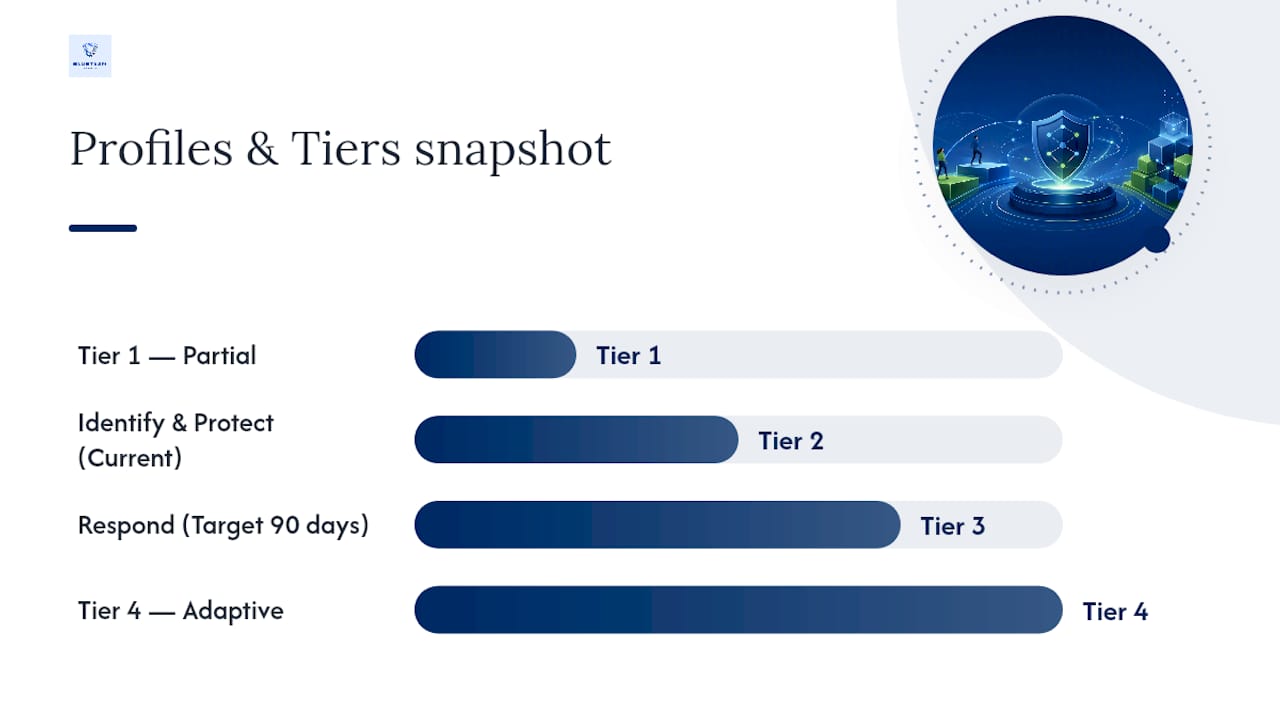
NIST’s CSF 2.0 document explains that Profiles and Tiers are distinct mechanisms: Profiles describe what outcomes you achieve; Tiers characterize how rigorously you govern and manage risk. Tiers run from Tier 1 (Partial, ad hoc) through Tier 4 (Adaptive, continuously improving). They are not a maturity score to maximize; they are a way to describe your current governance rigor honestly and set a realistic target.
Practical uses for Profiles and Tiers:
- Prioritization: Focus remediation budget on the highest-impact gaps between Current and Target Profiles
- Supplier assessment: Ask vendors to self-report their Current Profile against your required Target Profile
- Board reporting: Use Tier characterization to explain governance posture without technical jargon
- Regulatory alignment: Map Target Profile outcomes to HIPAA, CMMC, or state privacy requirements
Worked example: A payment processing system currently achieves Identify and Protect outcomes at Tier 2 but has no documented Respond playbook (gap in Respond). The Target Profile requires Tier 3 Respond outcomes within 90 days, owned by the incident response lead.
What changed in CSF 2.0 and what you need to do about it
NIST CSRC announced CSF 2.0 in 2024 with a clear focus on governance and enterprise risk integration. The practical changes for your program:
- New Govern Function: Cybersecurity policy, roles, risk tolerance, and supply-chain risk management now have their own Function. Implication: If you have no documented risk tolerance statement or RACI for cybersecurity decisions, that is now a visible gap in your Core.
- Stronger ERM alignment: The framework explicitly ties cybersecurity risk to enterprise risk registers. Implication: Your CISO or security lead should be presenting CSF-based risk findings at the same table as financial and operational risk.
- Workforce emphasis: People and skills are treated as a risk factor, not an afterthought. Implication: Workforce capability gaps belong in your Current Profile.
- Supply-chain risk management (C-SCRM): Supplier cybersecurity posture is now a first-class concern. Implication: Build a supplier assessment template based on CSF outcomes and include it in procurement contracts.
- Clarifications and mappings: NIST added Quick-Start Guides and community profiles to reduce the barrier to entry for smaller organizations.
The NIST CSF FAQs confirm the framework remains non-prescriptive: CSF 2.0 tells you what outcomes to achieve, never how to achieve them.
A practical quick-start plan for implementing the CSF
Start small, get governance buy-in, and expand scope deliberately.
- Days 1–30: Secure executive sign-off on the CSF adoption. Identify one high-value system (e.g., your payment processor or EHR platform) as the pilot scope. Document a Current Profile for that system by walking the six Functions and noting which outcomes you can demonstrate today.
- Days 31–90: Build the Target Profile for the pilot system with input from the system owner and risk management. Prioritize the top three gaps by business impact. Map existing controls to CSF Subcategories using SP 800-53 references; document justifications.
- Days 91–180: Implement prioritized controls for the pilot. Run a tabletop exercise against the Respond and Recover Functions. Expand scope to the next two or three critical systems. Present Tier characterization and gap status to leadership.
Mini Current→Target Profile template fields: Asset name | Business impact rating | Current outcomes achieved (by Function) | Target outcomes required | Priority (High/Medium/Low) | Owner | Target date
Pro Tip: Use NIST’s Quick-Start Guides (SP 1308) for your first pilot rather than the full CSF document. They are designed for exactly this: a scoped, manageable first pass before you tackle enterprise-wide rollout.
Where to find authoritative NIST resources and mappings
NIST publishes Quick-Start Guides and community profiles to translate CSF outcomes into implementation steps for specific use cases. The NIST CSF page links to all of them, including SP 1308 (the small business Quick-Start Guide) and IR 8374, the Ransomware Community Profile that maps CSF outcomes to ransomware-specific controls.
For control mappings, SP 800-53 Revision 5 is the primary reference. Each CSF Subcategory links to one or more SP 800-53 controls, giving you evidence-ready documentation for audits. The workflow is: CSF outcome → Subcategory → SP 800-53 control reference → implementation evidence.
Community profiles function as sector-specific Target Profiles. If your organization operates in healthcare, financial services, or critical infrastructure, check whether a relevant community profile exists before building your Target Profile from scratch.
How training accelerates CSF adoption across your team
The Govern Function makes one thing unavoidable: CSF adoption requires capability at every level, not just the security team. Different roles need different preparation.
- Executives: Governance and risk communication; how to read a Profile gap report and connect it to ERM
- Security managers: Program orchestration, prioritization against business impact, supplier risk checklists
- Practitioners: Control mapping workshops, detection rule tuning aligned to Detect Subcategories, incident response tabletop design
Specific module topics that close real implementation gaps include CSF mapping workshops (walking Subcategories against your control inventory), tabletop design for Respond and Recover Functions, SIEM rule tuning tied to Detect outcomes, and supplier risk assessment using CSF outcomes as evaluation criteria.
If you are building this capability from the IT side, the transition from IT to cybersecurity path at Blueteam-academy covers the practical decision-making skills that make CSF mapping work in practice, not just on paper. Cybersecurity awareness training also maps directly to the Govern and Protect Functions, particularly the workforce-related Subcategories CSF 2.0 elevated.
Common misconceptions about the NIST CSF
“CSF is only for large enterprises.” NIST designed the framework to scale. SP 1308 and the small business Quick-Start Guide exist specifically for organizations without a dedicated security team. A small business can implement a meaningful Current Profile covering just Identify and Protect in a single afternoon.
“CSF compliance means you are secure.” The CSF describes outcomes; it does not certify security. Achieving a Target Profile reduces documented risk, but no framework eliminates it. Treat the CSF as a continuous management tool, not a finish line.
“Tiers are a maturity score.” Tiers characterize governance rigor, not security effectiveness. A Tier 2 organization with well-implemented controls may carry less actual risk than a Tier 4 organization with poor execution. Use Tiers to describe where you are, not to compete.
“You need to implement all six Functions at once.” NIST’s own design principles stress modularity. Start with the Functions most relevant to your highest-risk systems and expand from there.
How different organizations tailor CSF implementation
A small business with five employees and no security staff can start with the Quick-Start Guide, focus on Identify (asset inventory) and Protect (MFA, patching), and document a two-page Current Profile. The Govern Function is addressed by a one-page risk tolerance statement signed by the owner.
A mid-size manufacturer with OT/IT convergence uses the CSF to bridge the gap between its IT security team and plant operations. The Identify Function covers both IT assets and industrial control systems; the Detect Function maps to both SIEM and OT monitoring tools. Supply-chain risk management under Govern addresses third-party maintenance vendors with remote access.
A large enterprise in financial services uses the CSF as the common language across 12 business units with different control frameworks. Each unit maintains its own Current and Target Profile; the enterprise security team aggregates them into a board-level risk dashboard. SP 800-53 mappings provide the audit trail regulators expect.
What the CSF gets right and where it has limits
Benefits: The CSF gives security teams a shared vocabulary with executives, which is the single biggest barrier to getting security investments approved. It scales from a five-person shop to a Fortune 500. It maps to ISO 27001, HIPAA, CMMC, and PCI-DSS, reducing duplication when you operate under multiple frameworks. And because it is outcome-focused, it does not become obsolete when your technology stack changes.
Limitations: The CSF does not tell you how to achieve outcomes, which means less experienced teams can produce a Target Profile that looks complete but lacks implementation depth. Mapping controls to Subcategories is subjective and requires organizational context; two teams can map the same control differently. The framework also does not prioritize for you: a 200-Subcategory gap analysis is still a gap analysis, and without business-impact weighting, it can feel paralyzing.
The practical fix for both limitations is training and governance involvement. When practitioners understand why a Subcategory matters and executives understand what the gap costs the business, prioritization becomes a conversation rather than a stalemate.
Continuous monitoring and improvement within the CSF
The CSF is not a one-time exercise. Treat your Current Profile as a living document that updates when your environment changes: new systems, new vendors, new threat intelligence, or new regulatory requirements all trigger a profile review.
Practical habits that keep the CSF useful over time:
- Quarterly gap reviews: Compare Current Profile against Target Profile and update priority ratings based on new threat data or business changes
- Tabletop exercises: Run Respond and Recover scenarios at least twice a year; document gaps and update the relevant Subcategories
- Supplier reassessments: Require annual self-reported CSF profiles from critical vendors; flag deviations from your required Target Profile
- Threat intelligence integration: When a new threat campaign emerges (ransomware, supply-chain compromise), check which Detect and Protect Subcategories it targets and verify your coverage
Continuous improvement does not require a full re-implementation. It requires a disciplined habit of comparing where you are against where you said you needed to be.
How the CSF aligns with ISO 27001, HIPAA, and other standards
The CSF is designed to complement, not replace, other frameworks. NIST publishes informative reference mappings that show which CSF Subcategories correspond to ISO 27001 controls, SP 800-53 controls, and COBIT practices. If you are already ISO 27001 certified, your existing controls likely satisfy a significant portion of CSF Subcategories; the mapping exercise tells you exactly which ones.
For HIPAA-covered entities, the Protect and Detect Functions map closely to the HIPAA Security Rule’s technical and administrative safeguards. Using the CSF as an organizing layer lets you present HIPAA compliance evidence in a format that also satisfies supply-chain partners who require CSF alignment.
CMMC (Cybersecurity Maturity Model Certification) for defense contractors draws heavily from SP 800-171, which itself maps to SP 800-53 and therefore to CSF Subcategories. If you are pursuing CMMC Level 2, building your CSF Target Profile around the relevant SP 800-171 controls gives you dual-purpose documentation.
The practical value of cross-framework alignment is reduced audit fatigue. One well-documented CSF implementation, with SP 800-53 control references, can satisfy multiple regulatory inquiries without rebuilding your evidence package from scratch each time.
The part of CSF 2.0 most teams are still getting wrong
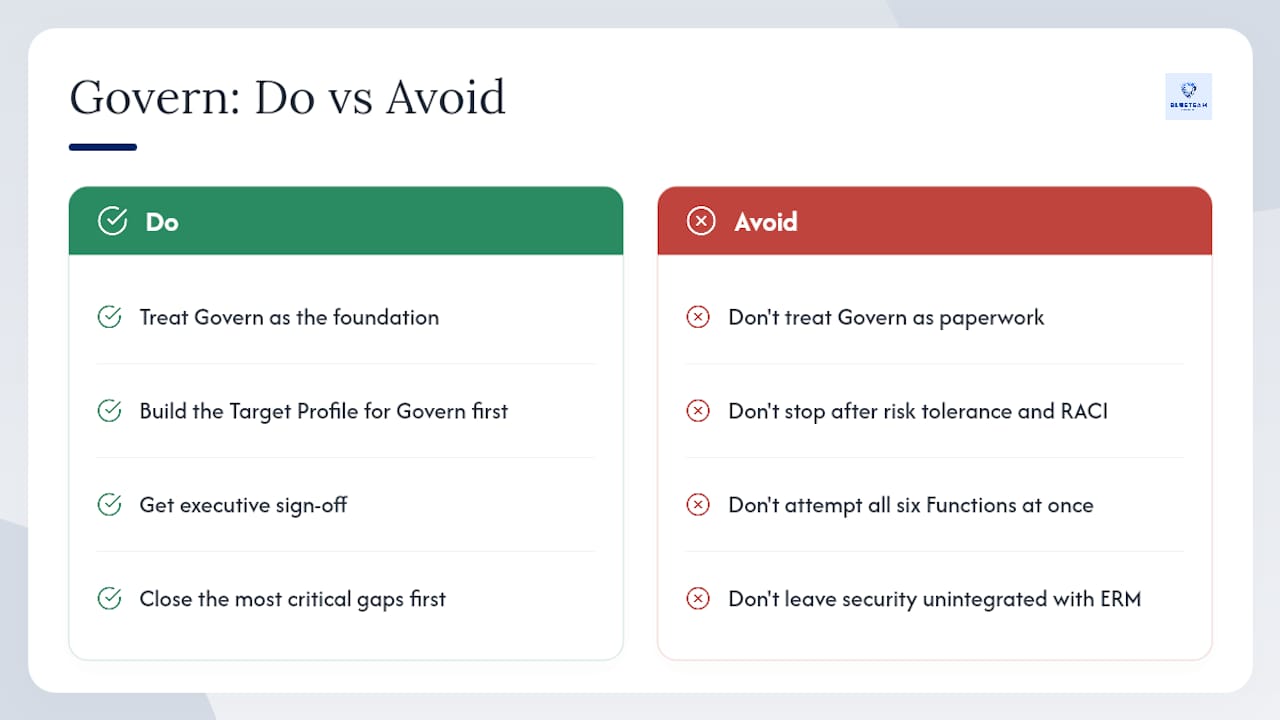
The Govern Function is the most consequential addition in CSF 2.0, and most teams are treating it as an administrative formality. They write a risk tolerance statement, assign a RACI, and move on. That misses the point.
Govern is what makes the other five Functions coherent. Without a documented risk tolerance, your Protect priorities are arbitrary. Without clear ownership, your Respond playbooks have no one accountable at 2 AM. Without ERM integration, your security investments compete for budget against every other operational priority with no shared language to make the case.
The teams that get the most out of CSF 2.0 are the ones that treat Govern as the foundation, not the paperwork. They build the Target Profile for Govern first, get executive sign-off, and then use that signed document as the authority for every prioritization decision that follows. That sequence turns the CSF from a technical exercise into a governance instrument, which is exactly what NIST designed it to be.
The other common mistake is scope creep on the first implementation. Attempting all six Functions across the entire enterprise simultaneously produces a gap analysis so large it stalls. Start with one system, close the most critical gaps, and use that success to build organizational confidence before expanding. NIST’s own Quick-Start Guides are built around this principle.
Blueteam-academy closes the gap between CSF knowledge and CSF execution
Understanding the framework is one thing. Knowing how to map controls to Subcategories, run a credible tabletop, or present a Profile gap to a board requires practiced skill. Blueteam-academy’s self-paced cybersecurity courses are built for IT professionals who already run infrastructure and need to operate at the security layer, covering exactly the practitioner skills the CSF’s Govern, Detect, Respond, and Recover Functions demand. The curriculum includes the Threat and Control Method, a practical decision-making framework that maps directly to how you prioritize CSF gaps by business impact. Browse the full course catalog at Blueteam-academy and enroll in the path that matches your role.
Sources
Every resource below is the primary NIST location for the document or topic it covers.
- Cybersecurity Framework | NIST
- NIST Cybersecurity Framework 2.0: Resource & Overview Guide
- The NIST CSF 2.0 is here | NIST CSRC

2 responses to “NIST CSF Explained: A Practical Guide to CSF 2.0”
[…] to reach and never how to reach it. We covered its Core, Profiles, and Tiers in depth in our practical guide to CSF 2.0, so this post stays on the […]
[…] One honesty note before the table. You’ll often see the Target breach described as a failure to follow the NIST Cybersecurity Framework. That’s anachronistic: NIST released version 1.0 of the framework in February 2014, two months after the breach. The fairer question is: if a security team ran into this same situation today, which controls would it reach for? That’s what this table answers, using NIST SP 800-53 Rev. 5 and NIST CSF 2.0. For a primer on how CSF 2.0 is organized, see our breakdown of the NIST Cybersecurity Framework for IT teams. […]