

SIEM is the centralized log and compliance store that correlates events across your environment. SOAR automates response playbooks once an alert fires. XDR unifies telemetry across endpoint, network, identity, and cloud to detect threats faster with less manual tuning. XDR does not replace SIEM or SOAR outright. Most SOCs need at least two of these layers, and which one comes first depends on your team’s size, compliance load, and alert volume.
TL;DR:
- XDR provides rapid detection and automated containment but typically offers shorter data retention windows, making it unsuitable for long-term compliance needs.
- SIEM delivers long-term log storage, correlation, and audit-ready security evidence but requires extensive manual tuning and has slower deployment times.
- SOAR automates response actions on trusted alerts, scaling incident management but depends on high-quality input from SIEM or XDR to avoid executing false positives.
- Combining XDR, SIEM, and SOAR optimizes security by balancing speed, depth, and automation, with the adoption order driven by team size, compliance requirements, and alert volume.
- Organizations should prioritize learning telemetry mapping, playbook design, and alert triage skills first, regardless of the specific tools, to improve overall SOC effectiveness.
Table of Contents
- SIEM vs SOAR vs XDR Explained: Where Each One Fits
- What Is XDR? Architecture, Telemetry, and Trade-Offs
- What Is SIEM? Data Store, Correlation, and Compliance
- What Is SOAR? Playbooks, Automation, and Orchestration
- SIEM vs SOAR vs XDR: A Side-by-Side Comparison
- How Should Your SOC Choose and Adopt These Tools?
- How XDR, SIEM, and SOAR Work Together in Practice
- Will XDR Replace SIEM or SOAR? Common Misconceptions
- What Skills Help SOC Teams Operate These Systems?
- An Editorial Take on Choosing Your First Layer
- Building the Skills to Run SIEM, SOAR, and XDR
- Sources
SIEM vs SOAR vs XDR Explained: Where Each One Fits
The confusion around SIEM vs SOAR vs XDR usually comes from vendors marketing all three as “unified security platforms.” They serve distinct roles: SIEM is the system of record, SOAR is the automation layer, and XDR is the detection engine built for speed. Think of it like a hospital. SIEM is the patient chart that keeps a permanent, auditable history. SOAR is the triage protocol that tells staff exactly what to do once a diagnosis comes in. XDR is the diagnostic equipment that flags the problem faster and with fewer false readings than a human scanning charts by hand.
None of these tools is optional in the abstract. They’re optional in combination, depending on what your organization actually needs to prove, detect, and act on. That’s the operational lens this article uses throughout, and it’s the lens vendors rarely lead with because it doesn’t sell a single SKU.
What Is XDR? Architecture, Telemetry, and Trade-Offs
XDR grew directly out of endpoint detection and response, a category that industry researcher Anton Chuvakin first named back in 2013 on the Gartner blog. Where EDR watched endpoints only, XDR pulls in network, identity, email, and cloud telemetry natively, then applies AI and machine learning to pre-correlate behavioral signals before an analyst ever sees an alert.
That pre-correlation is the real differentiator. Instead of you writing detection rules and tuning thresholds for months, XDR ships with built-in analytic models tuned by the vendor across its customer base. This reduces manual rule-writing and cuts alert volume compared to a rule-heavy SIEM running fresh out of the box.
What you gain in speed, you sometimes lose in flexibility. XDR platforms typically offer:
- Faster initial deployment, often producing usable detections within weeks rather than months
- Native, pre-built integrations across the vendor’s own ecosystem
- Automated containment actions (isolating a host, killing a process) without custom playbook work
- Retention windows are typically shorter than the long-term retention periods many compliance auditors expect
Pro Tip: Ask any XDR vendor for their default retention window in writing before you sign. Some marketing decks quote “extended retention” as an add-on SKU, and that gap is exactly where compliance-heavy teams get burned six months in.
The lock-in risk is real too. Native telemetry means the platform performs best on the vendor’s own agents and integrations, and stepping outside that ecosystem often means losing detection fidelity.
What Is SIEM? Data Store, Correlation, and Compliance
SIEM’s job is unglamorous but non-negotiable for regulated environments: aggregate logs from every system, normalize them into a searchable format, correlate events across sources, and retain everything long enough to satisfy an auditor. That long-term retention and correlation function is why SIEM survives even as XDR platforms mature.
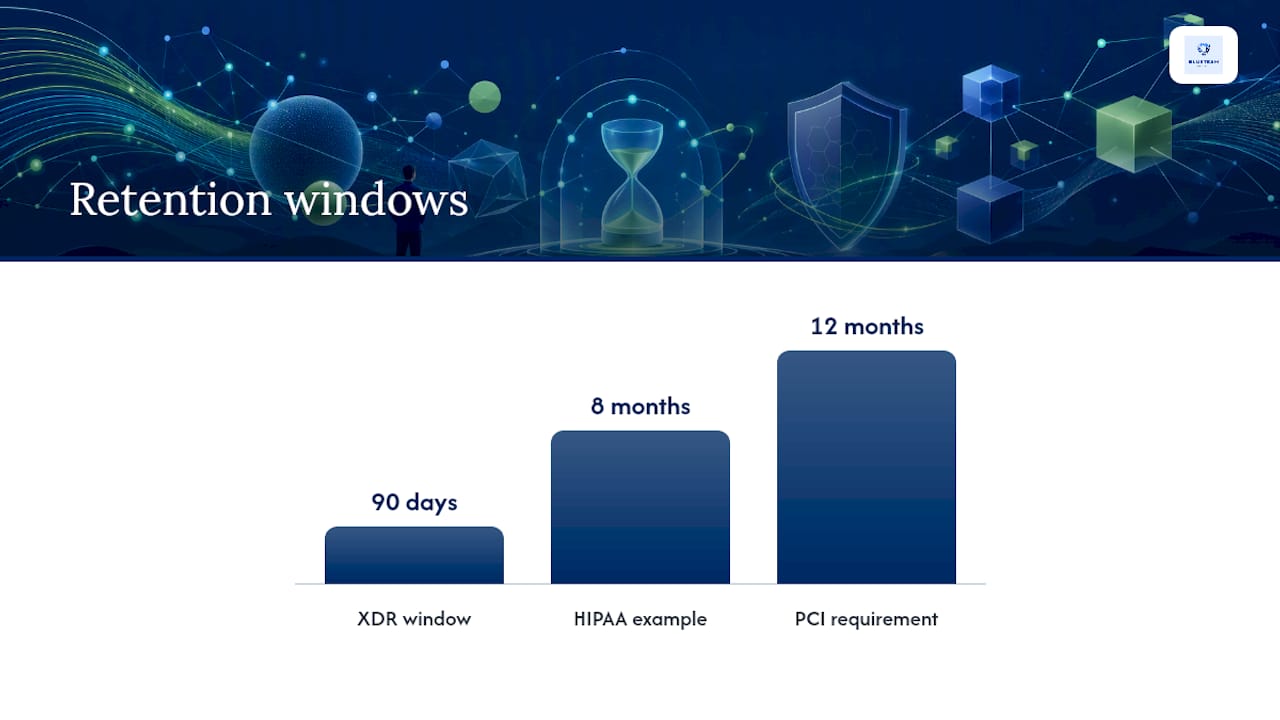
If your organization has to produce twelve months of authentication logs for a PCI assessment, or answer a HIPAA auditor’s question about who accessed a specific record eight months ago, XDR’s 90-day window simply won’t cover you. SIEM will.
That coverage comes at a cost. Traditional SIEM deployment involves:
- Building and maintaining connectors and parsers for every log source in your stack
- Writing and tuning correlation rules by hand, which takes real analyst time
- Budgeting for storage that scales with log volume, not with threat volume
- Staffing someone who understands query languages well enough to hunt effectively
Modern, cloud-native SIEM platforms have narrowed this gap by adding machine learning for anomaly detection and native automation features that used to require a separate SOAR layer. But the fundamental trade remains: SIEM gives you depth and defensibility. It rarely gives you speed out of the box.
What Is SOAR? Playbooks, Automation, and Orchestration
SOAR sits downstream of detection. It consumes alerts from SIEM, XDR, or both, then executes predefined playbooks that enrich the alert, take action, and document everything for an audit trail. Done well, this cuts mean time to respond dramatically on repetitive, well-understood incident types.
A typical SOAR workflow runs through four stages:
- Ingestion — pull the alert from SIEM or XDR along with any attached indicators
- Enrichment — query threat intelligence feeds, asset inventories, and identity systems to add context automatically
- Action — execute the playbook step: quarantine a device, disable a user account, open a ticket
- Documentation — log every action taken for compliance review and post-incident analysis
The catch is that SOAR is only as good as what feeds it. Automation staged on top of noisy, poorly tuned alerts doesn’t save analyst time. It just executes the wrong response faster and at scale, which is worse than doing nothing automated at all.
Pro Tip: Start SOAR automation on your highest-confidence, lowest-risk alert types only, things like known-bad IP blocks or password spray detections you’ve already validated for months. Expand from there once you can prove the automation isn’t creating new incidents.
Playbook design and maintenance is also an ongoing cost most teams underestimate. Integrations break when APIs change, and playbooks need review every time your tool stack shifts.
SIEM vs SOAR vs XDR: A Side-by-Side Comparison
Here’s how the three stack up across the dimensions that actually drive a buying decision.
| Dimension | SIEM | SOAR | XDR |
|---|---|---|---|
| Primary function | Centralized log storage, correlation, compliance evidence | Playbook automation and cross-tool orchestration | Cross-layer detection using native telemetry and ML |
| Data sources | Broad ingestion from nearly any log source via connectors | Alerts from SIEM/XDR plus threat intel and asset data | Native endpoint, network, identity, cloud, email telemetry |
| Automation level | Limited natively; growing with modern platforms | High; the platform’s core purpose | Moderate; automated containment, not full orchestration |
| Time-to-value | Slower; weeks to months of tuning | Slower still; depends on playbook maturity and detection quality upstream | Fastest; often usable within weeks of deployment |
| Compliance/retention | Strongest; built for audit evidence and long retention | Weak on its own; documents actions, not raw logs | Weakest natively; short retention windows |
The pattern that matters here: XDR wins on speed, SIEM wins on defensibility, and SOAR wins on repeatable execution once the first two are producing reliable signal. None of them wins on all five dimensions, which is exactly why operational fit rather than feature comparison should drive your decision.
How Should Your SOC Choose and Adopt These Tools?
Adoption order comes down to three questions: how big is your team, how heavy is your compliance burden, and how much alert volume are you actually generating today.
- Small team, light compliance, need speed now. Start with XDR. A lean SOC or a single security-focused admin gets faster time-to-value from XDR’s pre-built detections than from a SIEM that needs months of rule tuning.
- Regulated industry, audit deadlines, existing log sprawl. Start with SIEM. If you’re facing a PCI, HIPAA, or SOC 2 assessment in the near term, you need the retention and search depth SIEM provides regardless of how fast XDR detects.
- Detection is solid, alert volume is high, analysts are drowning in repetitive tickets. Add SOAR. This is the layer you bolt on once the first two are producing trustworthy signal, not before.
Before signing with any vendor, ask directly: What’s the default retention window, and what does extending it cost? How flexible are the playbook templates, and can our team edit them without vendor support tickets? What’s the integration pattern for tools we already run?
The biggest red flag in any pitch deck is a vendor pushing you to automate everything immediately. Automating noisy, untuned alerts, or deploying SOAR before your detection layer has months of proven accuracy, amplifies mistakes instead of catching them.
How XDR, SIEM, and SOAR Work Together in Practice
The most common integration pattern looks like this: XDR detects and pre-correlates a threat, forwards that finding to SIEM for retention and long-term correlation, and SIEM (or a connected SOAR platform) triggers the response playbook. Some modern SIEMs now build lightweight SOAR functionality directly into the platform, which simplifies this chain for smaller teams.
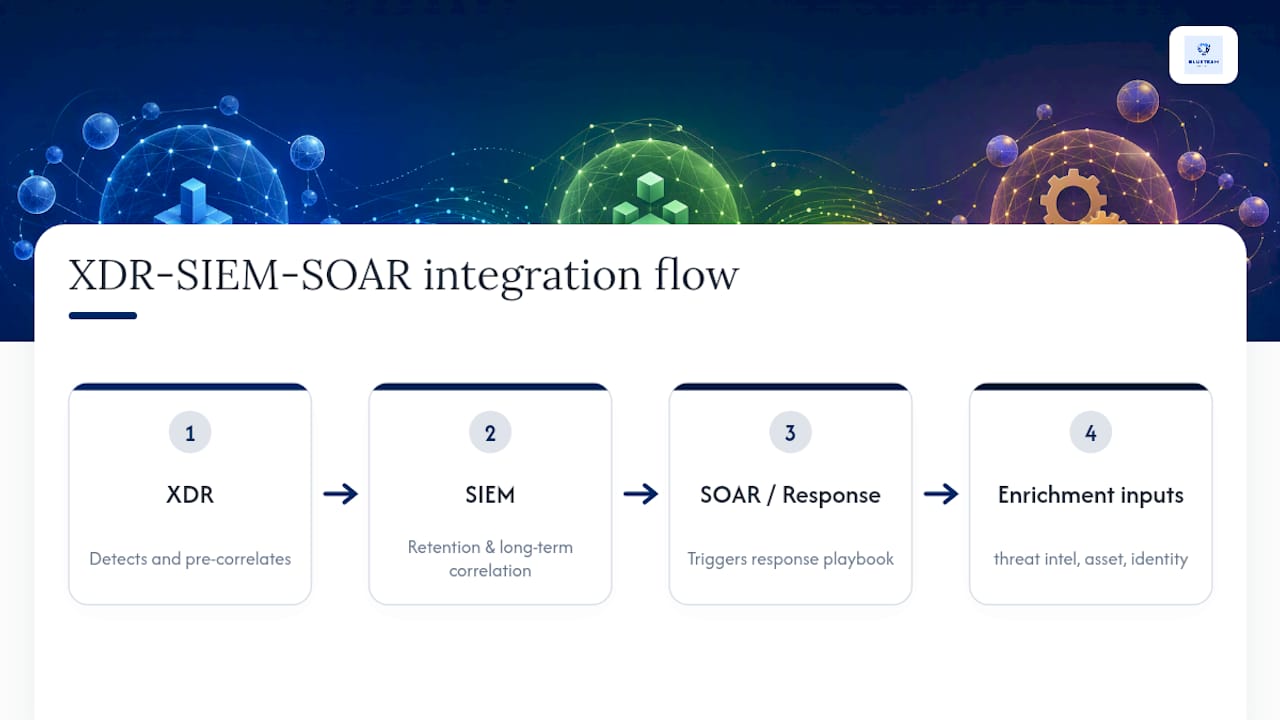
Enrichment sources matter across the whole stack, not just at the SOAR stage. Threat intelligence feeds, dark web monitoring services like Sentrix’s threat intelligence monitoring, asset inventories, and identity context all feed into better-informed playbook decisions.
Three KPIs worth tracking across the integrated stack: mean time to respond, the percentage of alerts handled through automation without human touch, and your false positive rate. If automation rate climbs but MTTR doesn’t drop, your playbooks are handling the wrong alerts.
Will XDR Replace SIEM or SOAR? Common Misconceptions
No. XDR’s native telemetry and shorter retention windows make it a poor fit for compliance reporting, broad ad-hoc search across years of history, and cross-domain investigations that touch systems outside the XDR vendor’s ecosystem.
A few misconceptions worth retiring:
- “XDR eliminates the need for a SIEM.” False for any organization with audit obligations, since XDR retention rarely covers a 12-month compliance window.
- “SOAR works with any detection source.” Technically yes, practically no. SOAR amplifies whatever alert quality it receives, good or bad.
- “One platform can do all three jobs equally well.” Vendors that claim this usually excel at one layer and bolt on weaker versions of the other two.
What Skills Help SOC Teams Operate These Systems?
Running SIEM, SOAR, and XDR well requires specific, learnable skills: mapping telemetry sources to detection coverage, authoring and maintaining playbooks, and triaging alerts efficiently under time pressure. These aren’t skills most IT generalists pick up on the job without structured practice.
Focused training that includes hands-on cybersecurity labs shortens the gap between “read the documentation” and “can tune a correlation rule without breaking detection coverage.” That’s the difference between a new SOC analyst who needs six months of hand-holding and one who contributes to playbook design in the first few weeks, a path outlined in Blueteam-academy’s guide on moving from IT to cybersecurity.
An Editorial Take on Choosing Your First Layer
Most teams overthink the SIEM vs SOAR vs XDR decision because vendors frame it as a platform choice instead of a sequencing question. Start with whichever layer your compliance exposure and alert volume actually demand right now, not the one with the flashiest dashboard. Learning to read telemetry and tune detections well is the skill that transfers across every layer you add later, and it’s also the skill that maps most directly to career growth inside a SOC analyst role.
— Konnio
Building the Skills to Run SIEM, SOAR, and XDR
Reading a comparison table won’t teach you how to tune a correlation rule at 2 a.m. when a false positive storm hits. Blueteam-academy’s self-paced training gives IT professionals what the vendor documentation skips: hands-on labs for telemetry mapping, playbook templates you can adapt to real environments, and a decision-making framework for exactly the kind of tool-sequencing questions this article walks through. You get 12 months of access, recorded classes, and a student community built for people making the same jump from general IT into SOC work, covered in more depth in what cybersecurity actually looks like for IT pros. If you’re deciding which layer to learn first, start with the Blueteam-academy course catalog and build the telemetry and playbook skills that apply no matter which vendor your future employer picks.
Sources
- SIEM vs. SOAR vs. XDR: Evaluate the key differences — TechTarget
- SIEM vs SOAR: What’s the difference & do you need both? — Kaseya
- XDR vs. SIEM: Which Security Platform Fits Your Stack? — N-able
