

Risk-based cybersecurity prioritizes controls by estimated likelihood times impact against mission-critical assets, not by which requirements a checklist demands. The primary benefit is budget alignment: limited security spend gets routed toward the exposures that would actually hurt the enterprise, which gives CISOs a defensible story when they ask finance for money. NIST’s RMF and CSF 2.0 both formalize this logic, and they’re the reference points most boards now expect security leaders to speak in.
TL;DR:
- Focusing on high-impact, mission-critical assets rather than checklist requirements ensures cybersecurity budgets address actual enterprise risks.
- Practical risk assessments should prioritize assets, map threats, and evaluate likelihood and impact, enabling targeted mitigation within weeks.
- A well-maintained risk register with clear descriptions and residual risk scores helps executives understand and track exposure over time.
- Cost-benefit analysis of controls should guide resource allocation, emphasizing measures that deliver the greatest risk reduction per dollar invested.
- Running a narrow, asset-specific risk assessment and reporting improvement regularly builds board trust more effectively than annual enterprise-wide evaluations.
Table of Contents
- Why Risk-Based Beats Compliance-Only Security
- The Core 8-Step Risk-Based Process You Can Run This Quarter
- Building a Risk Register the Board Will Actually Read
- Choosing Controls That Cut the Most Risk Per Dollar
- Using NIST RMF and CSF 2.0 Without Overengineering Governance
- How Blue Team Academy Helps Teams Operationalize This Approach
- Three Immediate Next Steps for Security Leaders
- The Perspective Most Risk-Based Advice Gets Wrong
- Sources
Why Risk-Based Beats Compliance-Only Security
Compliance is a floor, not a strategy. Frameworks like PCI DSS or HIPAA tell you the minimum controls a regulator expects, but they say nothing about which of your assets would cause the most damage if compromised tomorrow. A risk-based approach treats compliance as one input among many, then layers in likelihood and business impact to decide where the next dollar actually goes.
That’s checkbox mentality, and it’s expensive in the way that matters most, wasted spend on low-value controls while high-impact gaps stay open.
Risk-based prioritization catches what compliance checklists miss:
- A retailer discovers its point-of-sale network is PCI-compliant but shares a flat VLAN with an unpatched inventory system, an unranked risk that would never surface on an audit checklist.
- A hospital system passes HIPAA review yet has never modeled the impact of ransomware hitting its imaging archive, the asset that would actually shut down patient care.
- A manufacturer meets ISO 27001 documentation requirements while its industrial control systems, its true crown jewels, sit outside the assessment scope entirely.
Each example shares a pattern: compliance said “pass,” and the enterprise-level risk analysis said otherwise.
The Core 8-Step Risk-Based Process You Can Run This Quarter
A cybersecurity risk assessment follows a repeatable sequence, and running it end-to-end doesn’t require a multi-year program. Here’s the operational version:
- Scope the assessment. Define which business unit, system, or asset class you’re evaluating, and set a boundary the board can understand.
- Prioritize assets. Rank systems and data by business criticality, not by IT convenience, revenue-generating platforms and regulated data usually top the list.
- Map threats and vulnerabilities. Pair each priority asset with the threats most likely to target it and the known weaknesses that make exploitation feasible, drawing on asset inventory and threat mapping practices.
- Run risk analysis. Combine threat likelihood with potential business impact for each asset-threat pair.
- Calculate probability and impact. Assign scores or ranges so risks can be compared on a common scale rather than gut feel.
- Apply cost-benefit prioritization. Rank remediation options by risk reduction per dollar spent, not by which vendor pitched hardest.
- Implement controls. Deploy the prioritized fixes, technical, procedural, or contractual, with a named owner for each.
- Monitor continuously. Track whether the control actually reduced the risk it targeted, then feed results back into the register.
Each step produces a deliverable someone else needs: asset prioritization hands the CFO a criticality list, risk analysis hands the board a heat map, and monitoring hands internal audit a trend line.
Pro Tip: Scope your first pass to one mission-critical asset, not the entire environment. A tightly scoped assessment you finish in weeks builds more board credibility than an enterprise-wide effort that stalls at month six.
Building a Risk Register the Board Will Actually Read
A cybersecurity risk register is only useful if it answers the question executives ask first: “How exposed are we, and is it getting better or worse?” NIST IR 8286 lays out the fields that make a register usable at the enterprise level. Each entry needs:
- A plain-language description of the risk
- Likelihood and impact ratings on a consistent scale
- A named risk owner, not a team, a person
- The planned or in-progress mitigation
- Current status (open, mitigating, accepted, closed)
- Residual risk after controls are applied
Rolling individual entries into an enterprise risk management view means normalizing scores across business units so a “high” in the finance division means the same thing as a “high” in manufacturing. That normalization step is where most programs stumble, and it’s also where risk registers must stay living documents, updated after mergers, new systems, or org changes, or they go stale within a quarter.
Statistic Callout: Security teams measure progress through key risk indicator (KRI) trendlines tracking whether a specific control is actually lowering exposure over time, per NIST IR 8286. A useful KPI might be “percentage of critical assets with residual risk below tolerance,” reported quarterly against a board-approved threshold.
Choosing Controls That Cut the Most Risk Per Dollar
Not every control deserves equal budget, and treating them that way is how programs burn money on marginal improvements while real gaps stay open. Start with a simple scoring model: rate each candidate control on expected risk reduction (high, medium, low) against its cost and implementation effort, then rank the list.
A basic quantitative version works too, estimate the dollar exposure a risk represents, estimate the percentage of that exposure a control would eliminate, and divide by the control’s annual cost. You don’t need a sophisticated model to see that patching a public-facing server handling regulated data outranks upgrading endpoint software on a decommissioned lab network.
Common traps to avoid:
- Maturity-chasing, buying tools to hit a framework maturity score rather than to close a specific, measured risk.
- Spreading budget too thin across many medium-priority controls instead of fully funding the one or two that address top-ranked risks.
- Ignoring operational cost, a control that reduces risk on paper but requires headcount you don’t have will underperform in practice.
McKinsey’s analysis of risk-based cybersecurity transformation points to the same conclusion: shifting from maturity-based to risk-based control selection is what lets organizations optimize spend against the assets that matter, not the framework line items that look good in an audit.
Using NIST RMF and CSF 2.0 Without Overengineering Governance
You don’t need to invent your own framework language. The NIST Risk Management Framework-overview) maps cleanly onto the 8-step process: Categorize and Select correspond to asset prioritization and control selection, Assess and Monitor correspond to your ongoing risk analysis and monitoring steps. NIST CSF 2.0 adds an outcomes taxonomy and a Govern function specifically built to help you communicate risk posture to executives and connect it to enterprise risk management.
Practical governance actions that make this real instead of theoretical:
- Assign named risk owners for each priority asset category, not a shared team inbox.
- Stand up a risk council, security, IT, legal, and a business-unit representative, that meets on a fixed cadence to review the register.
- Set a reporting cycle (monthly for operational risks, quarterly for board-level rollups) so KRIs get reviewed before they go stale.
- Feed CSRM outputs into the same ERM process that tracks financial and operational risk, so cyber risk sits next to supply chain and market risk instead of in its own silo.
How Blue Team Academy Helps Teams Operationalize This Approach
Running the 8-step process well requires more than a framework citation, it requires people who can execute risk analysis, prioritize controls, and defend the numbers to a board. Blue Team Academy’s Threat & Control Method was built around that exact gap: matching specific threats to specific controls using the same likelihood-and-impact logic covered above, rather than teaching frameworks in the abstract.
What the training maps to directly:
- Practical exercises in asset prioritization and threat mapping, the same steps covered in your first risk assessment pass.
- Templates for building a cybersecurity risk register that holds up under ERM scrutiny.
- Tabletop exercises that simulate presenting a control cost-benefit case to a finance or board audience.
For IT professionals moving into defensive roles, the transition path covers how this translates into day-to-day responsibilities, and practitioners looking to strengthen human-layer controls can pair it with awareness training built to scale across the same risk register.
Three Immediate Next Steps for Security Leaders
Start narrow this week. First, scope a mini risk register for one mission-critical asset, not your whole environment. Second, pick a single KRI and a reporting cadence, monthly is fine, and commit to it publicly. Third, fund one targeted control and bring finance a one-page cost-benefit case instead of a maturity roadmap. A risk-based approach earns board trust through small, measurable wins, not sweeping transformation plans.
The Perspective Most Risk-Based Advice Gets Wrong
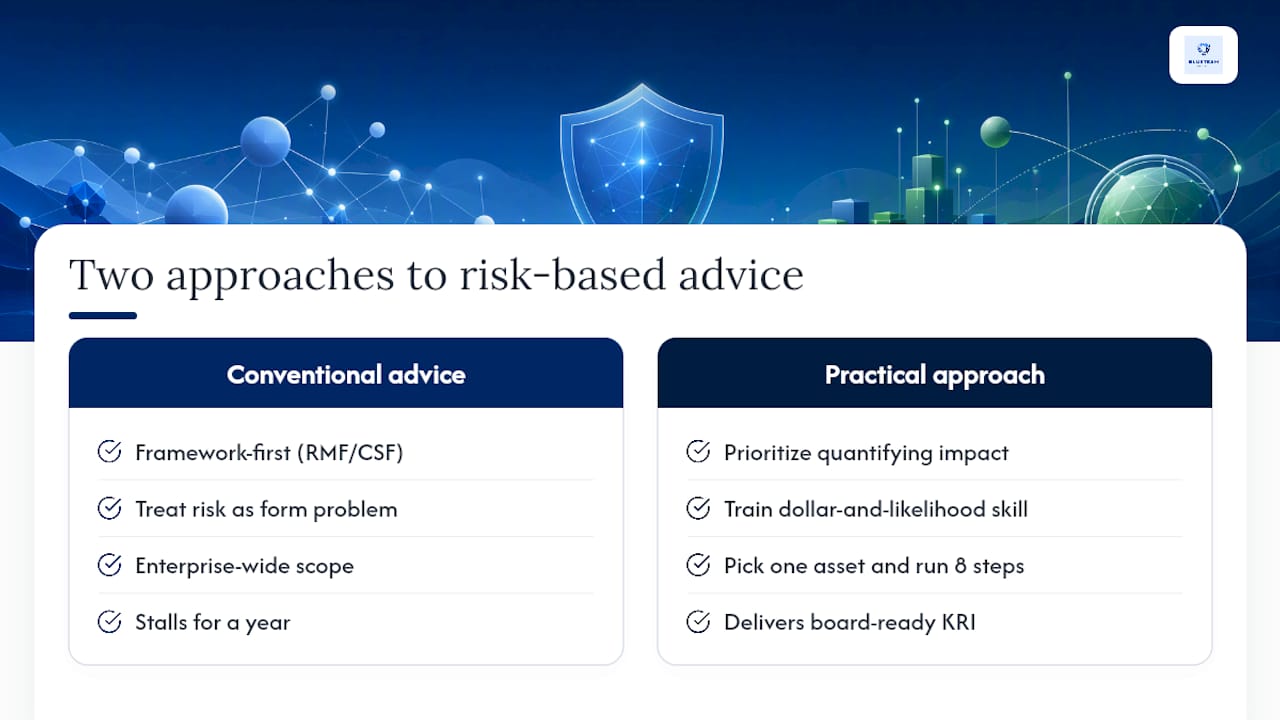
Most guidance on risk-based cybersecurity treats it as a framework problem: adopt RMF, cite CSF 2.0, build a register, done. That’s backwards. The frameworks are necessary scaffolding, but the actual bottleneck in most organizations is that nobody on the team has practiced translating a technical vulnerability into a dollar-and-likelihood statement a CFO will fund. You can hand a security team a perfect NIST IR 8286 template and still get vague, unranked risk entries because writing “high, medium, low” convincingly is a skill, not a form field.
The conventional advice also oversells scope. Enterprise-wide risk assessments sound thorough, and they usually stall for a year because nobody wants to own a project that big. The teams that actually shift budget toward risk-based work are the ones that pick one asset, run the full eight steps on it, and show the board a before-and-after KRI. That’s not a compromise version of risk-based cybersecurity, it’s the version that survives contact with a real budget cycle. Prioritize the skill of quantifying impact before you prioritize picking a framework logo for your slide deck.
— Konnio
Sources
- Integrating Cybersecurity and Enterprise Risk Management (ERM) | NIST IR 8286r1
- How To Perform a Cybersecurity Risk Assessment | CrowdStrike
