

The strongest cybersecurity Discord servers right now are Black Hills Information Security (BHIS) for practitioner Q&A, TryHackMe for guided lab practice, The Cyber Mentor’s community for beginner-to-intermediate learners, TheHiveMind for structured resource access, PrimeSec for CTF-focused hands-on work, OWASP for application security depth, and DEX Security for a general-purpose study community. Each one earns its spot for a different reason, and the right pick depends on where you are in your career shift.
- Black Hills Information Security (BHIS) — discord.com/invite/BHIS — practitioner-led Q&A, threat intel discussion, and regular webinar events
- TryHackMe — Discord — platform-connected study groups and guided lab support
- The Cyber Mentor (TCM) — community tied to TCM Security’s training catalog; best for learners working through PNPT or ethical hacking courses
- TheHiveMind — discord.com/servers/thehivemind-1235399448780341289 — 8,315 members, tiered resource library including a curated “Graveyard” section
- PrimeSec — discord.com/servers/primesec-1414146515139559495 — 1,135 members, CTF-heavy with OSCP prep and reverse engineering channels
- OWASP — application security, web vuln research, and chapter networking
- DEX Security — general-purpose community with active study channels and career discussion
- Malware Village — malware analysis, reverse engineering, and threat research
- r/cybersecurity Discord — broad news, career Q&A, and community discussion linked to the subreddit
- Blueteam-academy community — structured learner cohort with peer-reviewed resources and instructor access, tied to the From IT to Cybersecurity program
Key Takeaways
The best cybersecurity Discord servers for IT professionals are those with active moderation, structured resource channels, and regular events — not simply the largest ones.
| Point | Details |
|---|---|
| Join for your specific goal | BHIS for practitioner Q&A, PrimeSec for CTFs, TheHiveMind for structured resources, TryHackMe for guided labs. |
| Verify moderation before engaging | Check for a visible rules channel, topic-specific channels, and recent moderation activity within the first 10 minutes. |
| Size is not quality | TheHiveMind’s 8,315-member server with a curated Graveyard outperforms many larger, unmoderated communities for learning value. |
| Use Discord alongside structured training | Open communities accelerate networking; a defined course pathway builds the systematic skills employers verify at interview. |
| Blueteam-academy for structured progression | The From IT to Cybersecurity program combines course content, peer review, and a moderated learner community for deliberate career transition. |
Table of Contents
- Why joining a cybersecurity Discord server pays off
- How to choose the right server and join safely
- Top cybersecurity Discord servers — profiles and what each is best for
- Why moderation and structure predict long-term value
- How Blueteam-academy uses community to support learners
- Blueteam-academy offers structure alongside community access
- Sources
Why joining a cybersecurity Discord server pays off
The honest answer: a well-run server compresses years of trial-and-error into months. You get real-time feedback on your lab work, study partners who hold you accountable, and direct access to practitioners who have already passed the cert you’re chasing.
Curated community lists covering 30+ cybersecurity communities across platforms consistently show that the most active Discord groups bundle several value layers at once: structured study channels, hosted CTF events, writeup repositories, and job-networking threads. That combination is hard to replicate with solo self-study.
Concretely, here is what active servers deliver:
- Study cohorts and OSCP prep — dedicated channels where members share notes, flag tricky boxes, and run timed study sessions
- Hosted CTFs — recurring competitions that force you to apply knowledge under pressure, the fastest way to identify gaps
- Writeup and tooling channels — vetted walkthroughs and tool recommendations that save hours of searching
- Job and networking threads — hiring managers and recruiters participate in the larger servers; referrals happen in DMs after public conversations
- Live Q&A with practitioners — org-run servers like BHIS regularly host event-driven discussions where senior analysts answer questions in real time
If you’re already running infrastructure and considering a move into a security role, these channels give you a peer group that understands your starting point without requiring you to explain what a VLAN is.
How to choose the right server and join safely
Prioritize moderation, active topical channels, regular events, and evidence of peer-reviewed resources. A server with 50,000 members and no visible moderators is less useful than one with 2,000 members and a clear code of conduct.
Evaluate a server in this order after landing on its invite page:
- Check the rules channel — if there is no #rules or #code-of-conduct channel visible within the first 30 seconds, treat that as a warning sign
- Scan channel structure — look for topic-specific channels (e.g., #ctf-discussion, #blue-team, #oscp-prep) rather than a single #general dump
- Check event cadence — a pinned events calendar or a #announcements channel with recent posts confirms the server is still active
- Sample the resource channels — are writeups and tools posted with context, or is it just link dumps?
- Look at onboarding — verification steps (a bot quiz, an intro post requirement) signal that moderators care about quality membership
- Understand the cost model — most quality servers are free to join; premium tiers for resource libraries (like TheHiveMind’s Graveyard) are reasonable, but core channels should be accessible without payment
Red flags to walk away from:
- Invite spam in DMs or other servers
- No visible moderators or staff roles
- Constant off-topic noise with no moderation response
- Core learning resources locked behind a paywall with no free preview
- Requests to share credentials, API keys, or personal account details
| Server type | Moderation | Channel depth | Event cadence | Cost model |
|---|---|---|---|---|
| Vendor/org-run (BHIS, OWASP) | High — staff-moderated | Deep, topic-specific | Regular webinars and Q&A | Free |
| Community-run (TheHiveMind, DEX) | Moderate to high | Moderate to deep | Periodic CTFs and study sessions | Free core, optional premium |
| CTF-focused (PrimeSec) | Moderate | Narrow, hands-on | Frequent CTF events | Free |
| Cert-study (TCM, TryHackMe) | High — platform-linked | Structured by course | Course-aligned events | Free with platform account |
Pro Tip: Check the #mod-log or #audit-log channel if it’s public. A server that logs moderation actions transparently is one where the rules are actually enforced — you can see within minutes whether bans and warnings are being issued or whether the channel is empty.
Top cybersecurity Discord servers — profiles and what each is best for
Flare’s curated guide confirms that the strongest communities combine training resources, event Q&A, and expert discussion in one place. Here are the servers that consistently appear across vetted lists.
-
Black Hills Information Security (BHIS) — discord.com/invite/BHIS. Practitioner-led, event-driven, and one of the most cited communities in the field. Best for mid-level professionals who want threat intel discussion and direct access to senior analysts. Moderation is active; the culture is professional without being gatekeeping.
-
TryHackMe — Discord. Platform-connected community built around the TryHackMe lab environment. Best for beginners and career changers who want guided, structured practice with a peer group working through the same paths.
-
The Cyber Mentor (TCM) — community linked to TCM Security’s course catalog. Best for learners pursuing PNPT or ethical hacking certifications who want study partners and instructor-adjacent support. Moderation is consistent with the platform’s professional tone.
-
TheHiveMind — Discord. With 8,315 members and a tiered resource library, this server stands out for its curated “Graveyard” section — a vetted archive of study notes and writeups. Best for intermediate learners who want structured resources alongside community discussion.
-
PrimeSec — Discord. 1,135 members with a tight focus on CTFs, OSINT, and reverse engineering. Best for hands-on learners who want frequent competition practice and OSCP prep channels. Smaller size means less noise and more direct interaction.
-
OWASP Discord — application security, web vulnerability research, and chapter-level networking. Best for developers moving into AppSec or security engineers focused on OWASP Top 10 and secure coding. Community is globally distributed with regional chapter channels.
-
DEX Security — general-purpose community with active study channels and career discussion threads. Best for learners who want a broad entry point into the community before specializing. Moderation is present; channel structure covers both red and blue team topics.
-
Malware Village — focused on malware analysis, reverse engineering, and threat research. Best for analysts and incident responders who want a technically dense peer group. Not a beginner server; the discussion assumes familiarity with dynamic and static analysis tools.
-
r/cybersecurity Discord — community channel connected to the subreddit. Best for broad news consumption, career Q&A, and general discussion. Lower signal-to-noise ratio than specialized servers, but useful for staying current and asking general questions.
-
Blueteam-academy community — structured learner cohort with peer-reviewed resources, instructor access, and a moderated environment tied to the From IT to Cybersecurity program. Best for IT professionals making a deliberate career transition who want accountability and structured progression alongside community support.
Why moderation and structure predict long-term value
Moderation and a well-organized resource library are the strongest predictors of a useful community for learners. Member count alone tells you almost nothing about learning quality.
The evidence from server listings and curated guides points consistently in one direction:
- TheHiveMind’s Graveyard resource section — a curated archive of vetted writeups and study notes — is the feature members cite most when describing why they stay. Structure retains learners; open channels alone do not.
- PrimeSec’s CTF-focused model shows that a smaller, tightly scoped server with frequent events produces more active participation per member than a large, unfocused one.
- Org-run servers like BHIS bundle event Q&A and resource hubs in ways that give newer learners fast access to expert feedback — a pattern Flare’s guide identifies as a key differentiator for vendor and organization-run communities.
- Aggregator lists covering 30+ communities confirm that community value ranges widely — from general news discussion to specialized study groups — and that membership counts are not a reliable proxy for learning value.
The servers that produce the most career-relevant outcomes share one trait: they replicate cohort behavior. Vetted resource channels, moderation that enforces quality, and recurring events create the accountability structure that open Discord channels cannot provide on their own. The “Graveyard” pattern — a curated, gated archive of peer-reviewed study material — is the clearest signal that a community is built for serious learners, not just headcount.
How Blueteam-academy uses community to support learners
Discord communities are genuinely useful, and the best ones accelerate learning in ways that solo study cannot. The gap they leave is structure. Open channels are excellent for Q&A and networking; they are less reliable for systematic skill-building toward a specific role or certification.

Blueteam-academy’s approach fills that gap directly. The platform’s learner community operates alongside structured course content, peer-reviewed notes, and instructor access — the same elements that make the strongest Discord servers valuable, but organized around a defined cybersecurity career path rather than open discussion. For IT professionals who already manage infrastructure and want a deliberate transition into a security role, that structure matters.
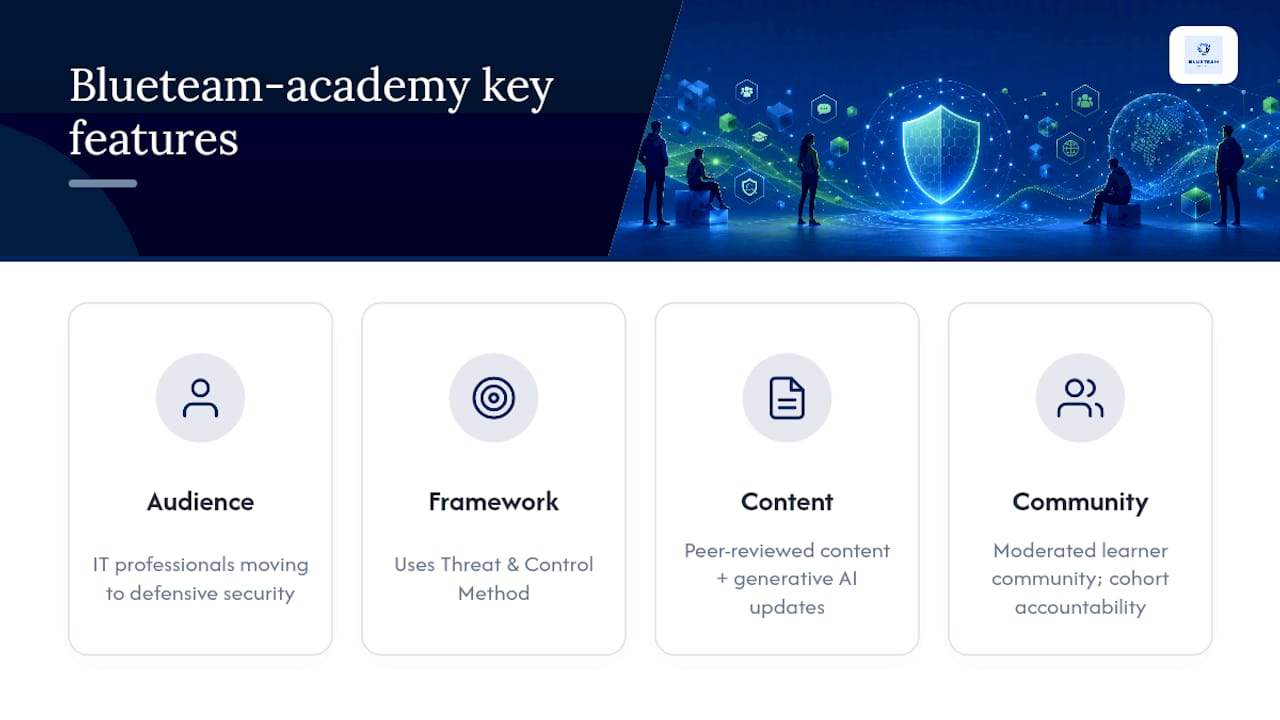
The From IT to Cybersecurity program is the anchor. It uses the Threat & Control Method to give learners a decision-making framework they can apply immediately, not just theory to memorize. Community access is built in, not bolted on.
[Author credentials: insert relevant cybersecurity education and practitioner background here.]
Blueteam-academy offers structure alongside community access
Discord servers give you peers and practice. What they rarely give you is a verified pathway from where you are now to a specific security role, with course content, templates, and instructor review built around that goal.
Blueteam-academy’s self-paced cybersecurity courses are built for IT professionals who already understand infrastructure and want to move into defensive security without starting from scratch. The Threat & Control Method gives you a practical framework. Peer-reviewed content and generative AI enhancements keep the material current. A moderated learner community means you get the accountability of a cohort without the noise of an open Discord server.
Twelve months of access, one-time fee, no subscription. Browse the full course catalog at Blueteam-academy and find the program that matches your current role and target position.
Sources
- Top Cybersecurity Discord Servers to Join – Flare
- PrimeSec – Discord Servers
- TheHiveMind – Discord Servers
- The 30 Best Cybersecurity Communities – The CTO Club
