

For most beginners, CompTIA Security+ is the right first cybersecurity certification. It’s vendor-neutral, widely recognized by U.S. employers, and covers the core domains that hiring managers actually test for. Download the official SY0-701 exam objectives from CompTIA’s site today and spend 30 minutes mapping what you already know against what you don’t.
This cert fits you best if you:
- Have some IT experience (helpdesk, sysadmin, networking) and want to move into a security role
- Are targeting titles like Security Analyst, SOC Analyst I, or IT Security Specialist
- Need a credential that passes HR resume filters at federal contractors, MSSPs, and enterprise security teams
Consider a different first cert if you:
- Have zero IT background (start with CompTIA A+ or ISC2’s Certified in Cybersecurity instead)
- Already work in a Cisco-heavy environment (Cisco CCST Cybersecurity may be a faster on-ramp)
- Want hands-on lab credit over theory (GIAC GFACT is built for that)
Typical first job titles Security+ helps unlock: SOC Analyst I, Junior Security Analyst, IT Security Technician, Information Security Specialist.
Key Takeaways
CompTIA Security+ is the most practical first cybersecurity certification for most U.S. beginners with IT experience, and pairing it with hands-on lab work is what actually gets you hired.
| Point | Details |
|---|---|
| Best first cert for most beginners | CompTIA Security+ (SY0-701) is vendor-neutral and widely recognized in U.S. job postings. |
| No IT background? Start earlier | CompTIA A+ or ISC2 CC builds the foundation Security+ assumes you already have. |
| Certs alone aren’t enough | Pair every cert with documented lab work; employers want proof of practical skill, not just a credential. |
| Free resources are genuinely good | Professor Messer’s free courses and ISC2’s free CC training cover most of what you need before spending on paid prep. |
| Blueteam-academy for structured prep | Blueteam-academy’s self-paced courses use the Threat & Control Method to connect cert domains to real defensive work. |
Table of Contents
- What cybersecurity certifications actually prove — and what they don’t
- Why CompTIA Security+ is the most practical first step
- Other beginner-friendly certifications and when to choose each one
- A practical certification roadmap based on your starting point
- How long preparation takes and what it costs in the U.S.
- Where to start if you have no budget
- Common mistakes beginners make when choosing their first cert
- How to choose your first cybersecurity certification
- How Blueteam-academy approaches beginner certification guidance
- Blueteam-academy’s certification prep courses for first-time candidates
- Sources
What cybersecurity certifications actually prove — and what they don’t
A certification proves you understand a defined body of knowledge well enough to pass a proctored exam. That’s it. It signals to an employer that you’ve cleared a baseline, which matters a lot when HR is filtering 200 applications and needs a fast proxy for competence.
What certifications do not do: they don’t guarantee a job, they don’t substitute for hands-on experience, and they don’t make you a specialist. A Security+ holder who has never touched a SIEM or written a basic firewall rule will struggle in a real SOC environment, regardless of the credential on their resume.
U.S. employers listing entry-level security roles typically expect candidates to arrive with a working knowledge of TCP/IP, basic Active Directory administration, and familiarity with security controls like MFA, endpoint protection, and log review. The NICE Framework from NICCS/CISA maps these expectations to specific work roles, and it’s a practical tool for building a study plan that aligns with what employers actually hire for.
Pro Tip: Don’t study in isolation. For every cert domain you cover, spend an equal amount of time in a lab. Set up a free home lab using VirtualBox or VMware Workstation Player, spin up a Windows Server VM, and practice the AD tasks that show up in entry-level job descriptions. That combination of cert knowledge plus lab evidence is what separates candidates who get callbacks from those who don’t.
The BLS Occupational Outlook for Information Security Analysts frames the occupation broadly, and hiring managers use that framing when writing job descriptions. Understanding what the role actually requires helps you pick a cert that maps to real responsibilities, not just a credential that looks good on paper.
Why CompTIA Security+ is the most practical first step
Security+ (current version: SY0-701) covers the domains that appear most consistently in entry-level U.S. job descriptions. It’s vendor-neutral, which means the skills transfer across AWS, Azure, on-prem, and hybrid environments without locking you into one vendor’s ecosystem.
Core skills and knowledge areas the exam validates:
- Threats, attacks, and vulnerabilities (phishing, malware types, social engineering)
- Network security architecture and segmentation
- Identity and access management, including MFA and directory services
- Security operations: log analysis, incident response basics, SIEM concepts
- Risk management, compliance frameworks (NIST CSF, PCI-DSS awareness)
- Cryptography fundamentals and PKI basics
- Cloud security concepts and virtualization
These aren’t abstract topics. They map directly to what a SOC Analyst I or Junior Security Analyst does on day one: reviewing alerts, triaging incidents, and applying security controls. That alignment is why Security+ appears in more U.S. federal contractor job postings than almost any other entry-level credential.
The exam consists of multiple choice and performance-based questions, with a passing score required. You have a limited time to complete the exam. Exam vouchers are priced through CompTIA directly [VERIFY current price on comptia.org], and the certification requires renewal every three years through continuing education units (CEUs) or by retaking the exam.
For readers who want to understand how this cert fits into a longer career arc, the cybersecurity career path guide at Blueteam-academy maps Security+ to the broader sequence of credentials and roles that follow it.
Other beginner-friendly certifications and when to choose each one
Security+ is the right call for most people, but not everyone. Here’s where the alternatives earn their place.
CompTIA A+ is the right starting point if you have no IT background at all. It covers hardware, operating systems, troubleshooting, and basic networking. Think of it as the foundation that makes Security+ study easier. If you can’t explain what a subnet mask does or why DNS matters, A+ fills that gap before you tackle security concepts.
CompTIA Network+ sits between A+ and Security+. If you already understand endpoints and operating systems but feel shaky on routing, switching, and network protocols, Network+ closes that gap. It’s not required before Security+, but readers who struggle with the network security domains in Security+ often wish they’d done it first.
ISC2 Certified in Cybersecurity (CC) is a strong option for career changers with no IT background who want a cybersecurity-specific credential from day one. ISC2 positions the CC as an entry-level credential designed for workforce newcomers, and ISC2 has run initiatives to expand access to entry-level training. The exam covers security principles, network security, and access controls at a foundational level.

GIAC GFACT is built for learners who want hands-on validation from the start. GFACT emphasizes practical skills across Linux, encryption, networking, and basic defensive techniques. It’s a credible signal for employers who care about Day-1 readiness over theoretical knowledge. The tradeoff: it’s less universally recognized than Security+ in HR resume filters.
Cisco CCST Cybersecurity makes sense if you’re already working in a Cisco-heavy environment or targeting network-adjacent security roles. Cisco positions it as a step along its career path toward CyberOps Associate and beyond. If your employer runs Cisco infrastructure, this credential speaks their language.
Professor Messer’s free Security+ study materials aren’t a certification, but they deserve mention here. His structured video courses and practice exams are among the most widely used free resources for Security+ prep, and many candidates use them as their primary study tool before sitting the exam.
| Certification | Best for | Experience required | Topics covered |
|---|---|---|---|
| CompTIA Security+ | Most beginners with IT background | 6–12 months IT recommended | Threats, network security, IAM, risk, cryptography |
| CompTIA A+ | Zero IT background | None | Hardware, OS, troubleshooting, basic networking |
| CompTIA Network+ | Weak on networking concepts | Basic IT familiarity | Routing, switching, protocols, network troubleshooting |
| ISC2 CC | Career changers, no IT background | None required | Security principles, access controls, network basics |
| GIAC GFACT | Hands-on learners, career changers | None required | Linux, encryption, networking, defensive techniques |
| Cisco CCST Cybersecurity | Cisco-environment workers | Basic networking helpful | Network security, endpoint security, vulnerability basics |
A practical certification roadmap based on your starting point
Your background determines where you enter, not where you end up. Two clear paths cover most readers.
Path 1: You already have IT experience
- Audit your current skills against the Security+ SY0-701 objectives. Download the exam objectives from CompTIA and mark what you already know from your IT work. This tells you exactly where to focus study time.
- Fill networking and AD gaps with targeted practice. If you’re weak on subnetting or Active Directory, spend two to four weeks on those topics specifically before starting a full Security+ course.
- Study Security+ with a structured course and parallel labs. Use Professor Messer’s free videos or a paid course alongside a home lab. Practice the performance-based question types, not just multiple choice.
- Schedule and sit the exam. Book your voucher when you’re consistently scoring above 80% on practice exams.
- Build employer-facing artifacts while you study. Document your lab work on GitHub or a simple portfolio page. Hiring managers at MSSPs and enterprise teams notice candidates who show their work.
- After Security+, consider CySA+ or a cloud security cert based on the role you’re targeting. The entry-level cybersecurity jobs guide explains which follow-on certs appear most often in U.S. job postings.
Path 2: No IT background yet
- Start with CompTIA A+ or ISC2 CC. Both are accessible without prior IT experience. A+ builds the IT foundation; ISC2 CC goes straight to security concepts.
- Add Network+ if networking concepts feel unclear after completing your first cert.
- Move to Security+ once you have a working understanding of networking and operating systems.
- Build hands-on experience in parallel using free platforms and home labs (covered in the next section).
- Target entry-level roles like IT Security Technician or Junior Analyst once you hold Security+ and have documented lab experience.
How long preparation takes and what it costs in the U.S.
Study time varies by background. Readers with active IT experience typically need less time than career changers starting from scratch.
Prep costs on top of the voucher range from $0 (free resources only) to $300–$500 for a structured paid course with practice exams. Bootcamp-style programs can run $1,000–$3,000 [VERIFY], but they’re rarely necessary for Security+ or A+. The free resources available for CompTIA exams are genuinely good.
Renewal matters too. Security+ requires 50 CEUs over three years or a retake. ISC2 CC requires annual maintenance fees and CPE credits. Budget for renewal from the start so the credential doesn’t lapse before you’ve used it.
Where to start if you have no budget
Free resources for Security+ prep are better than most paid alternatives from five years ago. Here’s what actually works.
- CompTIA’s official exam objectives (free): The SY0-701 objectives document is the authoritative study guide. Every exam question maps to it. Download it first and use it as your syllabus.
- Professor Messer’s free Security+ course: Structured video lessons organized by exam domain, available at no cost. His practice exams cost a small fee but are worth it.
- ISC2’s free CC self-paced training: ISC2 offers free online training for the Certified in Cybersecurity exam. For a zero-budget start, this is one of the most structured free options available.
- NICCS/CISA free resources: The NICE Framework and NICCS course catalog include free and low-cost training aligned to specific work roles.
- TryHackMe and Hack The Box (free tiers): Both platforms offer free beginner learning paths with browser-based labs. No hardware required.
- VirtualBox + free ISOs: Build a home lab with VirtualBox (free), a Windows Server evaluation ISO (free from Microsoft), and a Kali Linux ISO (free). Practice AD setup, basic firewall rules, and log review.
For a deeper look at building a study lab without paid subscriptions, the hands-on cybersecurity labs guide walks through specific configurations that work on consumer hardware.
Pro Tip: Convert your free lab work into demonstrable skills by documenting what you built and what you learned. A GitHub repo with a simple write-up of “how I set up an AD environment and tested a pass-the-hash attack” tells a hiring manager more than a cert alone.
Common mistakes beginners make when choosing their first cert
Most of these mistakes cost time and money. Knowing them in advance is the fastest way to avoid them.
- Skipping hands-on practice entirely. Studying flashcards and watching videos without touching a lab produces candidates who pass exams but freeze in technical interviews. Fix: pair every study session with at least one lab task.
- Picking a cert based on prestige rather than employer demand. CISSP is not a beginner cert. It requires five years of verified experience and is designed for security managers. Pursuing it first wastes months. Fix: check actual U.S. job postings for the roles you want and see which certs appear most often.
- Over-investing in expensive bootcamps before trying free resources. A $2,000 bootcamp for Security+ prep is rarely justified when Professor Messer’s free course covers the same material. Fix: exhaust free resources first, then spend on practice exams if needed.
- Ignoring the exam objectives document. The official objectives are the exam blueprint. Studying from a third-party course without cross-referencing the objectives means you may miss entire domains. Fix: download the objectives on day one.
- Treating the cert as the finish line. Employers want cert plus experience. A credential with no lab work, no portfolio, and no hands-on context is a weaker signal than you’d expect. Fix: build artifacts while you study.
- Choosing a cert your target employer doesn’t recognize. Some niche certs have strong community reputations but don’t appear in HR systems. Fix: search LinkedIn and Indeed for your target job title and filter by certifications listed as requirements.
How to choose your first cybersecurity certification
Run through this checklist before committing to any credential.
- Search 20 U.S. job postings for your target role. Note which certifications appear most often as requirements or preferences. That list is your priority order.
- Assess your current IT background honestly. If you can’t explain subnetting, DNS, or basic Windows administration, start with A+ or Network+ before Security+.
- Check the official prerequisites. Security+ has no hard prerequisites but recommends Network+ and two years of IT experience. ISC2 CC has none. GIAC GFACT has none. Mismatching your background to a cert’s assumed knowledge base makes prep harder than it needs to be.
- Calculate total cost: voucher plus prep. Use the ranges in the cost section above and verify current voucher prices on each vendor’s site before budgeting.
- Confirm the cert maps to real job responsibilities using the NICE Framework. Cross-reference the cert’s domains against the NICE work role that matches your target job title.
- Ask a hiring manager directly (LinkedIn outreach works): “Does your team require or prefer Security+ for entry-level analyst roles?” Their answer tells you more than any ranking list.
- Check renewal requirements before you start. A cert that lapses because you didn’t track CEUs is a credential gap on your resume. Know the maintenance requirements upfront.
- Red flag: any cert that promises job placement guarantees. No certification body guarantees employment. If a prep provider makes that claim, treat it as a signal about their credibility.
When weighing tradeoffs, prioritize employer recognition first, then cost, then study time. The IT to cybersecurity transition guide covers how to evaluate these tradeoffs in the context of your specific IT background.
How Blueteam-academy approaches beginner certification guidance
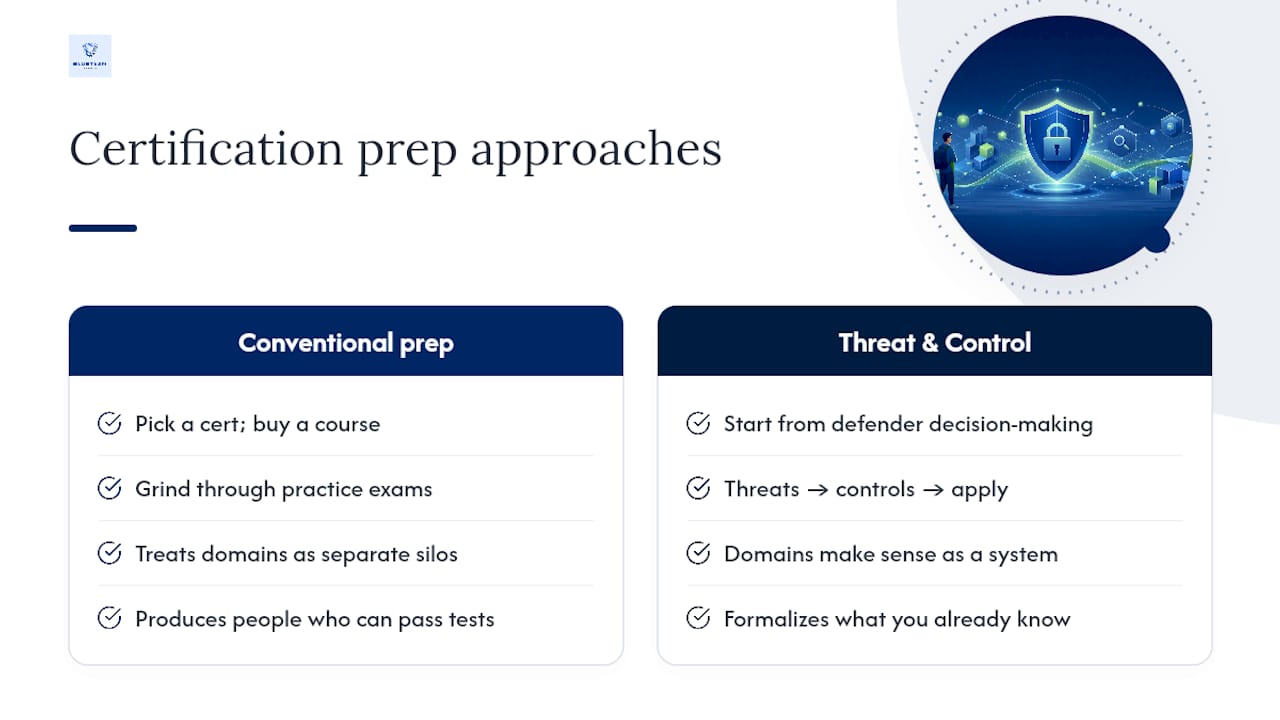
The conventional wisdom in certification prep is to pick a cert, buy a course, and grind through practice exams until you pass. That approach produces people who can pass tests. It doesn’t reliably produce people who can do the job.
At Blueteam-academy, the perspective is different. The Threat & Control Method that shapes our training starts from the defender’s actual decision-making process: what threats exist, what controls address them, and how to apply those controls in a real environment. When you study Security+ through that lens, the exam domains stop feeling like isolated topics and start making sense as a connected system. Cryptography isn’t just a domain to memorize; it’s a control that addresses specific confidentiality and integrity threats. IAM isn’t just a checklist; it’s the mechanism that limits blast radius when credentials are compromised.
For readers who already run infrastructure, this framing tends to click quickly. You’ve seen the problems the controls are designed to solve. The cert study becomes a matter of formalizing what you already know and filling the gaps you haven’t encountered yet.
For career changers with no IT background, the honest advice is to slow down. Start with A+ or ISC2 CC, build the foundational mental model, and then approach Security+ with enough context to understand why each domain matters. Rushing to Security+ without that foundation makes the study harder and the job interview harder still.
Peer-reviewed content and generative AI enhancements in Blueteam-academy’s courses are designed to surface the connections between domains that most cert-prep courses treat as separate silos. That’s where the practical value lives.
Blueteam-academy’s certification prep courses for first-time candidates
Passing your first certification is one milestone. Arriving at your first security role ready to contribute is a different one. Blueteam-academy’s self-paced courses are built for IT professionals making that transition, with 12 months of access, hands-on labs, job-focused modules, and a student community that answers questions when you’re stuck at 11 PM on a lab exercise.
The courses cover the domains that matter most for entry-level U.S. roles, structured around the Threat & Control Method so the material connects to real defensive work rather than exam trivia. Templates, lab guides, and peer-reviewed content are included. You don’t need to piece together a study plan from five different sources.
Browse the Blueteam-academy course catalog to see which courses align with your target certification and role, or review the full course overview to compare what’s included before you enroll.
Sources
- Security+ (Plus) Certification | CompTIA Global
- Information Security Analysts (Bureau of Labor Statistics)
- NICE Framework (NICCS / CISA)
